Translate

Showing posts with label Catalonia. Show all posts

Thursday, 13 December 2012

Girona

Girona


Girona is a city in the northeast of Catalonia, Spain at the confluence of the rivers Ter, Onyar, Galligants and Güell, with an official population of 96,722 in January 2011. It is the capital of the province of the same name and of the comarca of the Gironès. It is located 99 km (62 mi) northeast of Barcelona. Girona is one of the major Catalan cities.

The first historical inhabitants in the region were Iberians; Girona is the ancient Gerunda, a city of the Ausetani. Later, the Romans built a citadel there, which was given the name of Gerunda. The Visigoths ruled in Girona until it was conquered by the Moors. Finally, Charlemagne reconquered it in 785 and made it one of the fourteen original countships of Catalonia. Thus it was wrested temporarily from the Moors, who were driven out finally in 1015. Wilfred the Hairy incorporated Girona into the countship of Barcelona in 878. Alfonso I of Aragón declared Girona to be a city in the 11th century. 


The ancient countship later became a duchy (1351) when King Peter III of Aragon gave the title of Duke to his first-born son, John. In 1414, King Ferdinand I in turn gave the title of Prince of Girona to his first-born son, Alfonso. The title is currently carried by Prince Felipe, Prince of Asturias, the first since the 16th century to do so.

The 12th century saw a flourishing of the Jewish community of Girona, with one of the most important Kabbalistic schools in Europe. The Rabbi of Girona, Moshe ben Nahman Gerondi (better known as Nahmanides or Ramban) was appointed Great Rabbi of Catalonia. The history of the Jewish community of Girona ended in 1492, when the Catholic Kings expelled all the Jews from Catalonia. Today, the Jewish ghetto or Call is one of the best preserved in Europe and is a major tourist attraction. On the north side of the old city is the Montjuïc (or hill of the Jews in medieval Catalan), where an important religious cemetery was located.

Girona has undergone twenty-five sieges and been captured seven times. It was besieged by the French royal armies under Charles de Monchy d'Hocquincourt in 1653, under Bernardin Gigault de Bellefonds in 1684, and twice in 1694 under Anne Jules de Noailles.

 In May 1809, it was besiegedby 35,000 French Napoleonic troops under Vergier, Augereau and St. Cyr, and held out obstinately under the leadership of Alvarez until disease and famine compelled it to capitulate, 12 December. Finally, the French conquered the city in 1809, after 7 months of siege. Girona was center of the Ter department during the French rule, which lasted from 1809 to 1813. The defensive city walls were demolished at the end of the 19th century to allow for the expansion of the city. In recent years, the missing parts of the city walls on the eastern side of the city have been reconstructed. Called the Passeig de la Muralla it now forms a tourist route around the old city.

As with nearly all cultures, Catalonian cooking has great character. Its innovative cooking often looking back to history for inspiration. Although ultimately Mediterranean, Girona has been influenced by various cultures over the centuries: the Greeks, Romans, the Italians in the eighteenth century and the French have all left their mark on this complex cuisine. Catalonia has absorbed the best of each country and created a culinary package which forms part of the popular wisdom of the region.

The Catalonian cuisine uses the same ingredients as in other Mediterranean regions: tomatoes, garlic, fresh herbs, olive oil (particularly those of the Denomination of Origin Garrigues and Siurana, prepared using the variety of olive called the "arbequina"), onions, cod… The traveller is sometimes reminded of dishes from Provence, Rosellon, Naples or Sicily: cities which invaded the Kingdom of Aragon of which modern Catalonia formed part.

Another activity which reflects the Catalonian dynamism is the wine industry. There are eleven different Denominations of Origin, due to the varied landscapes of the region. Catalonia has both large production regions such as Penedés and small and more specialised regions, such as Conca de Barberá, Alella and Pla de Bages. With this wine heritage, Catalonia is capable of producing fresh, light white wines, powerful red wines and classical rosé wines; light internationally recognised red wines and sparkling wines which are exported world-wide and have the Denomination Cava, the best natural sparkling wine in the world, together with French champagne. 

Historically speaking, the Catalonian vineyard basically produced red wines until the production of cava at the end of the nineteenth century was increased, thereby boosting the production of three other local varieties at the same time: Xarel·lo, Macabeo and Parellada. The last great success of Catalonian viticulture has been the recognition of the D.O. Priorat, an area which produces powerful and complex reds from Garnacha and Cariñena grapes which are considered as among the best in the world. The example of Priorat has served to recognise other Catalonion D.O.s, such as Falset, Tarragona, Empordà-Costa Brava and Montsant (the last one). Recently, the D.O. Catalunya has been created for local products throughout Catalonia.


                                                        Girona’s Top 5:
       
  1. Girona Cathedral. The ancient cathedral, which stood on the site of the present one, was used by the Moors as a mosque, and after their final expulsion was either entirely remodelled or rebuilt. The present edifice is one of the most important monuments of the school of the Majorcan architect Jaume Fabre and an excellent example of Spanish Gothic architecture. It is approached by eighty-six steps. An aisle and chapels surround the choir, which opens by three arches into the nave, of which the pointed stone vault is the widest in Christendom (22 meters). Among its interior decorations is a retable which is the work of the Valencian silversmith Pere Bernec. It is divided into three tiers of statuettes and reliefs, framed in canopied niches of cast and hammered silver. A gold and silver altar-frontal was carried off by the French in 1809. The cathedral contains the tombs of Ramon Berenger and his wife.
  2. The city walls of the old town was an important military construction built in Roman times in the 1st century BC. It was thoroughly rebuilt under the reign of Peter III the Ceremonious in the second half of the 14th century. The Roman wall was used as a foundation. At the start of the 16th century, the wall was absorbed in the city. The walled precinct lost its military value. Bit by bit, the wall was degrading, as parts were gradually altered from the inside and the outside. The walls and lookout towers that make up these fortifications are split in two - a small section in the north of the old town and a much larger section in the south. It is possible to walk the entire length of the walls and climb the towers, where visitors can enjoy panoramic views of Girona and the surrounding countryside.
  3. The Collegiate Church of Sant Feliu is noteworthy from an architectural point of view. Its style is 14th-century Gothic, the façade dating from the 18th, and it is one of the few Spanish churches which possesses a genuine spire. It contains, besides the sepulchre of its patron and the tomb of the valiant Álvarez, a chapel dedicated to St. Narcissus, who according to tradition was one of the early bishops of the see.
  4. Houses on the Onyar. Laid out almost entirely in stone, Girona offers spectacular views of porticoed squares and steep alleyways. Its most emblematic sight, however, are the Houses on the Onyar --the river flowing through the city--, painted in bright colors against the impressing background images of Sant Feliu and the Cathedral.
  5. The Arab Baths.  Its structure is an imitation of Medieval Muslim baths, and its existence has been documented from the 12th century. It has a rectangular layout, and behind the entrance door is the apodyterium, or changing room, and an octagonal pool. A small room gives onto the frigidarium, or cold room, which in turn leads into the warm room or tepidarium. Rather less well conserved is the caldarium, which were been the hot steam baths. The building is situated in the Capuchin convent.


References: http://www.girona.cat/turisme/eng/activitats.php


Monday, 23 January 2012

Barcelona

Barcelona


Barcelona is the capital of Catalonia and the second largest city in Spain, after Madrid.  About five million people live in the Barcelona metropolitan area. It is also Europe's largest metropolis on the Mediterranean Sea. It is the main component of an administrative area of Greater Barcelona, It is located on the Mediterranean coast between the mouths of the rivers Llobregat and Besòs.

Barcelona is today one of the world's leading tourist, economic, trade fair/exhibitions and cultural-sports centres, and its influence in commerce, education, entertainment, media, fashion, science, and the arts all contribute to its status as one of the world's major global cities. 


Barcelona is the 16th-most-visited city in the world and the fourth most visited in Europe after Paris, London, and Rome, with several million tourists every year.

Founded as a Roman city, Barcelona became the capital of the County of Barcelona. After merging with the Kingdom of Aragon, Barcelona became one of the most important cities of the Crown of Aragon. Besieged several times during its history, Barcelona has a rich cultural heritage and is today an important cultural centre and a major tourist destination. Particularly renowned are the architectural works of Antoni Gaudí and Lluís Domènech i Montaner, which have been designated UNESCO World Heritage Sites.  


The founding of Barcelona is the subject of two different legends. The first attributes the founding of the city to the mythological Hercules 400 years before the building of Rome. The second legend attributes the foundation of the city directly to the historical Carthaginian Hamilcar Barca, father of Hannibal, who named the city Barcino after his family in the 3rd century BC
Barcelona is the passionate capital of Catalonia, an unforgettable city of art, culture and beauty. Gaudi's works, museums, concerts and FC Barcelona’s football team homeland.


A tree-lined pedestrian mall, La Rambla stretches for 1.2 kilometers between Barri Gòtic and El Raval, connecting Plaça de Catalunya in the centre with the Christopher Columbus Monument at Port Vell. La Rambla can be considered a series of shorter streets, each differently named, hence the plural form Les Rambles (the original Catalan form; in Spanish it is Las Ramblas). From the Plaça de Catalunya toward the harbour, the street is successively called the Rambla de Canaletes, the Rambla dels Estudis, the Rambla de Sant Josep, the Rambla dels Caputxins, and the Rambla de Santa Mònica. Construction of the Maremàgnum in the early 1990s resulted in a continuation of La Rambla on a wooden walkway into the harbour called the Rambla de Mar.

La Rambla
Walk along Las Ramblas to enjoy street musicians, living statues, hustlers and just plain loonies. Hop onto the Tramvia Blau for a tram trip up to the top of Tibidabo and take in the magnificent sights of the city below you. Shop along the Passeig de Gracia, at the most well known boutiques in Barcelona.

Have a sunset drink at a chiringuito bar on the Barceloneta beach, then after dark, join the locals for pub crawling at the Barri Gotic for a huge selection of tapas bars, wine bars, cocktail lounges and even Irish pubs! Now that you've worked up an appetite, head for El Born where you'll find the finest in new catalonian cuisine.


Picasso's Museum - Barcelona
The Picasso Museum
The best way to visit the Old Town is on foot, Gothic quarter streets, the old fisherman’s village of Barceloneta and the beach, the fantastic Palau de la Musica Catalana in the Borne district, leading you all the way over to the garden of Barcelona – La Cuitadella . This is a huge part of Barcelona and is a really great way to spend a day.


Barcelona is an extremely practical city in which to go shopping, everything you need is concentrated in the centre and the historical city. Fashion is particularly well represented, by world famous brands which all have a store in Barcelona alongside exciting, young designers. Barcelona is a city well known for interior design and decoration with many stylish outlets in the city, also Barcelona city markets are popular, colorful and noisy places. From food markets to fleas or books markets there is a wide selection throughout the centre on most days.

Barcelona has a uniquely wide range of bars: Ranging from colourful tapas bars , outdoor cafés, chocolaterias, coctelerías (cocktail bars), whiskerias (often singles bars with professional escorts), xampanyerias (Catalan cava, sparkling wine bars), and beer halls. Most stay open until about 2:30am, some even later..

Nightlife in Barcelona starts around 10pm for bars and midnight for clubs. Bars close around 2am in week days and 3am during the weekend. Clubs will often still be bouncing till dawn breaks.

Santa Maria del Mar
Santa Maria del Mar


                                                        Barcelona’s Top 5:
       
  1. La Sagrada Familia is the world wide symbol of Barcelona. The monumental church El Temple Expiatori de la Sagrada Família (Expiatory Temple of the Sacred Family) is Gaudi's most famous work and the finest example of his visionary genius. The architect undertook the task in 1883 on the site of a previous neo-Gothic project begun in 1882 by F. del Villar. Gaudi dedicated his life to carrying out this ambitious undertaking which due to his sudden death was left unfinished. Gaudi became obsessed with the church to the point that not only did he focus all of his creative energies into it, but he set up residence in his on-site study as well. On June 7, 1926, Gaudi was hit by a street car while crossing the Gran Vía at Barcelona. Three days later not having regained consciousness, Gaudi died at the age of 74. Work continued on the church, however, until it was interrupted in 1936 when the crypt and Gaudi's study holding his notes and designs were burnt by Spanish Civil War shelling. The project was resumed in 1952 using drawings and scale models as a base although the continuation of the work gave rise to much debate. From 1954 to 1976, the facade and the four towers of the Passion (Western side) were completed.
    The sculptor Josep. M. Subirachs joined the project team to work on the sculptures on the Portal of Passion in 1987. Today, the constructed part is open to visitors as well as the small Museu del Temple Expiatori de la Sagrada Família with scale models and drawings showing the construction process. The towers can be climbed and offer incredible sights of the city.
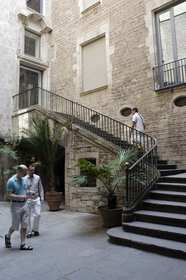
  2. The Picasso museum is "the" museum to visit in Barcelona. For the artist and for the building. Located in Montcada street, in the Gothic area, five medieval palaces linked together to make a museum. Concerning Pablo Ruiz Picasso the museum is indispensable for understanding his formative years. The genius of the young artist is revealed through the more than 3,500 works that make up the permanent collection. It also reveals his relationship with Barcelona: an intimate, solid relationship that was shaped in his adolescence and youth, and continued until his death. To see as well some oils and drawings from Picasso's Barcelona period and even some works from later stages in his career. The Museum also has a set of 42 pieces of ceramics (vases, dishes and plates) made in the 1950s and bequeathed by Jaqueline Picasso in 1982.
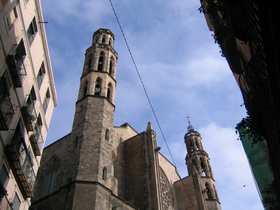
  3. Santa Maria del Mar is a Gothic church from the 14th century, located at the seaside, was built as a private initiative on the wealth accrued from overseas ventures by the inhabitants of La Ribera. The stained glass windows of this basilica, dating from the 15th and 18th centuries, are very famous. From the outside, Santa Maria gives an impression of massive severity that belies the interior. It is hemmed in by the narrow streets of the Ribera, making it difficult to obtain an overall impression, except from the Fossar de les Moreres and the Plaça de Santa Maria, both of them former burial grounds. The latter is dominated by the west end of the church with its rose window. Images of Saint Peter and Saint Paul occupy niches on either side of the west door, and the tympanum shows the Saviour flanked by Our Lady and Saint John. The north-west tower was completed in 1496, but its companion was not finished until 1902.
  4. The Cathedral of the Holy Cross and Saint Eulalia, also known as Barcelona Cathedral, is the Gothic cathedral and seat of the Archbishop of Barcelona. The cathedral was constructed throughout the 13th to 15th centuries, with the principal work done in the 14th century. The cloister, which encloses the Well of the Geese (Font de les Oques) was completed about 1450. The neo-Gothic façade was constructed over the nondescript exterior that was common to Catalan churches in the 19th century. The roof is notable for its gargoyles, featuring a wide range of animals, both domestic and mythical. The cathedral was constructed over the crypt of a former Visigothic chapel, dedicated to Saint James, which was the proprietary church of the Viscounts of Barcelona, one of whom, Mir Geribert, sold the site to Bishop Guislebert in 1058. Its site faced the Roman forum of Barcelona.
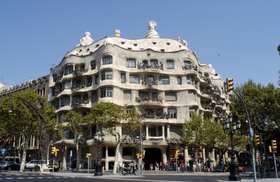
  5. Casa Milà.  After the Sagrada Familia, Casa Milà or "la Pedrera" as it is often called, is probably Gaudi's second most popular building in Barcelona. Casa Milà covers an area of more than 100 square meters and includes two large circular patios, so that almost every part of the house gets its share of sunlight. It is constructed entirely in natural stones, and lacking all the colors and ornamentation design. Maybe one of the most interesting places of the whole complex is the rooftop: here you can find a large ensemble of surrealistic chimneys all looking different and like sculptures standing there alone or in small groups, dominating the rooftop.


    La Pedrera Gaudi
     Casa Milà or "la  Pedrera"