Translate

Tuesday, 12 June 2012

Nicosia

Nicosia


Nicosia, known locally as Lefkosia, is the capital and largest city in Cyprus, as well as its main business center. After the collapse of the Berlin Wall, Nicosia remained the only divided capital in the world, with the southern and the northern portions divided by a Green Line. It is located near the center of the island, on the banks of the Pedieos River.

Nicosia is the capital and seat of government of the Republic of Cyprus. The northern part of the city functions as the capital of the self-proclaimed Turkish Republic of Northern Cyprus, a disputed breakaway region whose independence is recognized only by Turkey, and which the rest of the international community considers as occupied territory of the Republic of Cyprus since the Turkish Invasion in 1974.

Nicosia has been in continuous habitation since the beginning of the Bronze Age 2500 years BC, when the first inhabitants settled in the fertile plain of Mesaoria. Nicosia later became a city-state known as Ledra or Ledrae, one of the twelve kingdoms of ancient Cyprus built by Achaeans after the end of the Trojan War. Remains of old Ledra today can be found in the Ayia Paraskevi hill in the south east of the city. We only know about one king of Ledra, Onasagoras. The kingdom of Ledra was destroyed early. Under Assyrian rule of Cyprus, Onasagoras, was recorded as paying tribute to Esarhaddon of Assyria in 672 BC. Rebuilt by Lefkonas, son of Ptolemy I around 300 BC, Ledra is described as a small and unimportant town, also known as Lefkotheon. The main activity of the town inhabitants was farming. During this era, Ledra did not have the huge growth that the other Cypriot coastal towns had, which was primarily based on trade.


In Byzantine times the town was also referred to as Lefkousia and also as Kallinikisis. In the 4th century AD, the town became the seat of bishopship, with bishop Saint Tryphillius (Trifillios), a student of Saint Spyridon.

After the destruction of Salamis by Arab raids in 647, the existing capital of Cyprus, Nicosia became the capital of the island around 965, when Cyprus rejoined the Byzantine Empire. The Byzantines moved the islands administration seat to Nicosia, primarily for security reasons as coastal towns were often suffering from raids. Since then it remains as the capital of Cyprus. Nicosia had acquired a castle and was the seat of the Byzantine governor of Cyprus. The last Byzantine governor of the Island was Isaac Comnenus who declared himself emperor of the island and ruled the island from 1183–1191.


Selimiye Mosque
On his way to the Holy Land during the Third Crusade in 1187, Richard I of England fleet was plagued by storms. He himself stopped first at Crete and then at Rhodes. Three ships continued on, one of which was carrying Queen Joan of Sicily and Berengaria of Navarre, Richard's bride-to-be. Two of the ships were wrecked off Cyprus, but the ship bearing Joan and Berengaria made it safely to Limassol. Joan refused to come ashore, fearing she would be captured and held hostage by Isaac Comnenus, who hated all Franks. Her ship sat at anchor for a full week before Richard finally arrived on the 8th of May. Outraged at the treatment of his sister and his future bride, Richard invaded.

Richard laid siege to Nicosia. Richard finally met and defeated Isaac Comnenus at Tremetousia. Richard became ruler of the island but sold the island to the Knights Templar. The Knights Templar ruled the island having bought it from Richard the Lionheart for 100.000 gold byzantiums. Their seat was the castle of Nicosia. On Easter day on the 11th of April 1192 the people of Nicosia revolted and drove the Knights Templar off the city. Having driven the Knights Templar away, fearing their return the Nicosians demolished the castle of the city almost to its foundations.

Guy of Lusignan, King of Jerusalem, bought Cyprus from the Knights Templar and brought many noble men and other adventurers, from France, Jerusalem, Tripoli, the Principality of Antioch and Kingdom of Armenia, to the island. The Frankish rule of Cyprus started from 1192 and lasted until 1489. During this time, Nicosia was the capital of the medieval Kingdom of Cyprus, the seat of Lusignan kings, the Latin Church and the Frankish administration of the island. During the Frankish rule, the walls of the city were built along with many other palaces and buildings, including the gothic Saint Sofia Cathedral. The tombs of the Lusignan kings can be found there. 

In 1489 Cyprus was captured by the Republic of Venice. Nicosia was their administrative centre and the seat of the Venetian Governor. Since the threat from the Ottomans was visible, the Venetian Governors of Nicosia emphasized in their letters the need for all the cities of Cyprus to be fortified. In 1567 Venetians built the new fortifications of Nicosia, which are well-preserved until today, demolishing the old walls built by the Franks as well as other important buildings of the Frankish era including the King's Palace, other private palaces and churches and monasteries of both Orthodox and Latin Christians. The new walls took the shape of a star with eleven bastions. The design of the bastion is more suitable for artillery and a better control for the defenders. The river Pedieos used to flow through the Venetian walled city. In 1567 it was later diverted outside onto the newly built moat for strategic reasons, due to the expected Ottoman attack. 

On July 1 st 1570 the Ottomans invaded the island. On the 22nd of July, Piale Pasha having captured Paphos, Limassol and Larnaca marched his army towards Nicosia and laid siege to the city. The city managed to last 40 days under siege until its fall on 9 September 1570. Some 20,000 residents died during the sige and every church, public building, and palace was looted. After its siege it was reported that the walls that were ruined, Nicosia retained very few inhabitants. The main Latin churches were converted into mosques, such as the conversion of Saint Sofia Cathedral into the Selimiye Mosque. From 1570 when the Ottomans took over Nicosia, the old river bed through the walled city was left open and was used as a dumping ground for refuse, where rainwater would rush through clearing it temporarily.

The House of Hadjigeorgakis Kornessios
At the time of British administration, Nicosia was still contained entirely within its Venetian walls. Although full of private gardens and amply supplied with water carried to public fountains in aqueducts, the streets remained unpaved and just wide enough for a loaded pack animal. In 1881, macadamized roads through the town were completed to connect with the main roads to the coastal towns but no roads were asphalted until after World War I. On 5 July 1878 the administration of the island was officially transferred to Great Britain. On 31 July 1878, Garnet Wolseley, the first High Commissioner, arrived in Nicosia. He immediately established a skeletal administration by sending officers to each district to supervise the administration of justice and obtain all possible information about the area. Garnet Wolseley immediately established a Post Office at his camp at Kykko Metochi monastery outside Nicosia. Garnet Wolseley lived at ‘Monastery Camp' until a prefabricated residence had been built for him near Strovolos on the site of today's Presidential Palace.

In 1955 an armed struggle against the British rule began aiming to unite the island with Greece, Enosis. The struggle was led by EOKA, a Greek Cypriot nationalist military resistance organisation, and supported by the vast majority of Greek Cypriots. The unification with Greece failed and instead the independence of Cyprus was declared in 1960. During the period of the struggle, Nicosia was the scene of violent protests against the British rule.

In 1960 Nicosia became the capital of the Republic of Cyprus, whose constitution was based on the co-operation of the island's two main communities, Greek and Turkish Cypriots. In December 1963, during the aftermath of a constitutional crisis, skirmishes broke out between Greek Cypriots and the Turkish Cypriots. Nicosia was divided into Greek and Turkish Cypriot quarters. The dividing line, which cuts through the city, was named Green line because the pen used by the United Nations officer to draw the line on a city map was green.

On the 15th July 1974, there was an attempted coup d'état led by the Greek military junta to unite the island with Greece. The coup ousted president Makarios III and replaced him with pro-enosis nationalist Nikos Sampson.

On the 20th July 1974, the Turkish army invaded the island on the pretext of restoring the constitutional order of the Republic of Cyprus. However, even after the restoration of constitutional order and the return of Archbishop Makarios III to Cyprus in December 1974, the Turkish troops remained on the island occupying the northeastern portion of the island. The invasion was given the codename Operation Attila and included two phases.

The second phase of the Turkish invasion was performed on the 14th August 1974, where the Turkish army advanced their positions, eventually capturing a total of 37% of Cypriot territory including the northern part of Nicosia and the cities of Kyrenia and Famagusta. The fighting left the island with a massive refugee problem. Out of a population of 600,000, an estimated 200,000 Greek-Cypriots had been uprooted and forced to flee south of the Attila line, while an estimated 60,000 Turkish-Cypriots remained south of the Attila line, uncertain of their fate.

On February 13, 1975 the Turkish Cypriot community declared the Turkish Federated State of Cyprus in the area occupied by Turkish forces. On November 15, 1983, Turkish Cypriots proclaimed their independence as the Turkish Republic of Northern Cyprus.

Makarios III
The Turkish invasion, the continuous occupation of Cyprus as well as the self-declaration of independence of the TRNC have been condemned by several United Nations Resolutions adopted by the General Assembly and the Security Council. The Security Council is reaffirming their condemnation every year.

Despite the division Nicosia has managed to become a sophisticated and cosmopolitan city, rich in history and culture that combines its historic past with the amenities of a modern city.

Without a doubt, the 1000 year old capital should be on every visitor's agenda. It lies roughly in the centre of the island, within easy reach of the other towns. A day in Nicosia will be a day well spent. To walk through the old city is to step backwards in time. Narrow streets and old houses with ornate balconies jut from weather beaten sandstone walls, and craftsmen in small workshops practice trades unchanged for centuries.

Apart from the unique places of interest left from the ancient times with memories of many generations, the present Nicosia is a dynamic metropolitan city with highly developed infrastructure and an attractive modern look. The uniqueness of such combination makes the capital of Cyprus a place worth knowing and certainly a place worth visiting.


The traditional shopping district runs along Ledra street and its tributary roads within the medieval walls of the city. A bustle of traditional jewelers, shoe and fabric shops give a blend of Middle Eastern and European feel.Laiki Geitonia is a pedestrianised neighbourhood that has been preserved in its original architecture and is the best quarter if you are after souvenir shops. Big chains (e.g. Marks and Spencer, Zara etc) line the more modern Makariou Avenue. Stasikratous street has evolved into a mini local version of 5th Avenue/Bond street with expensive brands such as Armani and Versace stores. All the above are within walking distance of each other.

There are no real department stores in a purist sense, but Ermes (this chain inherited and re-branded the old local Woolworths) has several mini department stores across the island and a couple on Makarios Avenue. Alpha-Mega and Orphanides are local hypermarket chains (worthy equivalent of a Tesco or Wal-Mart) where it would be difficult not to find what you were after. Most of their stores however, are located in the suburbs.

Ledra Street
Traditional Cypriot cuisine is a melting pot of south European, Balkan and Middle Eastern influences. You will find most Greek, Turkish and Arabic dishes, often with a local name or twist. It is now decades since Cyprus has established itself as a tourist hotspot and as a consequence many of the local chefs have trained in Europe and elsewhere, bringing their experiences back home with them. As such most international cuisines are well represented (but unfortunately so are McDonalds & gang). In summary good food is not difficult to come by and most westerners will find dining quite affordable.

The shopping district is dotted with local tavernas and the likes of KFC and Pizza Hut. Virtually all restaurants allow smoking, (and unfortunately some don't even have a non-smoking area, and most restaurants with the non-smoking area don't enforce it). Al fresco dining is a luxury that can be enjoyed for over half the year. It would be a crime not to try (at least once) a mixed pork kebab with a chilled local KEO or Carlsberg (which is brewed locally and tastes different to the same brand overseas) beer. Carnivores are spoilt for choice, whilst vegetarians might find it a tad difficult.

The food is high quality and somewhat cheaper than in the most Western capitals. Snacks should be available from €2-4, kebabs from €7 and whole meals from €15-20. Local KEO beer costs around €4 a pint in bars, local wines starting from €10 a bottle. Hygienic standards are followed and even foods that usually are not recommended in the Mediterranean destinations, such as mayonnaise and salad-based foods, can be safely eaten.
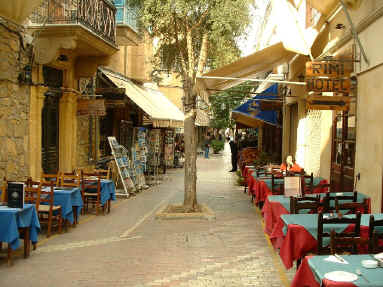
The substantial student population supports a flourishing industry of bars, pubs and nightclubs which keep the old city alive. Cypriots are true socialites and spend most of their time out as opposed to at home. In line with other south European countries going out is unheard of before 10-11pm. There is no official nightlife reference point but Makarios avenue turns into a catwalk cum cruising strip for Porsche owner show-offs. If you are after a more traditional flavour (generally catering for an older population) you could try a bouzouki bar.

Bars will stock the usual international brands of spirits. Local giants KEO beer and Carlsberg (the only other brand brewed on the island) have a universal presence. Local wines are now making a comeback after years of medioaracy and decline. Commandaria is the pride of Cyprus' dessert wines. The local spirit zivania (very similar to grappa) is usually drank as shots straight from the freezer. Cyprus brandy was introduced about 150 years ago and differs from other continental brandies in its lower alcohol content (around 32%). As such it is is often drank by locals whilst eating (and before and after) and is the basic ingredient for a local cocktail, The Brandy Sour. Local Ouzo is also another favourite.

Coffee culture is a way of life in Nicosia. It is the place to see and be seen in the afternoon to early evening. In the summer months, tables spill on to the streets. The posh cafes line Makarios avenue, intertwined with shops. Starbucks and Costa coffee have invaded the island but local equivalents also survive. For a change don't stick to the latte/capuccino, try a greek coffee. In the summer you must order a frappe (iced coffee).


                                                        Nicosia’s Top 5:
       
  1. Ayios Ioannis Cathedral. Is within the Archbishopric, Arch. Kyprianos Square. built by Archbishop Nikiforos in 1662, the recently restored 18th century wall paintings depict biblical scenes and the discovery of the tomb of Saint Barnabas at Salamis. Dedicated to Ayios loannis (Saint John). The archbishopric is the centre of the Cyprus Orthodox Church, the new Archbishopric built in a neo-byzantine style in 1960, contains the private suite of the late Archbishop Makarios. Open to the public only on special occasions.
  2. Selimiye Mosque or Agia Sofia Cathedral, formerly Cathédrale Sainte Sophie, is located in the Turkish controlled northern part of the walled city of Nicosia. It is the main mosque in the city. Possibly constructed on the site of an earlier Byzantine church. The building belongs to the pure Gothic style of the beginning of the 12th century. Due to the building’s large scale, lack of money and various historical events it took 150 years for the cathedral to be built and still, it was never entirely completed since the southwest tower and the portico’s upper floor were never constructed. The cathedral’s first construction phase began during the first years of Frankish rule (possibly in 1209) and already by 1228 the eastern part of the building was completed. By the end of the 13th century the side aisles and a large part of the middle aisle were completed. From 1319 to 1326 the Latin archbishop Giovanni del Conte or Giovanni de Polo was responsible for the completion of the middle aisle, the construction of the roof buttresses, the cathedral’s façade and the building of a chapel (which functioned as a baptistery) in the western part of the southern wall. He also adorned parts of the cathedral with frescoes and sculptures. In November 1326 the cathedral’s official inauguration took place.
  3. The Venetian City Walls. This fortification complex has a circumference of 3 miles, and contains eleven pentagon-shaped bastions named after eleven families, pillars of the Italian aristocracy of the town, who donated funds towards the construction of the walls and the three gates, Porta San Domenico Paphos Gate, Porta Guiliana -Famagusta Gate, and Porta del Proveditore -Kyrenia Gate-. Experts contemporary to the construction of the walls have considered them as a prime example of 16th century military architecture. Their design incorporates specific innovative techniques, marking the beginning of a renaissance era in fortification construction. These include the positioning of gates to the side of the adjoining bastions, so they could be more easily protected in times of siege, and leaving the upper half of the wall unlined with masonry, so as to increase its ability to absorb the impact from cannon shot.
  4. Cyprus Museum. This museum was established to collect, study and display archaeological artifacts from all over the island. Some of the exhibits are as old as 8,500 years. The museum is arranged in chronological order. The first hall contains pottery and implements from the Neolithic and Chalcolithic periods whilst the other rooms trace the history of Cyprus through the ages from the Bronze Age, Hellenic Period, Mycenaean times, and Roman Period to the earlyByzantine. A unique feature of the museum lies in the basement, where several graves rest in a dark cellar complete with skeletal remains and grave adornments that have been reconstructed.
  5. The House of Hadjigeorgakis Kornessios. Originally a Venetian Building. It is probably the most important 18th century building in Nicosia. It was once the house of the Dragoman Hadjigeorgakis Kornessios. The house is being restored and will house the Cyprus Ethnographic Museum. Hadjigeorgakis Kornessios house has won the Europa Nostra award in 1988.


    Venetian City Walls


Saturday, 9 June 2012

Niš

Niš


Niš is the largest city of southern Serbia and the third-largest city in Serbia (after Belgrade and Novi Sad). Niš is the administrative center of the Nišava District. It is one of the oldest cities in the Balkans and Europe, and has from ancient times been considered a gateway between the East and the West.

Archaeological evidence shows neolithic settlements in the city and area dating from 5,000 to 2,000 BCE. A notable archeological site is Humska Čuka. The ethnogenesis of the Thracians started in the Iron Age, one of the chief towns was Aiadava, the future Roman Remesiana. The Triballians dwelled in this region, as well and were mentioned as early as 424 BC. In 279 BC, during the Gallic invasion of the Balkans, the Scordisci tribe defeats the Triballi and settles the lands, at which time the city is known as Navissos.

At the time of the conquest of the Balkans by Rome in 168-75 BC, Naissos  was used as a base for operations. Naissus was first mentioned in Roman documents near the beginning of 2nd century CE, and was considered a place worthy of note in the Geography of Ptolemy of Alexandria.

The Romans occupied the town in the period of the "Dardanian War" (75-73 BC), and set up a legionary camp. The city (called refugia and vici in pre-Roman relation), because of its strategic position (the Thracians were based to the south) developed as an important garrison and market town of the province of Moesia Superior. The Romans built the Via Militaris in the early 1st century AD, with Naissus being one of the key towns. Five roads met at Naissus, from Lissus, Serdica, Singidunum, Ratiaria and Thessalonica (through Scupi). Tombstones of auxiliary units date to the rule of either Claudius (41-54) or Nero (54-68). An auxiliary fort was based to the north, at present-day Ravna, called Timacum Minus. Marcus Aurelius (161–180) promoted the city to municipia. Overall, several family tombstones point that this was an important military region and by the 3rd century a social class of peasants and soldiers emerged. Cohort I Aurelia Dardanorum was based in the city.

In the year 268 AD, during the "Crisis of the Third Century" when the Empire almost collapsed, the greatest Gothic invasion in history took place; the Gothic alliance ravaged Thrace, Macedonia, Moesia and Pannonia. Subsequently, Claudius II managed to defeat the invaders at the Battle of Naissus that took place in the same year, in one of the bloodiest battles of the 3rd century. The Gothic alliance allegedly left thirty to fifty thousand dead on the field. In 272 AD, the future Emperor Constantine the Great was born in Naissus. Constantine created theDacia Mediterranea province of which Naissus was the capital and also included Remesiana of the Via Militaris and the towns of Pautalia and Germania. He lived at Naissus in short periods from 316-322.


The latter half of the 6th century AD saw the first major migrations of Slavs and Avars. During the 6th and 7th century, Slavic tribes made eight attempts to take Niš. In 551, the Slavs crossed Niš initially headed for Thessalonica, but ended up in Dalmatia. By the 580s, the Slavs had conquered Serbia and much of northern Greece. During the final attack in 615, the Slavs seized the city and most of the Romans and Romanized Thracian/Dacian population fled, perished, or was assimilated.

The Slavs in the Sclaviniae remained independent for some while; in 785, Macedonia was conquered by Constantine VI, and in 842, with the death of Theophilos, the region was conquered by the Bulgars.

Prince Constantine Bodin was crowned Emperor of Bulgaria in 1072, amid the Bulgarian revolts in Macedonia against the Byzantine Empire. Bodin conquered Niš, but was later captured. During the People's Crusade, on July 3, 1096, Peter the Hermit clashed with Byzantine forces at Niš. He lost a quarter of his men, but managed to march on to Constantinople.

In 1375, after a 25-day long siege, the city fell to the Ottoman-Turks for the first time. The fall of the Serbian state decided the fate of Niš as well. After the Battle of Kosovo in 1389, even though Serbia existed much weakened as a semi-independent state for another 70 years, the Constantinople-Vienna road grew deserted.

In 1443, Niš fell into the hands of Ludanjin. The town itself was given back to the Serbs, while Branković gave it over to Đorđe Mrnjavčević. In the so-called Long Campaign, Christian armies, led by the Hungarian military leader Janos Hunyadi (known as Sibinjanin Janko in Serbian folk poetry) together with Serbian Despot Đurađ Branković, defeated the Turks and repelled them to Sofia. An important battle was fought near Niš, which remained a free city for a whole year after that.

Niš succumbed to Ottoman rule again in 1448 and remained under Ottoman control for the following 241 years. During the period of Ottoman rule, Niš was the seat of the Sanjak of Niš and Niš Eyalet.  On September 24, 1689, the Austrian Army captured the city after defeating the Turks at the Battle of Niš, but the Ottomans managed to retake it the next year. In 1737, Niš was seized again by the Austrian Army, in their campaign against the Turks. The war ended in 1739 and Niš fell under Ottoman rule once more.
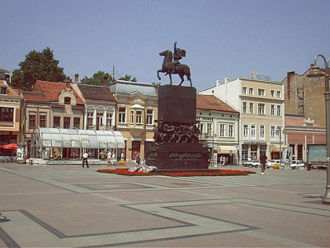
Čegar Monument

During the time of German occupation in World War II, the first Nazi concentration camp in Yugoslavia was located in Niš. About 30,000 people passed through this camp, of whom over 10,000 were shot on nearby Bubanj hill. On February 12th 1942, 147 prisoners staged mass escape. In 1944 city was heavily bombed by the Allies. On October 14th 1944 Niš was liberated from the Germans by Partisans and Soviet forces.

In 1996, Niš was the first city in Serbia to stand against the regime of Slobodan Milošević. A coalition of democratic opposition parties called Zajedno (meaning "Together" in Serbian) won the local elections in Niš in 1996 and protested for 88 days in the streets until Milošević`s Socialist Party surrendered power. The first democratic mayor of the City of Niš was Zoran Živković.

In the local elections held in May 2008, the Democratic Party, G17+ and coalition assembled around the Socialist Party of Serbia won and Miloš Simonović from the Democratic party became the elected mayor.

There has never been a better time to visit Niš, other than when Constantine the Great was alive of course. Serbia having been granted visa-free travel within the Schengen zone, in December 2009, the mass movement of people looks imminent. As the Serbs joyously savour the prospect of European travel, the budget airlines move in. With the advent of affordable connections out of Niš, inevitably come the inexpensive connections in. Thus the city can undoubtedly expect many more tourists in the immediate future, and realistically envisage a lot of change in the next 10 to 20 years, most of it positive. 

Though shopping will not be the principal reason for most trips to Niš, you shouldn't have much difficulty finding what you want, be it local art and crafts, a new camera, replacement moisturiser or some tired-looking Yugoslav relics from the country's quite recent past. Serbia, or Niš at least, has retained the traditional Christian working habits, the vast majority of shops being closed on Sundays. Moreover, it seems Saturday late-afternoons are reserved for coffee drinking and gossip, most places only working until 3 or 4pm. Centred around the pedestrianised 'Obrenovaćeva' thoroughfare, there's a good range of high-street outlets and several boutiques. More specialist shops are spread throughout the city. There are some great outdoor markets, worth a trip if only for the experience of wandering through the noisy, vibrant beehive of activity.

Aside from various international options, there are a couple of good fish restaurants and Italian eateries in Niš. Yes, the youth of the city like the same things as the rest of the world's youth; pizzerias are already numerous. That said, the typical and traditional Serbian restaurants do not appear to be suffering. From the simplest kafana - technically a café but often more akin to a restaurant - to mammoth-sized establishments aimed at visitors and locals alike - are equally always occupied. Furthermore, you'll more often than not stumble upon a party atmosphere, complete with live folk music and a jubilant patronage.

Cities the size of Niš are small enough so you'll not find huge crowds, but often there's still plenty going on after dark. The scene in Niš is most definitely alive; there are lots of bars, several varied clubs and many of the mass of cafes are just as popular, or even more so, at night. We stress 'night' rather than 'evening', given that coffee drinking goes on till 6 or 7pm, then the partying begins at about 11pm, on the weekend at least.

Mosaics at Mediana


                                                           Nis’ Top 5:
       
  1. Niš Fortress Is a complex and important cultural and historical monument. It rises on the right bank of the Nišava River, and is over two millennia old. The extant fortification is of Turkish origin, dating from the first decades of the 18th century (1719–1723). It is well-known as one of the most significant and best preserved monuments of this kind in the mid-Balkans. The Fortress was erected on the site of earlier fortifications - the ancient Roman, Byzantine, and later yet Mediaeval forts. The Fortress has a polygonal ground plan, eight bastion terraces and four massive gates. It stretches over 22 ha of land. On the outside, the Fortress was surrounded by a wide moat, whose northern part has been preserved to this day. Beside the massive stone rampart walls, the southern Stambol Gate and the western Belgrade Gate are pretty well preserved. Partly preserved are the water gates, while there are only partial remains of the northern Vidin Gate and the south-east Jagodina Gate. 
  2. The Skull Tower is a monument to 19th century Serbian rebels. It is situated on the old Constantinople Road leading to Sofia. The monument was built using the skulls of the Serbs killed by order of Ottoman Sultan Mahmud II during the 1809 Battle of Čegar.
    The tower stood in the open air until the liberation of Niš in 1878. By that time, much of the tower had deteriorated from weather conditions or from the removal of skulls for burial by relatives of killed rebels. In 1892, with donations gathered from all over Serbia, a chapel designed by the Belgrade architect Dimitrije T. Leko was built to enclose what was left of the tower. Today, only 58 skulls remain, including that of Sinđelić. Skull Tower was declared Monument of Culture of Exceptional Importance in 1979, and it is protected by Republic of Serbia.
  3. Čegar Is the location where the Battle of Čegar Hill took place. It was first marked on July 4, 1878 with the following inscription:"To voivoda Stevan Sinđelić and his undead heroes who lost their lives on May 19, 1809, in their attack on Niš. Knez Milan M. Obrenović IV and his brave soldiers redeemed them on December 27, 1877 by conquering Niš."Today's monument in the shape of a tower - a symbol of the soldiers' fortification - was erected for the fiftieth anniversary of the liberation of Niš from the Turks, on June 1, 1927. In 1938 a bronze bust of Stevan Sinđelić was positioned in the semicircular niche of the monument.
  4. Mediana is an important archeological site from the late Roman period located in the eastern suburb of the city of Niš. It represents a luxurious residence with a highly organized economy. Excavatations have revealed a villa with peristyle, thermae, granary and water tower. The residence dates to the reign of Constantine the Great 306 to 337. Although Roman artefacts can be found scattered all over the area of present-day Niš, Mediana represents the best-preserved part of Roman Naissus. In 1979, Mediana was added to the Archaeological Sites of Exceptional Importance list, protected by Republic of Serbia.
  5. Serbian Wartime Parliament Building - Birthplace of Yugoslavia. The building of the "Youth Home" Restaurant was erected in 1890. At first, the "Bulevar" restaurant was situated in the building. The Army General Staff bought the building in 1903 and turned it into an Officers' Home, which remained there until 1941. At the beginning of World War I this building was in the focus of public attention as the center of the political life of Serbia. On December 7, 1914 a war session of the National Assembly was held there. On that occasion the Assembly made the "Niš Declaration", which explicitly stated the military objectives of Serbia - to fight for the liberation and unification of the Balkan peoples. On May 6, 1915 the Yugoslav Congress was held in this building. The Congress issued the "Niš Resolution" which once again emphasized the need for national unity.


    Remains of the skull tower


Tuesday, 5 June 2012

Novi Sad

Novi Sad


Novi Sad is the second largest city in Serbia, capital of the northern Serbian province of Vojvodina, and the administrative centre of the South Bačka District. It is located in the southern part of Pannonian Plain, on the border of the Bačka and Srem regions, on the banks of the Danube river and Danube-Tisa-Danube Canal, facing the northern slopes of Fruška Gora mountain.

Human settlement on the territory of present-day Novi Sad has been traced as far back as the Stone Age (about 4500 B.C.). This settlement was located on the right bank of the river Danube in the territory of present-day Petrovaradin. This region was conquered by Celts (in the 4th century B.C.) and Romans (in the 1st century B.C.). The Celts founded the first fortress at this location, which was located on the right bank of the Danube. During Roman rule, a larger fortress was built in the 1st century with the name Cusum and was included into the Roman province of Pannonia. In the 5th century, Cusum was devastated by the invasion of the Huns.

By the end of the 5th century, Byzantines had reconstructed the town and called it by the names Cusum and Petrikon. The town was later conquered by Ostrogoths, Gepids, Avars, Franks, Bulgarians, and again by Byzantines. The region was conquered by the Kingdom of Hungary between the 10th and 12th century, and the town was mentioned under the name Bélakút or Peturwarad(Pétervárad) in documents from 1237. In the same year (1237), several other settlements were mentioned to exist in the territory of modern urban area of Novi Sad (on the left bank of the Danube).

Between 1526 and 1687, the region was under Ottoman rule. In the year 1590, population of all villages that existed in the territory of present-day Novi Sad numbered 105 houses inhabited exclusively by Serbs. However, Ottoman records mention only those inhabitants that paid taxes, thus the number of Serbs that lived in the area (for example those that served in the Ottoman army) was larger. 


Petrovaradin Fortress
For much of the 18th and 19th centuries, Novi Sad was the largest city in the world populated by ethnic Serbs. Because of its cultural and political influence, Novi Sad became known as the Serbian Athens. 

During the Revolution of 1848-1849, Novi Sad was part of Serbian Vojvodina, a Serbian autonomous region within the Habsburg Empire. In 1849, the Hungarian army located on the Petrovaradin Fortress bombarded and devastated the city, which lost much of its population.  Between 1849 and 1860, the city was part of a separate Austrian crownland known as the Vojvodina of Serbia and Tamiš Banat. After the abolishment of this province, the city was included into Bačka-Bodrog County. After 1867, Novi Sad was located within the Hungarian part of Austria-Hungary. 

On 25 November 1918, the Assembly of Serbs, Bunjevci and other Slavs of Vojvodina in Novi Sad proclaimed the union of Vojvodina region with the Kingdom of Serbia. Since 1 December 1918, Novi Sad was part of the Kingdom of Serbs, Croats, and Slovenes; and in 1929, it became the capital of the Danube Banovina, a province of the Kingdom of Yugoslavia. 

In 1941, the Kingdom of Yugoslavia was invaded and partitioned by the Axis powers, and its northern parts, including Novi Sad, were annexed by Hungary. During World War II, about 5,000 citizens were murdered and many others were resettled. In three days of Novi Sad raid (21—23 January 1942) alone, Hungarian police killed 1,246 citizens, among them more than 800 Jews, and threw their corpses into the icy waters of the Danube, while the total death toll of the raid was around 2,500. Citizens of all nationalities - Serbs, Hungarians, Slovaks, and others - fought together against the Axis authorities. In 1975 the whole city was awarded the title People's Hero of Yugoslavia.

Since 1945, Novi Sad has been the capital of Vojvodina, a province of the Socialist Federal Republic of Yugoslavia and Serbia. The city went through rapid industrialization and its population more than doubled in the period between World War II and the breakup of Yugoslavia. After 1992, Novi Sad was part of the Federal Republic of Yugoslavia, which, in 2003, was transformed into the State Union of Serbia and Montenegro. Since 2006, Novi Sad is part of an independent Serbia.

The number of tourists visiting Novi Sad each year has steadily risen since 2000. Every year, in the beginning of July, during the annual EXIT music festival, the city is full of young people from all over Europe. In 2005, over 150,000 people visited the festival, which put Novi Sad on the map of summer festivals in Europe. Besides EXIT festival, Novi Sad Fair attract many business people into the city; in May, the city is home to the biggest agricultural show in the region, which 600,000 people visited in 2005. There is also a tourist port near Varadin Bridge in the city centre welcoming various river cruise vessels from across Europe who cruise on Danube river.

There are many restaurants in Novi Sad that serve international and national cuisine, Italian specialities, Chinese food, fish and vegetarian food. The average price for a meal per person is €5 to €10. Local beer costs around €1, imported beer is €1.5 to €2.5, a cup of espresso coffee costs from €0.8 to €1.2 and juices are around €1. Most restaurants close at 11 pm. Numerous fast food restaurants and grill booths are open 24 hours, the average price for a meal is 1€ .


Due to the excellent grape growing conditions, the vineyards of Fruška Gora have been amongst the most important in Central Europe since the Middle Ages. In the Fruška Gora region there are three winemaking centres: Petrovaradin with Sremski Karlovci, Irig and Erdevik.

Not far from Novi Sad is the Fruška Gora National Park which harbours habitats of a large number of animal species. In Fruška Gora, besides forests, valuable ecosystems and geological features, there are also the famous Fruška Gora monasteries and a large number of picnic sites, including Iriški Venac, Zmajevac, Andrevlje and Koruška, as well as the Međeš and Borkovac lakes.

On the shoreline of the Danube near Novi Sad there is the Koviljsko-Petrovaradinski Rit marsh, a significant bird habitat which is home to some rare and endangered species. Each year at the beginning of June a photo-safari is held in the marsh.


                                                        Novi Sad’s Top 5:
       
  1. The Name of Mary Church  is a Roman Catholic church named after Virgin Mary.  Locals refer to it as the "Catholic cathedral", or just "cathedral", even though the actual cathedral (bishop's seat) is located in Subotica. The church was built on the foundation of an old Roman Catholic church, which was damaged during Revolution of 1848. This church was not restored correctly, so Catholics from Novi Sad decided to build a new church. It was finished in the end of the 19th century, in 1894 by architect Georg Molnar. The church is a three-nave building, with gothic arches. The altar is made of carved wood from Tyrol, the windows with stained glass from Budapest and the roof tiles were made of Zsolnay ceramics. It is the tallest church in Bačka region and dominates the city centre of Novi Sad.
  2. Petrovaradin Fortress. Is located in the province of Vojvodina, on the right bank of the Danube river. The cornerstone of the present-day southern part of the fortress was laid on October 18, 1692, by Charles Eugène de Croÿ. Petrovaradin Fortress has many underground tunnels as well (16 km of underground countermine system). In 1991 Petrovaradin Fortress was added to Spatial Cultural-Historical Units of Great Importance list, and it is protected by the Republic of Serbia. 
  3.  Novi Sad Synagogue is a Jewish synagogue and one of the many cultural institutions in Novi Sad. Located in Jevrejska (Jewish) Street, in the city centre, the synagogue has since been recognized as a landmark. The building of the new synagogue, the fifth to be erected on the same location since the 18th century, became a major project for the entire Jewish community of Novi Sad. The building work of the Novi Sad synagogue started in 1905 and was finished in 1909. It was projected by Hungarian architect Baumhorn Lipót.The synagogue was part of a bigger complex of buildings that included on both sides of the synagogue two edifices decorated in a similar pattern. One building served the Jewish school and other as offices of the Jewish Community.
  4. The Museum of Vojvodina, founded by Matica Srpska in 1847, houses a permanent collection of Serbian culture and a life in Vojvodina through history. Vojvodina from the Palaeolithic era to the middle of the 20th century. The museum includes exhibits relating to archaeology, history, ethnology and modern history.  The museum houses a collection of over 400,000 specimens and a library of over 50,000 volumes.
  5. Liberty Bridge is a Cable-stayed bridge on the Danube river. The bridge was built in 1981 and destroyed during NATO bombardment on April 4, 1999. It was rebuilt 2003-2005 and reopened on October 7, 2005. The bridge was designed by Nikola Hajdin.
    Rebuilding the bridge cost the city €40 million and lasted for 2 years and 22 days. Maja Gojković, the mayor of Novi Sad, reopened it on October 7, 2005. The official reopening was held a few days later, with officials from the European Agency for Reconstructionpresent. The bridge's reconstruction and opening was a cause for political clashes; one side saying Novi Sad and its citizens should be thankful to EU for the gift of the reconstructed bridge, and the other that EU was obliged to reconstruct it anyway, as a part of war damages compensation.


                 http://www.serbia.travel/destinations/cities-and-municipalities/novi-sad/#


Sunday, 3 June 2012

Nuremberg

Nuremberg


Nuremberg is a city in the German state of Bavaria, in the administrative region of Middle Franconia. Situated on the Pegnitz river and the Rhine–Main–Danube Canal, it is located about 170 kilometres (110 mi) north of Munich and is Franconia's largest city.

Nuremberg was probably founded around the turn of the 11th century, according to the first documentary mention of the city in 1050, as the location of an Imperial castle between the East Franks and the Bavarian March of the Nordgau. From 1050 to 1571, the city expanded and rose dramatically in importance due to its location on key trade routes. King Conrad III established a burgraviate, with the first burgraves coming from the Austrian House of Raab but, with the extinction of their male line around 1190, the burgraviate was inherited by the last count's son-in-law, of the House of Hohenzollern. From the late 12th century to the Interregnum (1254–73), however, the power of the burgraves diminished as the Hohenstaufen emperors transferred most non-military powers to a castellan, with the city administration and the municipal courts handed over to an Imperial mayor from 1173/74. The strained relations between the burgraves and the castellan, with gradual transferral of powers to the latter in the late-14th and early-15th centuries, finally broke out into open enmity, which greatly influenced the history of the city. 

Nuremberg is often referred to as having been the 'unofficial capital' of the Holy Roman Empire, particularly because Reichstage (Imperial Diets) and courts met at Nuremberg Castle. The Diets of Nuremberg were an important part of the administrative structure of the empire. The increasing demand of the royal court and the increasing importance of the city attracted increased trade and commerce to Nuremberg. In 1219, Frederick II granted theGroßen Freiheitsbrief (Great Letter of Freedom), including town rights, Reichsfreiheit (or Imperial immediacy), the privilege to mint coins and an independent customs policy, almost wholly removing the city from the purview of the burgraves. Nuremberg soon became, with Augsburg, one of the two great trade centers on the route from Italy to Northern Europe. In 1298, the Jews of the town were accused of having desecrated the host and 698 were slain in one of the many Rintfleisch Massacres. Behind the massacre in 1298 was also the desire to combine the northern and southern parts of the city, which were divided by the Pegnitz river. The Jews of the German lands suffered many massacres during the plague years. 

Albrecht Dürer's House
The cultural flowering of Nuremberg, in the 15th and 16th centuries, made it the centre of the German Renaissance. In 1525, Nuremberg accepted the Protestant Reformation, and in 1532, the religious Peace of Nuremberg, by which the Lutherans gained important concessions, was signed there. During the 1552 revolution against Charles V, Nuremberg tried to purchase its neutrality, but the city was attacked without a declaration of war and was forced into a disadvantageous peace. At the Peace of Augsburg, the possessions of the Protestants were confirmed by the Emperor, their religious privileges extended and their independence from the Bishop of Bamberg affirmed, while the 1520s' secularisation of the monasteries was also approved. 

Nuremberg held great significance during the Nazi Germany era. Because of the city's relevance to the Holy Roman Empire and its position in the centre of Germany, the Nazi Party chose the city to be the site of huge Nazi Party conventions – the Nuremberg rallies. The rallies were held annually from 1927 to 1938 in Nuremberg. After Adolf Hitler's rise to power in 1933 the Nuremberg rallies became huge Nazi propaganda events, a centre of Nazi ideals. The 1934 rally was filmed by Leni Riefenstahl, and made into a propaganda film called Triumph des Willens (Triumph of the Will). At the 1935 rally, Hitler specifically ordered the Reichstag to convene at Nuremberg to pass the anti-Semitic Nuremberg Laws which revoked German citizenship for all Jews. A number of premises were constructed solely for these assemblies, some of which were not finished. Today many examples of Nazi architecture can still be seen in the city. The city was also the home of the Nazi propagandist Julius Streicher, the publisher of Der Stürmer. 

During World War II, Nuremberg was the headquarters of Wehrkreis (military district) XIII, and an important site for military production, including aircraft, submarines, and tank engines. A subcamp of Flossenbürg concentration camp was located here. Extensive use was made of slave labour. The city was severely damaged in Allied strategic bombing from 1943–45. On 2 January 1945, the medieval city centre was systematically bombed by the Royal Air Force and the U.S. Army Air Forces and about ninety percent of it was destroyed in only one hour, with 1,800 residents killed and roughly 100,000 displaced. In February 1945, additional attacks followed. In total, about 6,000 Nuremberg residents are estimated to have been killed in air raids.

Nuremberg was a heavily fortified city that was captured in a fierce battle lasting from 17 to 21 April 1945 by the US , which fought house-to-house and block-by-block against determined German resistance, causing further urban devastation to the already bombed and shelled buildings. Despite this intense degree of destruction, the city was rebuilt after the war and was to some extent, restored to its pre-war appearance including the reconstruction of some of its medieval buildings. However, the biggest part of the historic structural condition of the old Imperial Free City was lost forever. Between 1945 and 1946, German officials involved in the Holocaust and other war crimes were brought before an international tribunal in the Nuremberg Trials.

Today, Nuremberg's many sights make sure that no visitor will be bored. From the Germanische Nationalmuseum, Albrecht Dürer's House, the New Museum for Art and Design right through to the Documentation Centre Party Rally Grounds, over 30 museums offer exhibitions on a wide variety of topics.

Those who prefer open-air exploration, may take a look at some of Nuremberg's many historical buildings. The imperial castle is particularly impressive. Nuremberg's churches and fountains are also well worth a visit. All those who are curious for more, can visit the "Tiergarten" one of Europe's most beautifully landscaped zoos, the Planetarium, the State Theatre and Opera and many fascinating small theatres.


Within the city you will find the famous Nürnberger Bratwürste, in the surrounding area Fränkische Bratwürste. Nürnberger are only about half the size, but contain more spices than Fränkische. Consequently one typically eats three Fränkische or six Nürnberger. In restaurants Bratwürste are served with Sauerkraut or potato salad. In some better restaurants you can order also "Saure Zipfel", cooked Bratwürste in vinegar-onion sauce with fresh horseradish and bread. On the street you can also buy two or three sausages in a roll ('Drei im Weggla'). But be careful to get "real" Nürnberger and not "foreign" Thüringer Bratwürste. Nürnberger Bratwürste / Nürnberger Rostbratwürste is also protected under EU law withProtected designation of origin status. .


Nuremberg's main shopping district ist the Lorenzer Altstadt, the part of the old town south of river Pegnitz. There are three shopping streets running from the white tower to the vicinity of St Lawrence church: The cheapest stores can be found in Breite Gasse, in Karolinenstrasse you find mid-priced stores and Kaisserstraße, next to the river, offers luxury goods. At their eastern end the three streets are connected by the street Königsstraße, which runs from the main station via St Lawrence church to the main market place. The biggest department stores, Karstadt, Galeria Kaufhof and Breuninger, are located here. On Trödelmarkt you find some small snugly shops. At Sebalder Altstadt you find antiques, curiosities and designer shops. 

Every year, Germany's most famous Christmas Market opens its stalls for visitors from all over the world, right in the middle of the city, on Nuremberg Main Market Square. At 5.30 p.m. on the Friday before the first Advent Sunday, the Christmas Angel opens her market, reciting the solemn prologue from the gallery of the church of Our Lady. And as every year, by Christmas Eve, more than two million visitors from all over the world will have sampled the delights of the Christmas Market.

About 180 wooden stalls, festooned with red-and-white cloth, have given the Christmas Market its name of "Little Town from Wood and Cloth". 200 stall holders present their traditional wares: Nuremberg spicy gingerbread, fruit loaves, bakery goods and sweets, typical Christmas articles such as Christmas tree angels, cribs, Christmas tree ornaments and candles, toys as well as arts and crafts products. Favourite souvenirs include "Nuremberg Plum People", little figures made from prunes. And of course, by way of refreshments, there are always rolls with Nuremberg roast sausages and mugs of mulled wine. Nuremberg Christmas Market with its traditional image has also been a model for other Christmas Markets. The "Little Town from Wood and Cloth" has also been much in demand as a picturesque backdrop for TV productions.


                                                        Nuremberg’s Top 5:
       
  1. Lorenzkirche (St. Lawrence's Church). The building of this basilica, one of the most important buildings in Nuremberg, in high gothic style started between 1243 and 1315. The western façade between the two steeples is decorated with a rosette window and can be dated via the joint coats of arms of Charles IV and his third wife Anna von Schweidnitz who got married in 1353. Plans were changed during building, integrating the side chapels between the buttresses for the side aisles (1391) and the galleries above the side portals. Between 1439 and 1477, the vast late gothic hall chancel was added. During World War II, St. Lawrence's Church was badly damaged. Reconstruction started after 1945, directed by Julius Lincke (re-consecration on 10 August, 1952). The interior contains important works of art, including numerous epitaphs, stone and wooden sculptures, and most remarkably the tabernacle by Adam Kraft (1493/96), the Annunciation with corresponding chandelier by Veit Stoß (1517/18), the Deocarus Altar (1437) and the Krell Altar (1483). The pulpit is a neo-gothic work.
  2. The Toll Hall (Mauthalle) was built above the last-but-one city moat between 1498 and 1502 by Hans Beheim the Elder as an Imperial Corn Store. Carts could be driven into the house from both narrow sides of the three-storey sandstone building with its five attic storeys. Hatches for a block-and-tackle above the gable axes and on the eaves sides assisted in transporting the goods inside. In 1571/72, the City's Toll and Weights and Measures Office moved in. In 1896, Toll Hall, which had up until then been used by the Customs Administration, was sold by the Bavarian State to the Foundation for the Hospice of the Holy Spirit and the Landalmosenamtsstiftung, another foundation administered by the City. The house which in 1897/98 had been transformed into a shop and commercial building, burnt out completely in 1945, and was reconstructed in simplified form between 1951 and 1953. Today, the cellar vault supported by 26 pillars houses a restaurant with its own micro-brewery.
  3. The Germanisches Nationalmuseum. Founded in 1852, the museum houses a large collection of items relating to German culture and art extending from prehistoric times through to the present day. With current overall holdings of about 1.2 million objects, the Germanisches Nationalmuseum is Germany's largest museum of cultural history. Formerly the Germanisches Museum, it was founded by a group of individuals led by Franconian baron, Hans von und zu Aufsess, whose goal was to assemble a "well-ordered compendium of all available source material for German history, literature and art". The buildings incorporate the remaining structures of the former Nuremberg Charterhouse, dissolved in 1525 and used for a variety of secular purposes until in 1857 what was left of the premises, by then badly dilapidated, was given to the Museum.
  4. Albrecht Dürer's House.  Under the heading "Back to Dürer", this house presents the residence and workplace of famous artist Albrecht Dürer (1471-1528).   The house was built around 1420. It has five stories; the bottom two have sandstone walls, while the upper stories are timber framed; the entire structure is topped by a half-hip roof. In 1501, it was purchased by Bernard Walther, a merchant and prominent astronomer. Walter remodeled the house, adding small windows to the roof so that it could function as an observatory. Walther died in 1504, and Dürer purchased the house five years later. Special attractions include a painting and printing workshop from Dürer's time, where various artistic techniques are demonstrated. The lady of the house herself, Agnes Dürer, guides visitors through her house by audio-guide (in five languages), telling them much about the everyday life in this artist's household. By special request, she even appears in person to guide visitors through the house.
  5. The Imperial Castle, symbol of Nuremberg, rises high above the city. The castle, where between 1050 and 1571 all Emperors of the Holy Roman Empire of the German Nation were in residence at least for some time, is one of the most important imperial palaces of the Middle Ages. The Palas (main building) with its sumptuously furnished Emperor's rooms, the Roman double chapel, the deep well, and the Sinwell Tower, as well as a comprehensive collection of weapons and utensils can be visited today.