Translate

Showing posts with label germany. Show all posts

Friday, 4 January 2013

Koblenz

Koblenz


Koblenz, also spelled Coblenz or Coblence, is a German city situated on both banks of the Rhine at its confluence with the Moselle, where the Deutsches Eck (German Corner) and its monument (Emperor William I on horseback) are situated.

Around 1000 BC, early fortifications were erected on the Festung Ehrenbreitstein hill on the opposite side of the Moselle. In 55 BC, Roman troops commanded by Julius Caesar reached the Rhine and built a bridge between Koblenz and Andernach. About 9 BC, the "Castellum apud Confluentes", was one of the military posts established by Drusus.

Remains of a large bridge built in 49 AD by the Romans are still visible. The Romans built two castles as protection for the bridge, one in 9 AD and another in the 2nd century, the latter being destroyed by the Franks in 259. North of Koblenz was a temple of Mercury and Rosmerta (a Gallo-Roman deity), which remained in use up to the 5th century.


With the fall of the Western Roman Empire, the city was conquered by the Franks and became a royal seat. After the division of Charlemagne's empire, it was included in the lands of his son Louis the Pious (814). In 837, it was assigned to Charles the Bald, and a few years later it was here that Carolingian heirs discussed what was to become the Treaty of Verdun (843), by which the city became part of Lotharingia under Lothair I. In 860 and 922, Koblenz was the scene of ecclesiastical synods. At the first synod, held in the Liebfrauenkirche, the reconciliation of Louis the German with his half-brother Charles the Bald took place. The town was sacked and destroyed by the Normans in 882. In 925, it became part of the eastern German Kingdom, later the Holy Roman Empire.

In 1018, the city was given by the emperor Henry II to the archbishop and prince elector of Trier after receiving a charter. It remained in the possession of his successors until the end of the 18th century, having been their main residence since the 17th century. Emperor Conrad II was elected here in 1138. In 1198, the battle between Philip of Swabia and Otto IV took place nearby. In 1216, prince-bishop Theoderich von Wied donated part of the lands of the basilica and the hospital to the Teutonic Knights, which later became the Deutsches Eck.

In 1249–1254, Koblenz was given new walls by Archbishop Arnold II of Isenburg; and it was partly to overawe the turbulent townsmen that successive archbishops built and strengthened the fortress of Ehrenbreitstein that still dominates the city.

The city was a member of the league of the Rhenish cities which rose in the 13th century. The Teutonic Knights founded the Bailiwick of Koblenz in or around 1231. Koblenz attained great prosperity and it continued to advance until the disaster of the Thirty Years' War brought about a rapid decline. After Philip Christopher, elector of Trier, surrendered Ehrenbreitstein to the French, the town received an imperial garrison in 1632. However, this force was soon expelled by the Swedes, who in their turn handed the city over again to the French. Imperial forces finally succeeded in retaking it by storm in 1636.

In 1688, Koblenz was besieged by the French under Marshal de Boufflers, but they only succeeded in bombing the Old City (Altstadt) into ruins, destroying among other buildings the Old Merchants' Hall (Kaufhaus), which was restored in its present form in 1725. The city was the residence of the archbishop-electors of Trier from 1690 to 1801.

Electoral Palace
In 1786, the last archbishop-elector of Trier, Clemens Wenceslaus of Saxony, greatly assisted the extension and improvement of the city, turning the Ehrenbreitstein into a magnificent baroque palace. After the fall of the Bastille in 1789, the city became, through the invitation of the archbishop-elector's chief minister, Ferdinand Freiherr von Duminique, one of the principal rendezvous points for French émigrés. The archbishop-elector approved of this because he was the uncle of the persecuted king of France, Louis XVI. Among the many royalist French refugees who flooded into the city were Louis XVI's two younger brothers, the Comte de Provence and the Comte d'Artois. In addition, Louis XVI's cousin, the Prince de Condé, arrived and formed an army of young aristocrats willing to fight the French Revolution and restore the Ancien Régime. The Army of Condé joined with an allied army of Prussian and Austrian soldiers led by Duke of Brunswick in an unsuccessful invasion of France in 1792. This drew down the wrath of the First French Republic on the archbishop-elector; in 1794, Coblenz was taken by the French Revolutionary army under Marceau (who was killed during the siege), and, after the signing of the Treaty of Lunéville (1801) it was made the capital of the new French départment of Rhin-et-Moselle. In 1814, it was occupied by the Russians. The Congress of Vienna assigned the city to Prussia, and in 1822, it was made the seat of government for the Prussian Rhine Province.

After World War I, France occupied the area once again. In retaliation against the French, the German populace of the city has insisted on using the more German spelling of Koblenz since 1926. During World War II it was the location of the command of Army Group B and like many other German cities, it was heavily bombed and rebuilt afterwards. Between 1947 and 1950, it served as the seat of government of Rhineland-Palatinate.

The Rhine Gorge was declared a World Heritage Site in 2002, with Koblenz marking the northern end.

The Romans brought the first wines to the region. Since then this old tradition has been maintained and has manifested into the wine town of Koblenz and about half a million wines. The wine growers can prove their fantastic talents in the Rhine and on the Moselle presenting the best of these two famous wine cultivation areas. 


During wine and wine growers festivals, directly on the wine grower’s premises, in one of the quaint taverns and in wine bars, restaurants and pubs along the banks of the river, you can enjoy a few “Schoppen” and delve into the world of the Bacchus.

The number of taverns, pubs and cafés has drastically increased in the old town and in the areas around Jesuit Square and Görres Square in the past few years. In addition to a large selection of venues with international food, the guest can also expect a large range of experience-oriented gastronomy with music and dance events, exhibitions and performances.

The Oberzentrum Koblenz offers varied shopping opportunities for residents, guests and the neighbouring towns and regions. Shoppers at the centre appreciate the wide range of goods and services on offer along with the overall shopping experience. The balanced mixture of specialist stores which have been in the old town, Schlossstraße and Oberer Löhr for years and the attractive department stores in Löhrstraße and in the Löhr-Center promises amusement and variety.

The shopping experience is extended throughout the year by numerous events in cooperation with the “Alle lieben Koblenz e.V.“ society, the “Schängelmarkt GmbH“ and the owner-operated Koblenz tourism board. Examples of this are the Sunday open days in March (Koblenz is blooming), September (Schängel Market) and October (Koblenz clinkers) and the Christmas market at the end of November.


The charm of the shopping town of Koblenz can be particularly experienced in the attractive pedestrian area in the historic old town near to the banks of the Moselle. Exclusive stores in narrow streets, little boutiques in romantic squares and cosy cafés with the backdrop of old patrician houses offer pure shopping experiences. Those who want to take time out from shopping will quickly find the way to the banks of the Rhine and Moselle or the German Corner.

                                                        Koblenz’s Top 5:
       
  1. The Basilica of St. Castor is the oldest church in Koblenz. It is located near Deutsches Eck at the confluence of the Rhine and the Moselle. A fountain called Kastorbrunnen("Castor well") was built in front of the basilica during Napoleon’s invasion of Russia in 1812.Pope John Paul II raised St. Castor to a basilica minor on 30 July 1991. This church is worth seeing for the historical events that have occurred in it, its extensive Romanesque construction and its largely traditional furnishings. Since 2002, the Basilica of St. Castor has been part of the UNESCO World Heritage cultural landscape of the Upper Middle Rhine Valley. In addition, it is a cultural property protected under the Hague Convention. The church of St. Castor was built between 817 and 836 by Hetto, the Archbishop of Trier with the support of Emperor Louis the Pious, just outside the city of Confluentes (the city founded by the Romans in the area) and dedicated on 12 November 836. As Koblenz had a Frankish royal court, Louis was in charge of the construction of the church and it was built as a Carolingian proprietary church. However, Louis did not come to Koblenz until after the consecration of the church. This points to the importance of the Archbishop in the building of the church, especially as the church was until the 13th century outside the city of Koblenz.
  2. The Electoral Palace (German: Kurfürstliche Schloss) was the residence of the last Archbishop and Elector of Trier, Clemens Wenceslaus of Saxony, who commissioned the building of the castle by the end of the 18th Century. In the mid-19th Century, the Prussian Crown Prince (later Emperor William I) resided in the castle for a number of years as a Rhenish-Westphalian military governor. Today it is the location of various federal agencies. One of the most important castles of the French early classicism in southwestern Germany, and one of the last residence palaces built before the French Revolution in Germany. Since 2002, the Electoral Palace is part of the World Heritage Upper Middle Rhine Valley, acknowledged by UNESCO.
  3. William I monument The Teutonic Knights were given an area for their Deutschherrenhaus Balley right at the confluence of the Rhine and Mosel, which became known as German Corner (Deutsches Eck).In 1897, a monument to German Emperor William I of Germany, mounted on a 14 meter high horse, was inaugurated there by his grandson William II. The architect was Bruno Schmitz, who was responsible for a number of nationalistic German monuments and memorials. The German Corner is since associated with this monument, the (re) foundation of the German Empire and the German refusal of any French claims to the area, as described in the song "Die Wacht am Rhein" together with the "Wacht am Rhein" called "Niederwalddenkmal" some 30 km upstream.
  4. Stolzenfels Castle Finished in 1259, Stolzenfels was used to protect the toll station at the Rhine, where the ships, back then were the main transport for goods, had to stop and pay toll. Over the years it was extended several times, occupied by French and Swedish troops in the Thirty Years' War and finally, in 1689, destroyed by the French during the Nine Years' War. For 150 years the ruins decayed, until in 1815 they were given as a present to Frederick William IV of Prussia by the city of Koblenz. Following the romantic traditions, the prince started to completely rebuild the castle after 1826 as a summer residence. Supported by famous neoclassic architect Karl Friedrich Schinkel, the castle was completely remodeled in the then fashionable neo-Gothic style, aiming to create a romantic place representing the idea of medieval knighthood - the architects even created a tournament site.
  5. Ehrenbreitstein Fortress is a fortress on the mountain of the same name on the east bank of the Rhine opposite the town of Koblenz. It was built as the backbone of the regional fortification system, Festung Koblenz, by Prussia between 1817 and 1832 and guarded the middle Rhine region, an area that had been invaded by French troops repeatedly before. The fortress was never attacked. Early fortifications at the site can be dated back to about 1000 BC. At about AD 1000 Ehrenbert erected a castle. Its initial name "Burg Ehrenbertstein" became:Burg Ehrenbreitstein. The Archbishops of Trier expanded it with a supporting castle Burg Helferstein and guarded the Holy Tunic in it from 1657 to 1794.


References: http://www.koblenz-touristik.de/en


Tuesday, 20 November 2012

Wiesbaden

Wiesbaden


Wiesbaden is a city in southwest Germany and the capital of the federal state of Hesse. It has about 280,000 inhabitants, plus approximately 10,000 United States citizens (mostly associated with the United States Army). Wiesbaden, together with the cities of Frankfurt am Main, Darmstadt and Mainz, is part of the Frankfurt Rhine Main Region, a metropolitan area with a combined population of about 5.8 million people.

Wiesbaden is one of the oldest spa towns in Europe. Its name translates to "meadow baths," making reference to the hot springs. At one time, Wiesbaden boasted 26 hot springs. Fourteen of the springs are still flowing today.


While evidence of settlement at present-day Wiesbaden dates back to the Neolithic era, historical records document continuous occupancy after the erection of a Roman fort in 6 AD which housed an auxiliary cavalry unit. The thermal springs of Wiesbaden are first mentioned in Pliny the Elder's Naturalis Historia. They were famous for their recreation pools for Roman army horses and as the source of a mineral used for red hair dye (which was very fashionable around the turn of BC/AD among women in Rome).

The Roman settlement is first mentioned using the name Aquae Mattiacorum (Latin for "Waters of the Mattiaci") in 121. The Mattiaci were a Germanic tribe, possibly a branch of the neighboring Chatti, who lived in the vicinity at that time. The town also appears as Mattiacum in Ptolemy's Geographia. The line of Roman frontier fortifications, the Limes Germanicus, was constructed in the Taunus not far north of Wiesbaden.

The capital of the province of Germania Superior, Mogontiacum (present-day Mainz), base of 2 (at times 3) Roman legions, was just over the Rhine and connected by a bridge at the present-day borough of Mainz-Kastel (Roman "castellum"), a strongly fortified bridgehead.

The Alamanni, a coalition of Germanic tribes from beyond the Limes, captured the fort c. 260. Later, in the 370s, when the Romans and Alamanni were allied, the Alemanni gained control of the Wiesbaden area and were in charge of its defense against other Germanic tribes.

After the Franks under Clovis I defeated the Alamanni in the Battle of Tolbiac in 496, the Franks eventually displaced the Alamanni in the Wiesbaden area over the course of the 6th century. In the 8th century, Wiesbaden became the site of a royal palace of the Frankish kingdom. The first documented use of the name Wiesbaden is by Einhard, the biographer of Charlemagne, whose writings mention "Wisabada" sometime between 828 and 830.

When the Frankish Carolingian Empire broke up in 888, Wiesbaden was in the eastern half, called East Francia (which would evolve into the Holy Roman Empire). The town was part of Franconia, the heartland of East Francia. In the 1170s, the Counts of Nassau, Walram I, received the area around Wiesbaden as a fiefdom. When Franconia fragmented in the early 13th century, Nassau emerged as an independent state as part of the Holy Roman Empire.

In 1232 Wiesbaden became a reichsstadt, an imperial city, of the Holy Roman Empire. However, in 1242, during the war of Emperor Frederick II against the Pope, the Archbishop of Mainz, Siegfried III, ordered the city's destruction.

Wiesbaden returned to the control of the House of Nassau in 1270 under Count Walram II of Nassau-Weilburg. However, Wiesbaden and the castle at Sonnenberg were again destroyed in 1283 in conflict with Eppstein.

Walram's son and successor Adolf would later became King of Germany from 1292 until 1298. In 1329, under Adolf's son Gerlach I of Nassau-Weilburg the House of Nassau and thereby, Wiesbaden, received the right of coinage from Holy Roman Emperor Louis the Bavarian.

In 1355, the County of Nassau-Weilburg was divided among the sons of Gerlach. The County of Nassau's holdings would be subdivided many times among heirs, with the parts being brought together again whenever a line died out. Wiesbaden became the seat of the County of Nassau-Wiesbaden under Count Adolf I (1307–1370), eldest son of Gerlach. It would eventually fell back to Nassau-Weilburg in 1605.

As a result of Napoleon's victory over Austria in the Battle of Austerlitz in 1805, the Holy Roman Empire was dissolved. On July 12, 1806, 16 states in present-day Germany, including the remaining Countships of Nassau-Usingen and Nassau-Weilburg, formally left the Holy Roman Empire and joined together in the Confederation of the Rhine. Napoleon was its "protector." Under pressure from Napoleon, both countships merged to form the Duchy of Nassau on August 30, 1806.

After World War I, Wiesbaden fell under the Allied occupation of the Rhineland and was occupied by the French army in 1918. In 1921, the Wiesbaden Agreement on German reparations to France was signed in the city. In 1925, Wiesbaden became the headquarters of the British Rhine Army until the withdrawal of occupying forces from the Rhineland in 1930.

In 1929, an airport was constructed in Erbenheim on the site of a horse-racing track. In 1936, Fighter Squadron 53 of the Luftwaffe was stationed here.

In the Kristallnacht pogrom on November 10, 1938, Wiesbaden's large synagogue on Michelsberg was destroyed. The synagogue had been designed by Phillip Hoffmann and built in 1869. Another synagogue in Wiesbaden-Bierstadt was also destroyed. During the Third Reich, a total of approximately 1200 Wiesbaden Jews were deported and murdered.

During the war, Wiesbaden was largely spared by allied bombing raids. But between August 1940 and March 1945, Wiesbaden was attacked by allied bombers on 66 days. In the attacks, about 18% of the city's homes were destroyed and approximately 1,700 people lost their lives.

Wiesbaden was captured by U.S. Army forces on March 28, 1945. The U.S. 317th Infantry Regiment attacked in assault boats across the Rhine from Mainz while the 319th Infantry attacked across the Main River near Hochheim am Main. The attack started at 0100 and by early afternoon the two forces of the 80th U.S.Infantry Division had linked up with the loss of only three dead and three missing. The Americans captured 900 German soldiers and a warehouse full of 4,000 cases of champagne.

After World War II, the state of Hesse was established, and Wiesbaden became its capital, though nearby Frankfurt am Main is much larger and contains many Hessian government offices. Wiesbaden however suffered much less than Frankfurt from air bombing. There is a constant rumour that the U.S. Army Air Force spared the town due to its scheduled function as a postwar HQ, but USAAF sources claim this to be a myth, arguing that Wiesbaden's economic and strategic importance simply did not justify more bombing. Wiesbaden was host to the Headquarters, U.S. Air Forces, Europe based at the former Lindsey Air Station from 1953 to 1973.

American armed forces have been present in Wiesbaden since World War II. The U.S. 1st Armored Division was headquartered at the Wiesbaden Army Airfield, just off the Autobahn toward Frankfurt, until the Division completed relocation to Fort Bliss, Texas in 2011. Wiesbaden is now home to the U.S. Army Europe Command and Battle Center. The Smaller supporting American kasernes and housing areas are scattered around the city. More Americans are moving in from bases scheduled to be closed such as Darmstadt and Heidelberg.


                                                        Wiesbaden’s Top 5:
       
  1. St. Bonifatius is the central Catholic parish and church in the capital of Hesse. The present building was designed by architect Philipp Hoffmann in Gothic Revival style and built from 1844 to 1849. Twin steeples of 68 m dominate the Luisenplatz. The parish is part of the Diocese of Limburg. The first Catholic parish after the Reformation was founded in 1800. The congregation first met in a Bethaus (oratory) in the Marktstraße. It soon became too small for the growing number of Catholics in the town, which prospered as a spa and Residenz of Nassau. The parish received grounds adjacent to the Luisenplatz from the Duke of Nassau, and from 1829 to 1831 Friedrich Ludwig Schrumpf built a rigidly Neoclassical church, in keeping with the buildings around the square. Soon after the building was completed, it collapsed on 11 February 1831. A likely reason is insufficient foundation on ground which had previously been ponds. On 24 May 1843, the young Philipp Hoffmann received the commission to build a church.  The foundation was laid on the day of the patron saint St. Bonifatius, on 5 June 1845. The interior was consecrated by the Bishop of Limburg Peter Josef Blum on 19 June 1849. In World War II the church suffered severe damage. An air raid on 2 February 1945 destroyed all the windows, the roof and part of the vault. The repair wasn't performed until 1949, replacing the vault by a simple construction. 
  2. The Kurhaus ("cure house") is the spa house in Wiesbaden. It serves as the city's convention centre, and is the social center of the spa town with many events throughout the year. In addition to a large and a smaller hall, it houses a dining restaurant and the Wiesbaden Casino, or Spielbank, which is notable for allowing the "highest roulette stakes in Germany" (as of 2005), and where Fyodor Dostoyevsky was said to have received the inspiration for his novel, The Gambler.
  3. Marktkirche (English: Market Church) is the main Protestant church in Wiesbaden. The neo-Gothic church on the central Schloßplatz(English: Palace Square) was designed by Carl Boos and built between 1853 and 1862. At the time it was the largest brick building of the Duchy of Nassau. It is also called Nassauer Landesdom (Cathedral of Nassau).
  4. Museum Wiesbaden is a museum in the Hessian capital Wiesbaden. Besides the museums in Kassel and Darmstadt, it is one of the three Hessian state museums. The museum comprises an art collection, a natural history collection and a collection of Nassauian antiquities.
  5. The Wiesbaden Stadtschloss (Wiesbaden City Palace) is a neo-classical building in the center of Wiesbaden. It was completed in 1841 as the principal city residence of the Dukes of Nassau. The palace has several wings, 145 rooms, and is architecturally integrated with a group of ancillary buildings constructed both before and after it was built. With ornate towers, gables and a slate roof laid in herringbone patterns, the three-story complex lends charm and its name to the central square of Wiesbaden: Palace Square. The Palace has had a turbulent history. After withstanding the Revolutions of 1848 and annexation by Prussia in 1866, it has served variously as a second home of the German Emperors, a gathering place for soldiers and workers during the German Revolution of 1918–1919, a museum, and a military headquarters for both the Wehrmacht and Allied occupation forces. Damaged during World War II, the Palace has since been restored and portions modernized. Since 1946 it has been the seat of the State Parliament of Hesse . A new Parliamentary Chamber was added to the complex in 2008.


Saturday, 17 November 2012

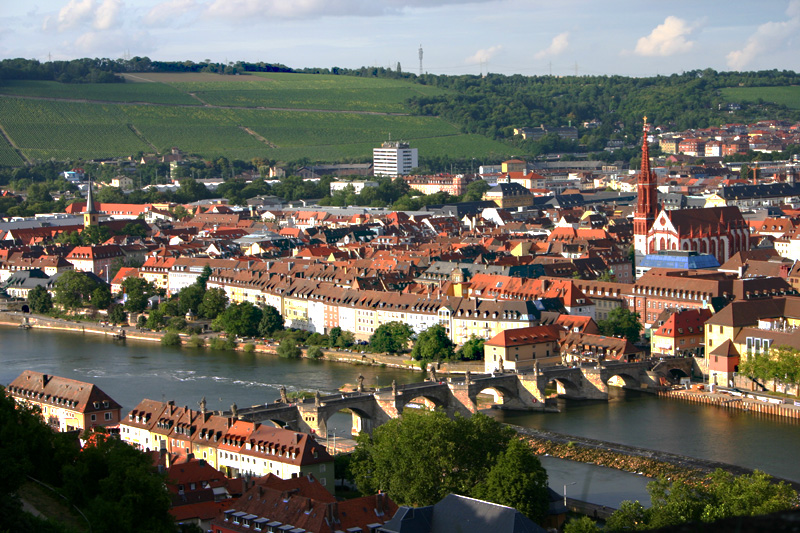
Würzburg

Würzburg


Würzburg is a city in the region of Franconia, Northern Bavaria, Germany. Located on the Main River, it is the capital of the Regierungsbezirk Lower Franconia. The regional dialect is Franconian.

Würzburg lies at about equal distance (120 kilometres, or 75 miles) between Frankfurt am Main and Nuremberg. Although the city of Würzburg is not part of the Landkreis Würzburg, i.e. the county or district of Würzburg, it is the seat of the district's administration.


A Bronze Age (Urnfield culture) refuge castle stood on the site of the present Fortress Marienberg. The former Celtic territory was settled by the Alamanni in the 4th or 5th century, and by the Franks in the 6th to 7th. Würzburg was a Merovingian seat from about 650, Christianized in 686 by Irish missionaries Kilian, Kolonat and Totnan. The city is mentioned in a donation by Hedan II to bishop Willibrord, dated 1 May 704, in castellum Virteburch. The Ravenna Cosmography lists the city as Uburzis at about the same time. The name is presumably of Celtic origin, but based on a folk etymological connection to the German word Würze "herb, spice", the name was Latinized asHerbipolis in the medieval period. Beginning in 1237, the city seal depicted the cathedral and a portrait of Saint Kilian, with the inscription SIGILLVM CIVITATIS HERBIPOLENSIS.

The first diocese was founded by Saint Boniface in 742 when he appointed the first bishop of Würzburg, Saint Burkhard. The bishops eventually created a duchy with its center in the city, which extended in the 12th century to Eastern Franconia. The city was the seat of several Imperial Diets, including the one of 1180, in which Henry the Lion was banned from the Empire and his duchy was handed over to Otto of Wittelsbach. Massacres of Jews took place in 1147 and 1298.

The first church on the site of the present Würzburg Cathedral was built as early as 788, and consecrated that same year by Charlemagne; the current building was constructed from 1040 to 1225 in Romanesque style. The University of Würzburg was founded in 1402 and re-founded in 1582. The citizens of the city revolted several times against the prince-bishop, until decisively defeated in 1400.

Würzburg was a center of the German Peasants' War. Notable prince-bishops include Julius Echter von Mespelbrunn (1573–1617) and members of the Schönborn family, who commissioned a great number of the monuments of today's city. The coat of arms of the city dates to the 16th century. It shows a banner on a tilted lance, formerly in a blue field, with the banner quarterly argent and gules (1532), later or and gules (1550). This coat of arms replaced the older seal of the city, showing Saint Kilian, from 1570.

The Würzburg witch trials, which occurred between 1626 and 1631, are one of the largest peace-time mass trials. In Würzburg, under Bishop Philip Adolf an estimated number between six hundred and nine hundred witches were burnt. In 1631, Swedish King Gustaf Adolf invaded the town and destroyed the castle. In 1720, the foundations of the Würzburg Residence were laid. The city passed to the Electorate of Bavaria in 1803, but two years later, in the course of the Napoleonic Wars, it became the seat of the Electorate of Würzburg, the later Grand Duchy of Würzburg. In 1814, the town became part of the Kingdom of Bavaria and a new bishopric was created seven years later, as the former one had been secularized in 1803.

On 16 March 1945, about 90% of the city full of civilians was destroyed in 17 minutes by 225 British Lancaster bombers during a World War II air raid. All of the city's churches, cathedrals, and other monuments were heavily damaged or destroyed. The city center, which dated from medieval times, was totally destroyed in a firestorm in which 5,000 people perished. Over the next 20 years, the buildings of historical importance were painstakingly and accurately replicated. The citizens who rebuilt the city immediately after the end of the war were mostly women – Trümmerfrauen ("rubble women") – because the men were either dead or taken prisoner of war. In comparison, Würzburg was destroyed to a larger extent than was Dresden in a firebombing the previous month.

On April 3, 1945, Würzburg was attacked by the US 12th Armored Division and US 42nd Infantry Division in a series of frontal assaults masked by smokescreens. The battle continued until the final German resistance was defeated 5 April 1945.

After the war, Würzburg was host to the U.S. Army's 3rd Infantry Division, 1st Infantry Division, U.S. Army Hospital and various other U.S. military units that maintained a presence in Germany. The U.S. units were withdrawn from Würzburg in 2008, bringing an end to over 60 years of U.S. military presence in Würzburg.

Würzburg is home of the oldest Pizzeria in Germany. Nick di Camillo opened his restaurant named "Bier- und Speisewirtschaft Capri" on 24 March 1952. Mr Camillo received the honor of the Italian Order of Merit.

There are some great restaurants in Würzburg, catering for all spectrums. At the highest end is the Schloss Steinburg. Situated a few kilometres north west from the centre of town, it is perched above a vineyard overlooking the river Main, the town, and with great views across to the Marienberg. Prices are naturally at the high end, but for fabulous food, great views, and an unforgettable ambiance - this is the place.

Great restaurants in the town centre include the Altemainmuehle, the Burgerspital, the Juliuspital and Stachel. All serve excellent food in rustic settings with by no means unreasonable prices. Service is great and you can be guaranteed a great meal.

It musn't be forgetten that Würzburg is a student town, so local establishments cater accordingly. These tend to be situated in the southern sector of the town on Sanderstrasse. Recommended are Unicafe (on the corner of Neubaukirche and Sanderstrasse), Cafe Muck and Cafe Kult( both Sanderstrasse). Here you can expect a good honest meal at very reasonable prices in a freindly atmosphere.

Takeaways include Tigris, Pinar as well as other Indian and Chinese establishments. Best Doner in town is at the West end of the AlteMainbrucke, it is called MC' Doner. Fresh pitas regularly.

The local brewery, Würzburger Hofbraeu, brews excellent wheat beer (Weissbier), which carries the name of a 1600s bishop of Würzburg, Julius Echter. Basically this beer is served for you in almost all the local bars, if you order a hefe.
Germany may be world renowned for its beer, but its wine is its hidden treasure. Franconian wine is amongst the best in the country and Wuerzburg has been growing grapes since its first contact with the Romans. Be sure to pick up a memory that will last by picking up a bottle of wine. Franconian wine is often sold in special bottles named "Bocksbeutel". Normally having 3/4 litre there also exist smaller ones with 3/8 litre. These bottles look small and fat. If you do not know much about wine, buy it directly from the winegrowers or from small shops which sell only wine.

Würzburger Residenz


                                                        Würzburg’s Top 5:
       
  1. Würzburg Cathedral is a Roman Catholic cathedral dedicated to Saint Kilian. It is the seat of the Bishop of Würzburg. The present cathedral, built from 1040 onwards by Bishop Bruno of Würzburg, reckoned to be the fourth largest Romanesque basilica in Germany, is the third church on the site: the previous two, built in about 787 and 855, were respectively destroyed and severely damaged by fire. After Bruno's accidental death in 1045, his successor Adalbero completed the building in 1075.
    The side aisles were remodelled in about 1500 in the Late Gothic style. The stuccoist Pietro Magno decorated the cathedral in Baroque stucco work in 1701. The greater part of the building collapsed in the winter of 1946 in consequence of the bombing of Würzburg on 16 March 1945. Reconstruction was completed in 1967, in the course of which the Baroque components were removed in favour of a re-Romanisation. The new interpretation emphasizes the contrast between the surviving historical parts of the structure, resulting in a sometimes controversial combination of predominantly Romanesque with modern and Baroque elements. The Neo-Romanesque west front with a rose window, the tripartite gallery and the opening for the clock were combined during the reconstruction with a plain pumice stone wall, and revealed again during renovation work up to November 2006.
  2. The Würzburg Residence (German: Würzburger Residenz) is a palace in Würzburg. Johann Lukas von Hildebrandt and Maximilian von Welsch, representants of the Austrian/South German Baroque were involved in the construction, as well as Robert de Cotte and Germain Boffrand, who were followers of the French Style. Balthasar Neumann, architect of the court of the Bishop of Würzburg, was the principal architect of the Residenz, which was commissioned by the Prince-Bishop of Würzburg Johann Philipp Franz von Schönborn and his brother Friedrich Carl von Schönborn in 1720, and completed in 1744. The Venetian painter Giovanni Battista Tiepolo, assisted by his son, Domenico, painted frescoes in the building. Interiors include the grand staircase, the chapel, and the grand salon. The building was dubbed the "nicest parsonage in Europe" by Napoleon. It was heavily damaged during World War II, and restoration has been in progress since 1945.
  3. Würzburg's Old Main Bridge (Alte Mainbrücke) was built 1473–1543 to replace the destroyed Romanesque bridge that had dated from 1133. In two phases, beginning in 1730, the bridge was adorned with statues of saints and historically relevant figures. The bridge shows similarities to the Charles Bridge in Prague.  
  4. The Museum im Kulturspeicher is a municipal art museum located at Veitshöchheimer Strasse 5, Würzburg. The museum opened in 2002 within a converted river-side warehouse that provides 3,500 m² of exhibit space in 12 rooms. It contains two distinct collections: the municipal art collection, founded in 1941 as the Städtische Gallerie and originally located in Hofstraße; and the Peter C. Ruppert Collection of European concrete art from World War II to the present day. The municipal collection exhibits regional art, primarily from Franconia and Southern Germany, ranging from Biedermeier-style portraits and landscapes of the first half of the 19th century, through German impressionism and painters of the Berlin Secession, as well as members of the Weimar Saxon-Grand Ducal Art School. It also includes works by Bauhaus painter Hans Reichel and works from the estate of sculptor Emy Roeder, as well as about 30,000 graphics works.
  5. Marienberg Fortress  is a prominent landmark on the Main river in Würzburg. The mighty Fortress Marienberg is the symbol of Würzburg and served as a home of the prince-bishops for nearly five centuries. It has been a fort since ancient times. After Gustavus Adolphus of Sweden conquered the area in 1631, the castle was reconstructed in the Baroque style. Today, it is a park and museum.


Thursday, 8 November 2012

Ulm

Ulm


Ulm is a city in the federal German state of Baden-Württemberg, situated on the River Danube. The city forms an urban district of its own and is the administrative seat of the Alb-Donau district. Ulm, founded around 850, is rich in history and traditions as a former Free Imperial City. Today, it is an economic centre due to its varied industries, and it is the seat of a university (University of Ulm, founded in 1967). Internationally, Ulm is primarily known for having the church with the tallest steeple in the world, the Gothic minster and as the birthplace of Albert Einstein.


The oldest traceable settlement of the Ulm area began in the early Neolithic period, around 5000 BC. Settlements of this time have been identified at the villages of Eggingen and Lehr, today districts of the city. In the city area of Ulm proper, the oldest find dates from the late Neolithic period. Ulm is mentioned in records dating to as early as 854. The city was declared an Imperial City by Friedrich Barbarossa in 1181.

At first, Ulm's significance was due to the privilege of a Königspfalz, a place of accommodation for the medieval German kings and emperors on their frequent travels. Later, Ulm became a city of traders and craftsmen. One of the most important legal documents of the city, an agreement between the Ulm patricians and the trade guilds, dates from 1397. This document, considered an early city constitution, and the beginning of the construction of an enormous church, financed by the inhabitants of Ulm themselves rather than by the church, demonstrate the assertiveness of Ulm's mediæval citizens. Ulm blossomed during the 15th and 16th centuries, mostly due to the export of high-quality textiles. The city was situated at the crossroads of important trade routes extending to Italy. These centuries, during which many important buildings were erected, also represented the zenith of art in Ulm, especially for painters and sculptors like Hans Multscher and Jörg Syrlin the Elder. During the Reformation, Ulm became Protestant (1530). With the establishment of new trade routes following the discovery of the New World (16th century) and the outbreak and consequences of the Thirty Years' War (1618–48), the city began to decline gradually. Around 1700, it was alternately invaded several times by French and Bavarian soldiers.

In the wars following the French Revolution, the city was alternately occupied by French and Austrian forces, with the former ones destroying the city fortifications. In 1803, it lost the status of Imperial City and was absorbed into Bavaria. During the campaign of 1805, Napoleon managed to trap the invading Austrian army of General Mack and forced it to surrender in the Battle of Ulm. In 1810, Ulm was incorporated into the Kingdom of Württemberg and lost its districts on the other bank of the Danube, which came to be known as Neu-Ulm (New Ulm).

In the mid-19th century, the city was designated a fortress of the German Confederation with huge military construction works directed primarily against the threat of a French invasion. The city became an important centre of industrialisation in southern Germany in the second half of the 19th century, its built-up area now being extended beyond the medieval walls. The construction of the huge minster, which had been interrupted in the 16th century for economic reasons, was resumed and eventually finished (1844–91) in a wave of German national enthusiasm for the Middle Ages.

From 1933 to 1935, a concentration camp primarily for political opponents of the regime was established on the Kuhberg, one of the hills surrounding Ulm. The Jews of Ulm, around 500 people, were first discriminated against and later persecuted; their synagogue was torn down after Kristallnacht in November 1938. The sole RAF strategic bombing during World War II against Ulm occurred on December 17, 1944, against the 2 large lorry factories of Magirus-Deutz and Kässbohrer, as well as other industries, barracks, and depots in Ulm. The Gallwitz Barracks and several military hospitals were among 14 Wehrmacht establishments destroyed. The raid killed 707 Ulm inhabitants and left 25,000 homeless and after all the bombings, over 80% of the medieval city centre lay in ruins.

Most of the city was rebuilt in the plain and simple style of the 1950s and 1960s, but some of the historic landmark buildings have been restored. Due to its almost complete destruction in 1944, the Hirschstraße part of the city primarily consists of modern architecture. Ulm experienced substantial growth in the decades following World War II, with the establishment of large new housing projects and new industrial zones. In 1967, Ulm University was founded, which proved to be of great importance for the development of the city. Particularly since the 1980s, the transition from classical industry towards the high-tech sector has accelerated, with, for example, the establishment of research centres of companies like Daimler, Siemens and Nokia and a number of small applied research institutes near the university campus. The city today is still growing, forming a twin city of 170,000 inhabitants together with its neighbouring Bavarian city of Neu-Ulm, and seems to benefit from its central position between the cities of Stuttgart and Munich and thus between the cultural and economic hubs of southern Germany.


                                                        Ulm’s Top 5:
       
  1. Ulm Minster is a Lutheran church located in Ulm, Germany. Although sometimes referred to as Ulm Cathedral because of its great size, the church is not a cathedral as it has never been the seat of a bishop. Ulm Minster, like Cologne Cathedral, was begun in the Gothic era and not completed until the late 19th century. It is the tallest church in the world, and the 4th tallest structure built before the 20th century, with a steeple measuring 161.5 metres (530 ft) and containing 768 steps. From the top level at 143 m (469 ft) there is a panoramic view of Ulm in Baden-Württemberg and Neu-Ulm in Bavaria and, in clear weather, a vista of the Alps from Säntis to the Zugspitze. The final stairwell to the top (known as the third Gallery) is a tall, spiraling staircase that has barely enough room for one person.
  2. Wiblingen Abbey was a former Benedictine abbey which was later used as barracks. Today its buildings house several departments of the medical faculty of the University of Ulm. The former abbey is located south of the confluence of the rivers Danube and Iller, south of the city of Ulm in the German state of Baden-Württemberg. Administratively, the former independent village of Wiblingen now belongs to the city of Ulm. The abbey is part of the Upper Swabian Baroque Route.
  3. The Rathaus (Town Hall), built in 1370, featuring some brilliantly-coloured murals dating from the mid-16th century. On the gable is an astronomical clock dating from 1520. Restored after serious damage in 1944.
  4. Albert Einstein Memorial - A small memorial at the site of the house where Albert Einstein was born in the Bahnhofstraße, between the present-day newspaper offices and the bank. The house itself and the whole district was destroyed in the firebombing of 1944.
  5. Stadtbibliothek, the building of the public library of Ulm was erected by Gottfried Böhm in the form of a glass pyramid and is situated directly adjacent to the town hall.


Find the best hotel deals with HotelsCombined.com

Friday, 12 October 2012

Trier

Trier


Trier, historically called in English Treves, is a city in Germany on the banks of the Moselle. It is the oldest city in Germany, founded in or before 16 BC. Trier lies in a valley between low vine-covered hills of ruddy sandstone in the west of the state of Rhineland-Palatinate, near the border with Luxembourg and within the important Mosel wine region.

The city is the oldest seat of a Christian bishop north of the Alps. In the Middle Ages, the Archbishop of Trier was an important prince of the church, as the Archbishopric of Trier controlled land from the French border to the Rhine. The Archbishop also had great significance as one of the seven electors of the Holy Roman Empire.


According to the legendarium recorded in the 12th-century Gesta Treverorum, the city was founded by an eponymous otherwise unrecorded Trebeta, an Assyrian prince, placing the city's founding legend centuries before and independently of ancient Rome: a medieval inscription on the facade of the Red House in Trier market,

ANTE ROMAM TREVIRIS STETIT ANNIS MILLE TRECENTIS.PERSTET ET ÆTERNA 
PACE FRVATVR. AMEN.

"Thirteen hundred years before Rome, Trier stood / may it stand on and enjoy eternal peace, amen," reflects the proud city tradition. Further embroidery in the monkish Gesta made of Trebeta the son of Ninus, a "King of Assyria" imagined by the ancient Greeks, by a wife prior to his marriage to the equally non-historical Queen Semiramis. His stepmother, Semiramis, despised him and when she took over the kingdom after the death of his father, Ninus, Trebeta left Assyria and went to Europe. After wandering for a time, he led a group of colonizers to the site of Trier. Upon his death, his body was cremated on Petrisberg by the people of Trier. The image of "Trebeta" became an icon of the city during the Middle Ages.

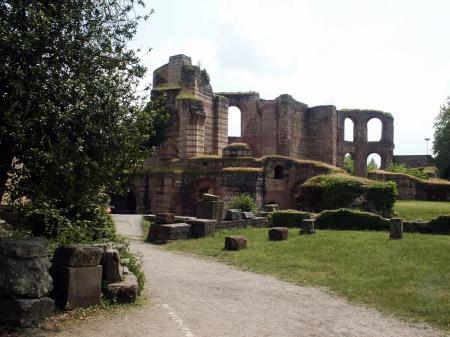
In historical time, the Roman Empire subdued the Treveri in the 1st century BC and established Augusta Treverorum (Lit: August (Regal, noble) [City] of the Treveri) in 30 BC. The name is likely to be taken from the title Augustus held by the Princeps or head of state at the time, Augustus Caesar. The city later became the capital of the Roman province of Gallia Belgica, as well as the Roman prefecture of Gaul. It covered 282 ha within its walls and may have had as many as 70,000 inhabitants. The Porta Nigra is counted among the Roman architecture of the city. A residence of the Western Roman Emperor, Roman Trier was the birthplace of Saint Ambrose. Sometime between 395 and 418 the Roman administration moved the staff of Pretorian Prefecture from the city to Arles. The city continued to be inhabited, but was not as prosperous as before, because of the absence of 2,000 staff members of the Prefecture and military. However, the city remained the seat of a governor and had state factories for the production of ballistae and armor, and a wool mill for uniforms for the troops, clothing for the civil service and high-quality garments for the Court. Northern Gaul was held by the Romans along a line from north of Cologne to the coast at Boulogne through what is today southern Belgium until 460. South of this line, Roman control was firm, as evidenced by the continuing operation of the imperial arms factory at Amiens.

The Franks seized Trier from Roman administration in 459 AD. In 870, it became part of Eastern Francia, which developed into the Holy Roman Empire. Relics of Saint Matthias brought to the city initiated widespread pilgrimages. The bishops of the city grew increasingly powerful and the Archbishopric of Trier was recognized as an electorate of the empire, one of the most powerful states of Germany. The University of Trier was founded in the city in 1473.

In the 17th century, the Archbishops and Prince-Electors of Trier relocated their residences to Philippsburg Castle in Ehrenbreitstein, near Koblenz. A session of the Reichstag was held in Trier in 1512, during which the demarcation of the Imperial Circles was definitively established.

In the 17th and 18th centuries, Trier was sought after by France, who invaded during the Thirty Years' War, the War of the Grand Alliance, the War of the Spanish Succession, and the War of the Polish Succession. France succeeded in finally claiming Trier in 1794 during the French Revolutionary Wars, and the electoral archbishopric was dissolved. After the Napoleonic Wars ended in 1815, Trier passed to the Kingdom of Prussia. Karl Marx was born in the city in 1818.

As part of the Prussian Rhineland, Trier developed economically during the 19th century. The city rose in revolt during the revolutions of 1848 in the German states, although the rebels were forced to concede. It became part of the German Empire in 1871.

In June 1940 over 60,000 British prisoners of war, captured at Dunkirk and Northern France, were marched to Trier, which became a staging post for British soldiers headed for German prisoner-of-war camps. Trier was heavily bombed and bombarded in 1944 during World War II. The city became part of the new state of Rhineland-Palatinate after the war. The university, dissolved in 1797, was restarted in the 1970s, while the Cathedral of Trier was reopened in 1974. Trier officially celebrated its 2,000th anniversary in 1984.


                                                       Trier’s Top 5:
       
  1. The Cathedral of Saint Peter is the oldest cathedral in Germany. The edifice is notable for its extremely long life span under multiple different eras each contributing some elements to its design, including the center of the main chapel being made of Roman brick laid under the direction of Saint Helen, resulting in a cathedral added on to gradually rather than rebuilt in different eras. Its dimensions, 112.5 by 41 m, make it the largest church structure in Trier. Since 1986 it has been on the UNESCO list of World Heritage Sites. The structure is raised upon the foundations of Roman buildings of Augusta Treverorum. Following the conversion of the Emperor Constantine the Bishop Maximin of Trier (329-346) coordinated the construction of the grandest ensemble of ecclesiastical structures in the West outside Rome: on a groundplan four times the area of the present cathedral no less than four basilicas, a baptistery and outbuildings were constructed; the four piers of the crossing formed the nucleus of the present structure. The fourth century structure was left in ruins by the Franks and rebuilt. Normans destroyed the structure again in 882. Under Bishop Egbert the Dom was restored once more.
  2. The Porta Nigra (Latin for black gate) is a large Roman city gate in Trier. It is today the largest Roman city gate north of the Alps and has been designated a World Heritage Site. The name Porta Nigra originated in the Middle Ages due to the darkened color of its stone; the original Roman name has not been preserved. Locals commonly refer to the Porta Nigra simply as Porta. The Porta Nigra was built in grey sandstone between 186 and 200 AD. The original gate consisted of two four-storied towers, projecting as near semicircles on the outer side. A narrow courtyard separated the two gate openings on either side. For unknown reasons, however, the construction of the gate remained unfinished. For example, the stones at the northern (outer) side of the gate were never abraded, and the protruding stones would have made it impossible to install movable gates. Nonetheless, the gate was used for several centuries until the end of the Roman era in Trier.
  3. St. Matthias' Abbey is a Benedictine monastery in Trier. The abbey church, a Romanesque basilica, is a renowned place of pilgrimage because of the tomb of Saint Matthias the Apostle, after whom the abbey is named, located here since the 12th century, and the only burial of an apostle in Germany and north of the Alps. The abbey was originally named after Saint Eucharius, first Bishop of Trier, whose tomb is in the crypt. The church has been given the status of a basilica minor.
  4. The Basilica of Constantine. or Aula Palatina, is a Roman palace basilica that was built by the emperor Constantine (306–337 AD) at the beginning of the 4th century.
    Today it is owned and used as church by a congregation within the Evangelical Church in the Rhineland. The basilica contains the largest extant hall from antiquity ranked a World Heritage Site. The room has a length of 67 m, a width of 26.05 m and a height of 33 m. The Aula Palatina was built around 310 AD as a part of the palace complex. Originally it was not a free standing building, but had other smaller buildings (such as a forehall, an entrance vestibule and some service buildings) attached to it. The Aula Palatina was equipped with a floor and wall heating system (hypocaust). During the Middle Ages, it was used as the residence for the bishop of Trier. For that, the apse was redesigned into living quarters and pinnacles were added to the top of its walls. In the 17th century, the archbishop Lothar von Metternich constructed his palace just next to the Aula Palatina and incorporating it into his palace some major redesign was done. Later in the 19th century, Frederick William IV of Prussia ordered the building to be restored to its original Roman state, which was done under the supervision of the military architect Carl Schnitzler. In 1856, the Aula Palatina became a Protestant church. In 1944, the building burned due to an air raid of the allied forces during World War II. When it was repaired after the war, the historical inner decorations from the 19th century were not reconstructed, so that the brick walls are visible from the inside as well.
  5. The Roman Bridge is an ancient structure over the Mosel. It is the oldest standing bridge in the country. The nine bridge pillars date from the 2nd century AD. The upper part was renewed twice, in the early 12th and in the early 18th century, after suffering destruction in war.


Monday, 17 September 2012

Stuttgart

Stuttgart


Stuttgart is the capital of the state of Baden-Württemberg in southern Germany. The sixth-largest city in Germany. The city lies at the centre of a densely populated area, surrounded by a ring of smaller towns. This area called Stuttgart Region has a population of 2.7 million. Stuttgart's urban area has a population of roughly 1.8 million, making it Germany's seventh largest. With over 5 million inhabitants, the greater Stuttgart Metropolitan Region is the fourth-biggest in Germany after the Rhine-Ruhr area, Berlin/Brandenburg and Frankfurt/Rhine-Main.

Stuttgart is spread across a variety of hills (some of them vineyards), valleys and parks – unusual for a German city and often a source of surprise to visitors who primarily associate the city with its industrial reputation as the 'cradle of the automobile'. Stuttgart has the status of Stadtkreis, a type of self-administrating urban county. It is also the seat of the state legislature, the regional parliament, local council and the Protestant State Church in Württemberg as well as one of the two co-seats of the bishop of the Roman Catholic Diocese of Rottenburg-Stuttgart.


The first known settlement of Stuttgart was around the end of the 1st century AD with the establishment of a Roman fort in the modern district of Cannstatt on the banks of the river Neckar. Early in the 3rd century the Romans were pushed by the Alamanni back past the Rhine and the Danube. Although nothing is known about Cannstatt during the period of Barbarian Invasion it is believed that the area remained inhabited as it is mentioned in Abbey of St. Gall archives dating back to 700 AD. 

Stuttgart itself was probably founded around 950 AD shortly before the Battle of Lechfeld by Duke Liudolf of Swabia, one of the sons of Holy Roman Emperor Otto I the Great. The town was used for breeding cavalry horses in fertile meadows at the very centre of today's city, although recent archaeological excavations indicate that this area was already home to Merovingian farmers.

A gift registry from Hirsau Abbey dated around 1160 mentioned 'Hugo de Stuokarten', confirmation of the existence of the Stuttgart of today.

Between this time and the 14th century, the settlement was owned by the Margraves of Baden and the Württemberg towns of Backnang and Besigheim.

Around 1300, Stuttgart became the residence of the Counts of Württemberg, who expanded the growing settlement into the capital of their territory (Territorialstaat). Stuttgart was elevated to the status of city in 1321 when it became the official royal residence. The territory around Stuttgart was known as the County of Württemberg before the counts were elevated to dukes by the Holy Roman Emperor in 1495, when Stuttgart became the Duchy capital and Ducal residence.

The name Württemberg originates from a steep hill in Stuttgart, formerly known as Wirtemberg.

In the 18th century, Stuttgart temporarily surrendered its residence status after Eberhard Ludwig founded Ludwigsburg to the north of the city. In 1775, Karl Eugen requested a return to Stuttgart, ordering the construction of the New Castle. 

In 1803, Stuttgart was proclaimed capital of the Electorate of Württemberg until Napoleon Bonaparte's break-up of the Holy Roman Empire in 1805 when Stuttgart became capital of the Kingdom of Württemberg. The royal residence was expanded under Frederick I of Württemberg although many of Stuttgart's most important buildings, including the Wilhelm Palace, Katharina Hospital, the State Gallery, the Villa Berg and the Königsbau were built under the reign of King Wilhelm I. The jubilee column (erected between 1841 and 1846) on the Schlossplatz is located on the orthodromic distance line from the church of St. Michael in Roeselare over the Kokino observatory to the Dome of the Rock in Jerusalem.

Stuttgart's development as a city was impeded in the 19th century by its location. It was not until the opening of the Main Station in 1846 that the city underwent an economic revival. The population at the time was around 50,000.

During the revolution of 1848/1849, a democratic pan-German national parliament (Frankfurt Parliament) was formed in Frankfurt to overcome the division of Germany. After long discussions, the parliament decided to offer the title of the German emperor to King Frederick William IV of Prussia. As the democratic movement became weaker, the German princes regained control of their independent states. Finally, the Prussian king declined the revolutionaries' offer. The members of parliament were driven out of Frankfurt and the most radical members (who wanted to establish a republic) fled to Stuttgart. A short while later, this rump parliament was dissolved by the Württemberg military.

By 1871 Stuttgart boasted 91,000 inhabitants, and by the time Gottlieb Daimler invented the automobile in a small workshop in Cannstatt, the population had risen rapidly to 176,000.

In 1871, as an autonomous kingdom, Württemberg joined the German Empire created by Otto von Bismarck, Prime Minister of Prussia, during the unification of Germany.

At the end of the First World War the Württemberg monarchy broke down: William II of Württemberg refused the crown – but also refused to abdicate – under pressure from revolutionaries who stormed the Wilhelm Palace. The Free State of Württemberg was established, as a part of the Weimar Republic. Stuttgart was proclaimed the capital.

In 1920 Stuttgart became the seat of the German National Government (after the administration fled from Berlin, see Kapp Putsch).

Under the Nazi regime, Stuttgart began the deportation of its Jewish inhabitants in 1939. Around sixty percent of the German Jewish population had fled by the time restrictions on their movement were imposed on 1 October 1941, at which point Jews living in Württemberg were forced to live in 'Jewish apartments' before being 'concentrated' on the former Trade Fair grounds in Killesberg. On 1 December 1941 the first deportation trains were organised to Riga. Only 180 Jews from Württemberg held in concentration camps survived.

During the period of Nazi rule, Stuttgart held the "honorary title" Stadt der Auslands deutschen (City of the Germans living outside of the Reich).

During World War II, the centre of Stuttgart was almost completely destroyed in Allied air raids. Some of the most severe bombing took place in 1944 carried out by Anglo-American bombers. The heaviest raid took place on 12 September 1944 when the Royal Air Force bombed the old town of Stuttgart dropping over 184,000 bombs including 75 blockbusters. More than 1000 people perished in the resulting firestorm. In total Stuttgart was subjected to 53 bombing raids, resulting in the destruction of 68% of all buildings and the deaths of 4477 people.

The Allied ground advance into Germany reached Stuttgart in April 1945. The French 5th Armored Division, French 2nd Moroccan Infantry Division and French 3rd Algerian Infantry Division, began their drive on Stuttgart on 18 April 1945. Two days later, the French forces coordinated with the US Seventh Army for the employment of US VI Corps heavy artillery to barrage the city. The French 5th Armored Division then captured Stuttgart on 21 April 1945, encountering little resistance. The French army occupied Stuttgart until the city was transferred to the American military occupation zone in 1946.


The automobile and motorcycle were invented in Stuttgart (by Karl Benz and subsequently industrialised in 1887 by Gottlieb Daimler and Wilhelm Maybach at the Daimler Motoren Gesellschaft). As a result it is considered by many to be the starting point of the worldwide automotive industry and is sometimes referred to as "The cradle of the automobile". Mercedes-Benz, Porsche and Maybach are all produced in Stuttgart and nearby towns. Thus, local residents lovingly nicknamed their home city "Benztown". The very first prototypes of the VW Beetle were manufactured in Stuttgart based on a design by Ferdinand Porsche. Also automotive parts giants Bosch and Mahle are based in the city. A number of auto-enthusiast magazines are published in Stuttgart.

Stuttgart is the only city in Germany where wine is grown within the urban area, mainly in the districts of Rotenberg, Uhlbach and Untertürkheim.

Wine-growing in the area dates back to 1108 when, according to State archives, Blaubeuren Abbey was given vineyards in Stuttgart as a gift from 'Monk Ulrich'. In the 17th century the city was the third largest German wine-growing community in the Holy Roman Empire. Wine remained Stuttgart's leading source of income well into the 19th century.

Stuttgart is still one of Germany's largest wine-growing cities with more than 400 hectares of vine area, thanks in main to its location at the centre of Germany's fourth largest wine region, the Württemberg wine growing area which covers 11,522 hectares (28,470 acres) and is one of only 13 official areas captured under German Wine law. The continuing importance of wine to the local economy is marked every year at the annual wine festival ('Weindorf').

Stuttgart also has several famous breweries such as Stuttgarter Hofbräu, Dinkelacker, and Schwaben Bräu.


                                                        Stuttgart’s Top 5:
       
  1. The Stiftskirche Stuttgart (Collegiate Church) is an inner-city church. It is the main church of the Evangelical-Lutheran Church in Württemberg (Evangelische Landeskirche in Württemberg) as well as the parish church of the evangelical (Lutheran) inner-city church district of Stuttgart. Structures of a small Romanesque church from the 10th and 11th centuries could recently be traced as having been exactly in today's church outline. In 1240, a stately three-naved church with two towers is built in the Romanic style, apparently by the Counts of Württemberg who from around that time are residing in the nearby Old Castle. From the end of the 13th century a double tomb is preserved in today's South tower chapel. It contains the remains of Ulrich I, Count of Württemberg and his second wife, Countess of Württemberg, Agnes von Schlesien-Liegnitz (both died in 1265). With Stuttgart the new residence of the rulers of Württemberg, a new Gothic chancel was built from 1321 to 1347. To it was added a Late Gothic nave in the second half of the 15th century by Ulrich V. In 1500, a coloured, later (from the 19th century) golden pulpit was added.With the adoption of the Lutheran Protestant Reformation in Württemberg in 1534, all pictures and altars are removed from the naves, pewage and a gallery is added. The tombstones are moved to the interior of the church.
  2. The Old Castle (German: Altes Schloss) is located in the centre of Stuttgart. It dates back to the 10th century. The first castle dated back to around 950 when Stuttgart was a settlement for breeding horses. In the 14th century it became the residence of the sovereign Counts of Württemberg. In the 16th century dukes Christopher and Ludwig ordered it to be converted into a Renaissance castle. Moats around the castle were removed in the 18th century. In 1931, the castle was severely damaged by a fire and before it could be reconstructed it was damaged by bombing in the Second World War. The castle was finally renovated in 1969. Today the Old Castle is home to the Württemberg State Museum. King Charles I of Württemberg and his wife Olga are buried beneath the castle church. The inner courtyard houses a monument to Eberhard I. The Old Castle stands adjacent to its replacement, the New Castle, which was built in the late 18th century. On the Karlsplatz side of the Old Castle is a museum dedicated to the memory of Claus Schenk Graf von Stauffenberg a former resident of Stuttgart who attempted to assassinate Adolf Hitler on 20 July 1944.
  3. The New Palace (German: "das Neue Schloss", which may also be translated as New Castle) is a building which stands on the south edge of Schlossplatz, the central square in Stuttgart, Germany. The castle is built in late Baroque style. From 1746 to 1797 and from 1805 to 1807, it served as a residence of the kings of Württemberg. (At other times, the Ludwigsburg Palace, a few miles to the north was the favoured residence of the royal family). The palace stands adjacent to the Old Castle. The castle was almost completely destroyed by Allied bombing during the Second World War and was reconstructed between 1958 and 1964. During this time most of the inside of the castle was also restored and the building was used by the Baden-Württemberg State Parliament. Today it is used by the State Ministries of Finance and Education. Public tours of the building are only permitted by special arrangement. Schlossplatz stands next to two other popular squares in Stuttgart:Karlspatz to the south and Schillerplatz to the south west. The future German President, Richard von Weizsäcker was born in the New Castle on April 15, 1920.
  4. The Mercedes-Benz Museum is an automotive museum housed in Stuttgart, Germany. Stuttgart is home to the Mercedes-Benz brand and the international headquarters of Daimler AG. The current building, which stands directly outside the main gate of the Daimler factory in Stuttgart, was designed by UN Studio. It is based on a unique cloverleaf concept using three overlapping circles with the center removed to form a triangular atrium. The building was completed and opened on 19 May 2006. Previously, the museum was housed in a dedicated building within the factory complex and visitors had in recent decades been transported from the main gate by a secured shuttle. The building's height and "double helix" interior were designed to maximise space, providing 16,500 square metres (178,000 sq ft) of exhibition space on a footprint of just 4,800 square metres (52,000 sq ft). The museum contains more than 160 vehicles, some dating back to the very earliest days of the motor engine. The vehicles are maintained by the Mercedes-Benz Classic Center of Fellbach. The museum provides visitors with free audio tours in a variety of languages. In 2007 the museum was visited by 860,000 people.
  5. The Staatstheater Stuttgart (Stuttgart State Theatre) are a multi-branch-theatre with the branches Oper Stuttgart (Opera Stuttgart), Stuttgart Ballet (Stuttgarter Ballett) and Stuttgart Drama Theatre (Schauspiel Stuttgart) in Stuttgart, Germany. Designed by the noted Munich architect, Max Littmann, who won a competition to create new royal theatres, the building was constructed between 1909 and 1912 as the Königliche Hoftheater, royal theatres of the Kingdom of Württemberg with a Grosses Haus and a Kleines Haus. In 1919 the theatres were renamed the Landestheater, and later, theStaatstheater. The Small House was destroyed by bombing during the Second World War and, today, the site is occupied by a new Kleines Haus designed by Hans Volkart, which opened in 1962.


HotelsCombined.com