Translate

Showing posts with label belgium. Show all posts

Thursday, 29 November 2012

Bruges

Bruges


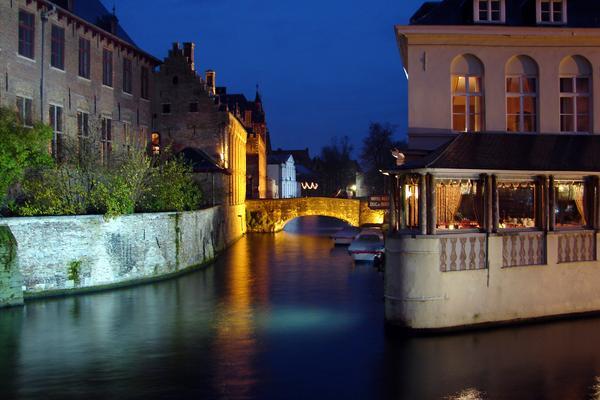
Bruges is the capital and largest city of the province of West Flanders in the Flemish Region of Belgium. It is located in the northwest of the country. The historic city centre is a prominent World Heritage Site of UNESCO.

Along with a few other canal-based northern cities, such as Amsterdam, it is sometimes referred to as "The Venice of the North". Bruges has a significant economic importance thanks to its port. At one time, it was the "chief commercial city" of the world.


Very few traces of human activity in Bruges date from the Pre-Roman Gaul era. The first fortifications were built after Julius Caesar's conquest of the Menapii in the first century BC, to protect the coastal area against pirates. The Franks took over the whole region from the Gallo-Romans around the 4th century and administered it as the Pagus Flandrensis. The Viking incursions of the ninth century prompted Baldwin I, Count of Flanders to reinforce the Roman fortifications; trade soon resumed with England and Scandinavia.

Bruges received its city charter on July 27, 1128 and new walls and canals were built. Since about 1050, gradual silting had caused the city to lose its direct access to the sea. A storm in 1134, however, re-established this access, through the creation of a natural channel at the Zwin. The new sea arm stretched all the way to Damme, a city that became the commercial outpost for Bruges.

Bruges had a strategic location at the crossroads of the northern Hanseatic League trade and the southern trade routes. Bruges was already included in the circuit of the Flemish and French cloth fairs at the beginning of the 13th century, but when the old system of fairs broke down the entrepreneurs of Bruges innovated. They developed, or borrowed from Italy, new forms of merchant capitalism, whereby several merchants would share the risks and profits and pool their knowledge of markets. They employed new forms of economic exchange, including bills of exchange (i.e. promissory notes) and letters of credit. The city eagerly welcomed foreign traders, most notably the Portuguese pepper and spice traders.

With the reawakening of town life in the twelfth century, a wool market, a woollens weaving industry, and the market for cloth all profited from the shelter of city walls, where surpluses could be safely accumulated under the patronage of the counts of Flanders. The city's entrepreneurs reached out to make economic colonies of England and Scotland's wool-producing districts. English contacts brought Normandy grain and Gascon wines. Hanseatic ships filled the harbor, which had to be expanded beyond Damme to Sluys to accommodate the new cog-ships. In 1277, the first merchant fleet from Genoa appeared in the port of Bruges, first of the merchant colony that made Bruges the main link to the trade of the Mediterranean. This development opened not only the trade in spices from the Levant, but also advanced commercial and financial techniques and a flood of capital that soon took over the banking of Bruges.

Such wealth gave rise to social upheavals, which were for the most part harshly contained by the militia. In 1302, however, after the Bruges Matins (the nocturnal massacre of the French garrison in Bruges by the members of the local Flemish militia on 18 May 1302), the population joined forces with the Count of Flanders against the French, culminating in the victory at the Battle of the Golden Spurs, fought near Kortrijk on July 11. The statue of Jan Breydel and Pieter de Coninck, the leaders of the uprising, can still be seen on the Big Market square. The city maintained a militia as a permanent paramilitary body. It gained flexibility and high prestige by close ties to a guild of organized militia, comprising professionals and specialized units. Militia men bought and maintained their own weapons and armour, accoding to their family status and wealth.
At the end of the 14th century, Bruges became one of the Four Members, along with Franc of Bruges, Ghent and Ypres. Together they formed a parliament, however they frequently quarrelled amongst themselves.

In the 15th century, Philip the Good, duke of Burgundy, set up court in Bruges, as well as Brussels and Lille, attracting a number of artists, bankers, and other prominent personalities from all over Europe. The weavers and spinners of Bruges were thought to be the best in the world, and the population of Bruges grew to 200,000 inhabitants at this time. This is also the time when Edward IV and Richard III of England spent time in exile here.

In the last half of the 19th century, Bruges became one of the world's first tourist destinations attracting wealthy British and French tourists. By 1909 it had in operation an association called 'Bruges Forward: Society to Improve Tourism.' After 1965 the original medieval city experienced a renaissance. Restorations of residential and commercial structures, historic monuments, and churches generated a surge in tourism and economic activity in the ancient downtown area. International tourism has boomed, and new efforts have resulted in Bruges being designated 'European Capital of Culture' in 2002. It attracts some 2 million tourists annually.

The port of Zeebrugge was built in 1907. The Germans used it for their U-boats in World War I. It was greatly expanded in the 1970s and early 1980s and has become one of Europe's most important and modern ports.

Restaurants are not always cheap or wonderfu in Bruges, although mussels and frites or fricadellen, frites with mayonnaise are outstanding here. Stay away from the central market place ("Grote Markt") and the Burg Square (e.g. the Tom Pouce Restaurant) when eating. Tourists are easy victims here. One tactic used by tourist traps is to present items (e.g. bread) as if they were free with your meal, then charge you exorbitantly for them. Even water may be charged at an exorbitant €6 for a small bottle.

You will, however, find great food if you wander off the beaten track. Find a street with more locals than tourists and ask somebody. The locals will be glad to help.


                                                        Bruges’ Top 5:
       
  1. The Church of Our Lady dates mainly from the 13th, 14th and 15th centuries. Its tower, at 122.3 meters in height, remains the tallest structure in the city and the second tallest brickwork tower in the world (the tallest being the St. Martin's Church in Landshut, Germany). In the choir space behind the high altar are the tombs of Charles the Bold, last Valois Duke of Burgundy, and his daughter, the duchess Mary. The gilded bronze effigies of both father and daughter repose at full length on polished slabs of black stone. Both are crowned, and Charles is represented in full armor and wearing the decoration of the Order of the Golden Fleece. The altarpiece of the large chapel in the southern aisle enshrines the most celebrated art treasure of the church—a white marble sculpture of the Madonna and Child created by Michelangelo around 1504. Probably meant originally for Siena Cathedral, it was purchased in Italy by two Brugean merchants, the brothers Jan and Alexander Mouscron, and in 1514 donated to its present home. The sculpture was twice recovered after being looted by foreign occupiers—French revolutionaries circa 1794 and Nazi Germany in 1944.
  2. The Belfry of Bruges, or Belfort, is a medieval bell tower in the historical centre of Bruges. One of the city's most prominent symbols, the belfry formerly housed a treasury and the municipal archives, and served as an observation post for spotting fires and other danger. A narrow, steep staircase of 366 steps, accessible by the public for an entry fee, leads to the top of the 83-metre-high building, which leans about a metre to the east. To the sides and back of the tower stands the former market hall, a rectangular building only 44 m broad but 84 m deep, with an inner courtyard. The belfry, accordingly, is also known as the Halletoren (tower of the halls).
  3. The Groeningemuseum is a municipal museum of Bruges. It houses a comprehensive survey of six centuries of Flemish and Belgian painting, from Jan van Eyck to Marcel Broodthaers. The museum's many highlights include its collection of "Flemish Primitive" art, works by a wide range of Renaissance and Baroque masters, as well as a selection of paintings from the 18th and 19th century neo-classical and realist periods, milestones of Belgian symbolism and modernism, masterpieces of Flemish expressionism and many items from the city's collection of post-war modern art.
  4. The Sint-Salvator Cathedral, the main church of the city, is one of the few buildings in Bruges that have survived the onslaught of the ages without damage. Nevertheless, it has undergone some changes and renovations. This church was not originally built to be a cathedral; it was granted the status in the 19th century. Since the 10th century the Sint-Salvator was a common parish church. At that time the St Donatian's Cathedral, which was located at the very heart of Bruges, opposite of the town hall, was the central religious building of the city. At the end of the 18th century the French occupiers of Bruges threw out the bishop of Bruges and destroyed the Sint-Donatius Church, which was his residence. In 1834, shortly after Belgium's independence in 1830, a new bishop was installed in Bruges and the Sint-Salvator church obtained the status of cathedral. However, the buildings external image did not resemble a cathedral back then: it was much smaller and less imposing than the nearby Onze-Lieve-Vrouwekerk and had to be adapted to its new role. Building a higher and more impressive tower was one of the viable options.
  5. The Basilica of the Holy Blood is a Roman Catholic minor basilica. Originally built in the 12th century as the chapel of the residence of the Count of Flanders, the church houses a venerated relic of the Holy Blood allegedly collected by Joseph of Arimathea and brought from the Holy Land by Thierry of Alsace, Count of Flanders. Built between 1134 and 1157, it was promoted to minor basilica in 1923. The 12th-century basilica is located in the Burg square and consists of a lower and upper chapel. The lower chapel dedicated to St. Basil the Great is a dark Romanesque structure that remains virtually unchanged. The venerated relic is in the upper chapel, which was rebuilt in the Gothic style during the 16th century and renovated multiple times during the 19th century in Gothic Revival style.


Wednesday, 21 November 2012

Ypres

Ypres


Ypres is a Belgian municipality located in the Flemish province of West Flanders. Though Ieper is the Dutch and local name, Ypres is most commonly used in English. The municipality comprises the city of Ypres and the villages of Boezinge, Brielen, Dikkebus, Elverdinge, Hollebeke, Sint-Jan, Vlamertinge, Voormezele, Zillebeke, and Zuidschote. Together, they count some 34,900 inhabitants.


Ypres is an ancient town, known to have been raided by the Romans in the first century BC.
During the Middle Ages, Ypres was a prosperous Flemish city with a population of 40,000, renowned for its linen trade with England, which was mentioned in the Canterbury Tales.

As the third largest city in the County of Flanders (after Ghent and Bruges) Ypres played an important role in the history of the textile industry. Textiles from Ypres could be found on the markets of Novgorod in Russia in the early 12th century. In 1241 a major fire ruined much of the old city. The powerful city was involved in important treaties and battles, including the Battle of the Golden Spurs, the Battle at Pevelenberg, The Peace of Melun and the Battle of Cassel.

The famous Cloth Hall was built in the thirteenth century. Also during this time cats, then the symbol of the devil and witchcraft, were thrown off Cloth Hall, possibly due to the belief that this would get rid of evil demons. Today, this act is commemorated with a triennial Cat Parade through town.

After the destruction of Thérouanne, Ypres became the seat of the new Diocese of Ypres in 1561, and Saint Martin's Church was elevated to cathedral status.

During the Norwich Crusade, led by the English bishop Henry le Despenser, Ypres was besieged from May to August 1383, until French relief forces arrived. On 25 March 1678 Ypres was conquered by the forces of Louis XIV of France. It remained French under the treaty of Nijmwegen and Vauban constructed his typical fortifications, that can still be seen today. In 1697, after the Treaty of Ryswick, Ypres was returned to the Spanish Crown.

During the War of the Spanish Succession, the Duke of Marlborough in 1709 intended to capture Ypres, at the time a major French fortress, but changed his mind due to the long time and effort it had taken him to capture Tournai and apprehension of disease spreading in his army in the poorly drained land around Ypres. In 1713 it was handed over to the Habsburgs, and became part of the Austrian Netherlands.

In 1782 the Austrian emperor Joseph II ordered parts of the walls torn down, making it easy for the French to take over the city during the first coalition war in 1794.

Ypres had long been fortified to keep out invaders. Parts of the early ramparts, dating from 1385, still survive near the Rijselpoort (Lille Gate). Over time, the earthworks were replaced by sturdier masonry and earth structures and a partial moat. Ypres was further fortified in 17th and 18th centuries while under the occupation of the Habsburgs and the French. Major works were completed at the end of the 17th century by the French military engineer Sebastien Le Prestre, Seigneur de Vauban. 

Ypres occupied a strategic position during World War I because it stood in the path of Germany's planned sweep across the rest of Belgium and into France from the north (the Schlieffen Plan). The neutrality of Belgium was guaranteed by Britain; Germany's invasion of Belgium brought the British Empire into the war. The German army surrounded the city on three sides, bombarding it throughout much of the war. To counterattack, British, French, and allied forces made costly advances from the Ypres Salient into the German lines on the surrounding hills.

Menin Gate


In the First Battle of Ypres (12 October to 11 November 1914), the Allies captured the town from the Germans. The Germans had used tear gas at the Battle of Bolimov on 3 January 1915. Their use of poison gas for the first time the on 22 April 1915 marked the beginning of the Second Battle of Ypres, which continued until 25 May 1915. They captured high ground east of the town. The first gas attack occurred against Canadian, British, and French soldiers; including both metropolitan French soldiers as well as Senegalese and Algerian tirailleurs (light infantry) from French Africa. The gas used was chlorine. Mustard gas, also called Yperite from the name of this city, was also used for the first time near Ypres, in the autumn of 1917.

Of the battles, the largest, best-known, and most costly in human suffering was the Third Battle of Ypres (21 July to 6 November 1917, also known as the Battle of Passchendaele), in which the British, Canadians, ANZAC, and French forces recaptured the Passchendaele Ridge east of the city at a terrible cost of lives. After months of fighting, this battle resulted in nearly half a million casualties to all sides, and only a few miles of ground won by Allied forces. During the course of the war the town was all but obliterated by the artillery fire.

English-speaking soldiers in that war often referred to Ieper/Ypres by the deliberate mispronunciation Wipers. British soldiers even published a wartime newspaper called the Wipers Times. The same style of deliberate mispronunciation was applied to other Flemish place names in the Ypres area for the benefit of British troops, such as Whyteshaete becoming White Sheet and Ploegsteert becoming Plug Street.

Ypres was one of the sites that hosted an unofficial Christmas Truce in 1914 between German and British soldiers.

After the war the town was rebuilt using money paid by Germany in reparations, with the main square, including the Cloth Hall and town hall, being rebuilt as close to the original designs as possible (the rest of the rebuilt town is more modern in appearance). The Cloth Hall today is home to In Flanders Fields Museum, dedicated to Ypres's role in the First World War.

Today, Ypres is a small city in the very western part of Belgium, the so-called Westhoek. Ypres these days has the title of "city of peace" and maintains a close friendship with another town on which war had a profound impact: Hiroshima. Both towns witnessed warfare at its worst: Ypres was one of the first places where chemical warfare was employed, while Hiroshima suffered the debut of nuclear warfare. The city governments of Ypres and Hiroshima advocate that cities should never be targets again and campaign for the abolition of nuclear weapons. The City of Ypres hosts the international campaign secretariat of Mayors for Peace, an international Mayoral organization mobilizing cities and citizens worldwide to abolish and eliminate nuclear weapons by the year 2020. Mayors for Peace 2020 Vision Campaign.


                                                        Ypres’ Top 5:
       
  1. Saint Martin's Cathedral or Saint Martin's Church was a cathedral and the seat of the former diocese of Ypres from 1561 to 1801. Although no longer a technically a cathedral, it is still often referred to as one, as is the case with many proto-cathedrals. At 102 metres (335 ft) tall, it is among the tallest buildings in Belgium. Construction started on the church in 1230, and was finished in 1370. There had previously been a Romanesque church in the area, dating from the 10th or 11th century. The diocese was originally part of the Diocese of Thérouanne, which had been established in the 7th or 8th century. In 1553 Charles V besieged the city of Thérouanne, then a French enclave in the Holy Roman Empire, in revenge for a defeat by the French at Metz. After he captured the city he razed the city. In 1557, as a result of the war damage to its see, the diocese was abolished. This led to a reform of sees at the Council of Trent, Council of Trent, and the bishopric of Thérouanne was split between the Diocese of Saint-Omer, the diocese of Boulogne and the Diocese of Ypres. With this, Saint Martin's Church was elevated to cathedral status, as it became the see of the new diocese.
  2. The Menin Gate Memorial to the Missing is a war memorial dedicated to the British and Commonwealth soldiers who were killed in the Ypres Salient of World War I and whose graves are unknown. The memorial is located at the eastern exit of the town and marks the starting point for one of the main roads out of the town that led Allied soldiers to the front line. Designed by Sir Reginald Blomfield and built by the British government, the Menin Gate Memorial was unveiled on 24 July 1927. The memorial's location is especially poignant as it lies on the eastward route from the town which allied soldiers would have taken towards the fighting – many never to return.
  3. The In Flanders' Fields Museum is devoted to the study of World War I and occupies the second floor of the Cloth Hall. The curator, Piet Chielens, is a World War I historian. The museum is named for the famous poem by Canadian John McCrae. Visitors to the museum will find no glorification of war; rather the museum suggests the futility of war, especially as seen in Flanders in World War I. Following a closure for refurbishments, the museum has reopened in June 2012. The renovation goes well beyond a new layout and embellishments, and is aimed at providing visitors with a more intense perception and richer experience. It also presents a general introduction to WWI in Flanders with reference to other sites and museums, and is intented to encourage the visitor to view the actual sites for themselves. The museum includes a new WWI research centre.
  4. Saint George's Memorial Church was built to commemorate over 500,000 British and Commonwealth troops, who had died in the three battles fought for the Ypres Salient, during World War I. The church was built following an appeal led by The Ypres League and its President Field Marshal Sir John French, Earl of Ypres, for a British memorial church to be built. Land was given by the town, and the foundation stone was laid by Field Marshal Lord Plumer on July 24, 1927. The church was consecrated by the Bishop of Fulham on March 24, 1929.
  5. The Cloth Hall of Ypres was one of the largest commercial buildings of the Middle Ages, when it served as the main market and warehouse for the Flemish city's prosperous cloth industry. The original structure, erected mainly in the 13th century and completed 1304, lay in ruins after artillery fire devastated Ypres in World War I. Between 1933 and 1967, the hall was meticulously reconstructed to its prewar condition, under the guidance of architects J. Coomans and P.A. Pauwels. At 125 metres in breadth, with a 70-metre-high belfry tower, the Cloth Hall recalls the importance and wealth of the medieval trade city.


Wednesday, 24 October 2012

Tournai

Tournai


Tournai is a Walloon city and municipality of Belgium located 85 kilometres southwest of Brussels, on the river Scheldt, in the province of Hainaut.

Along with Tongeren, Tournai is the oldest city in Belgium and it has played an important role in the country's cultural history.


Tournai, known as Tornacum, was a place of minor importance in Roman times, a stopping place where the Roman road from Cologne on the Rhine to Boulogne on the coast crossed the river Scheldt. It was fortified under Roman Emperor Maximian in the third century, when the Roman border defence was withdrawn to the string of outposts along the road. It came into the possession of the Salian Franks in 432. Under king Childeric I, who was buried or reburied there, Tournai was the capital of the Frankish empire. In 486, Clovis moved the center of power to Paris. In turn, a native son of Tournai, Eleutherius, became bishop of the newly created bishopric of Tournai, extending over most of the area west of the Scheldt. In 862 Charles the Bald, first king of Western Francia and still to become Holy Roman Emperor, would make Tournai the seat of the County of Flanders.

After the partition of the Frankish empire by the Treaties of Verdun (843) and of Meerssen (870), Tournai remained in the western part of the empire, which in 987 became France. The city participated in eleventh-century rise of towns in the Low Countries, with a woollen cloth industry based on English wool, which soon made it attractive to wealthy merchants. An ambitious rebuilding of the cathedral was initiated in 1030. The commune's drive for independence from the local counts succeeded in 1187, and the city was henceforth directly subordinated to the French Crown, as the seigneurie de Tournaisis, as the city's environs are called. The stone Pont des Trous over the Scheldt, with defensive towers at either end, was built in 1290, replacing an earlier wooden structure.

During the 15th century, the city's textile trade boomed and it became an important supplier of tapestry. The art of painting flourished too: Jacques Daret, Robert Campin and Rogier van der Weyden all came from Tournai. It was conquered in 1513 by Henry VIII of England, making it the only Belgian city ever to have been ruled by England. It was also represented in the 1515 Parliament of England. The city was handed back to French rule in 1519.

In 1521, Emperor Charles V added the city to his possessions in the Low Countries, leading to a period of religious strife and economic decline. During the 16th century, Tournai was a bulwark of Calvinism, but eventually it was conquered by the Spanish governor of the Low Countries, the Duke of Parma, following a prolonged siege in 1581. After the fall of the city, its Protestant inhabitants were given one year to sell their possessions and emigrate, a policy that was at the time considered relatively humane, since very often religious opponents were simply massacred.

One century later, in 1668, the city briefly returned to France under Louis XIV in the Treaty of Aachen. After the end of the War of Spanish Succession in 1713, under terms of the Treaty of Utrecht the former Spanish Netherlands, including Tournai, came into possession of the Austrian Habsburgs. From 1815 on, following the Napoleonic Wars, Tournai formed part of the United Netherlands and after 1830 of newly independent Belgium. Badly damaged in 1940, Tournai has since been carefully restored.


                                                        Tournai’s Top 5:
       
  1. The Cathedral of Our Lady is Roman Catholic church, see of the Diocese of Tournai. It has been classified both as a Wallonia's major heritage since 1936 and as a World Heritage Site since 2000. There was a diocese centered at Tournai from the late 6th century and this structure of local blue-gray stone occupies rising ground near the south bank of the Scheldt, which divides the city of Tournai into two roughly equal parts. Begun in the 12th century on even older foundations, the building combines the work of three design periods with striking effect, the heavy and severe character of the Romanesque nave contrasting remarkably with the Transitional work of the transept and the fully developed Gothic of the choir. The transept is the most distinctive part of the building, with its cluster of five bell towers and apsidal (semicircular) ends.
  2. The belfry of Tournai is a freestanding bell tower of medieval origin, 72 metres in height with a 256-step stairway. This landmark building is one of a set of belfries of Belgium and France registered on the UNESCO World Heritage List. Construction of the belfry began around 1188 when King Philip Augustus of France granted Tournai its town charter, conferring among other privileges the right to mount a communal bell to ring out signals to the townsfolk. The tower in its original form was evocative of the feudal keep, with a square cross section and crenelated parapet. It served in part as a watchtower for spotting fires and enemies. The growing city saw fit to expand the belfry in 1294, raising it by an additional stage, and buttressing its corners with four polygonal towerlets. A soldier statue was placed atop each towerlet, and a dragon icon surmounted the entire structure. The dragon, symbol of power and vigilance, also adorns other old tower tops in Belgium, including those of the Cloth Hall of Ypres and the belfry of Ghent.
  3. The Museum of Fine Arts Inaugurated on Sunday 17th June 1928, the Museum of Fine Arts is a building created by the genius for spatial conception, Belgian great Art Nouveau architect Victor Horta. He conceived it especially for presenting the very rich collections bequeathed to the city by the Brussels mecenas Henri Van Cutsem, deceased in 1904. The combinaition of the rooms that radiate from the central polygonal entrance hall is so original that the building itself deserves a visit. The collections shown include many ancient paintings, which added to the works bequeathed by Henri Van Cutsem, together with purchases, deposits, gifts and legacies, permit to offer the visitors an interesting overvieuw of the pictorial production history from the 15th century up to now.
  4. Tournai Town Hall Before 1940, the accesses of the Town Hall contained some visible vestiges of the Gothic cloister erected in around 1500 by Abbot Jean le Flameng and a garden that was open towards the municipal park. The deambulatory of the cloister’s only remaining wing was adulterated by the addition of a floor and by the obstruction of its ogival bays by bricks and bars, as well as by its division into administrative offices.
    After the Second World War, the restoration of the building gave the deambulatory back all of its imposing presence with its brick and stone vaults and enabled its original Gothic appearance to be returned to it. One can still admire, on one of the keystones, Jean le Flameng’s coat of arms.
  5. The Pont des Trous is one of the country’s most prestigious monuments of mediaeval military architectural remains. This former aqueduct belonged to the second municipal precinct and defended the Scheldt with its enormous grids. The architectural structure includes two towers: The one known as The Bourdiel (1281) on left bank and the other, known as The Thieulerie, on the right bank (1302-1304). The curtain wall is perforated with bays and arrow-slits.  This bridge has had its fair share of ups and downs. In 1340, an attack on the city by King Edward III of England damaged its pillars. Later, in 1940, the English blew it up. At the time of its reconstruction in 1947, the towers and pillars were elevated by 2.40 metres in order to facilitate the passage of the ships.


Monday, 25 June 2012

Ostend

Ostend


Ostend is a Belgian city and municipality located in the Flemish province of West Flanders. It comprises the boroughs of Mariakerke (West Flanders), Stene and Zandvoorde, and the city of Ostend proper – the largest on the Belgian coast.

In earlier times, Ostend was nothing more than a small village built on the east-end of an island (originally called Testerep) between the North Sea and a beach lake. Although small, the village rose to the status of "town" around 1265 when the inhabitants were allowed to hold a market and to build a market hall.

The major source of income for the inhabitants was fishing. The North Sea coastline has always been rather unstable and in 1395 the inhabitants decided to build a new Ostend behind large dikes and further away from the always-threatening sea.

The strategic position on the North Sea coast had major advantages for Ostend as a harbour but also proved to be a source of trouble. The town was frequently taken, ravaged, ransacked and destroyed by conquering armies. The Dutch rebels, the Geuzen, took control of the town. The Siege of Ostend, 1601 to 1604, of which it was said that "the Spanish assailed the unassailable and the Dutch defended the indefensible", cost a combined total of more than 80,000 dead or wounded, making it the single bloodiest battle of the Eighty Years' War. This shocking event set in motion negotiations that led to a truce several years later. When the truce broke down, it became a Dunkirker base.

After this era, Ostend was turned into a harbour of some importance. In 1722, the Dutch again closed off the entrance to the harbour of Antwerp, the Westerschelde. Therefore, Ostend rose in importance because the town provided an alternative exit to the sea. The Southern Netherlands (largely the territory of present Belgium) had become part of the Austrian Empire. The Austrian Emperor Charles VI granted the town the trade monopoly with Africa and the Far-East. The Oostendse Compagnie (the "Ostend trade company") was allowed to found colonies overseas. However, in 1727 the Oostendse Compagnie was forced to stop its activities because of Dutch and British pressure. The Netherlands and Britain would not allow competitors on the international trade level. Both nations regarded international trade as their privilege.

In later times, the harbour of Ostend continued to expand because the harbour dock, as well as the traffic connections with the hinterland, were improved. In 1838, a railway connection with Brussels was constructed. Ostend became a transit harbour to England in 1846 when the first ferry sailed to Dover. It no longer serves the Dover route, but now has passenger and freight connections with Ramsgate. Very important for the image of the town was the attention it started to receive from the Belgian kings Leopold I and Leopold II. Both liked to spend their holidays in Ostend. Important monuments and villas were built to please the Royal Family. The rest of aristocratic Belgium followed and soon Ostend became known as "The Queen of the Belgian sea-side resorts".

In 1866 Ostend was the venue for a crucial meeting of exile Spanish Liberals and Republicans which laid the framework for a major uprising in their country, culminating in Spain's Glorious Revolution two years later. In the twentieth century wars brought significant destruction to Ostend. Many opulent buildings not destroyed in wars were also later razed and replaced with the structures in the modernist architecture style.

At the 'City by the Sea', over five and a half miles of sandy beaches invites you to delightful sunbathing and a refreshing dip in the North Sea. After frolicking in the sun, take a walk down the promenade where you will find many shops, bars and restaurants.

Ostend is a cosmopolitan city with a harbour, yacht-basin, airport and over 50 hotels. Visitors will be amazed by all there is to see and do. All year round, many activities take place. Some highlights are: Oostende at Anchor, Theatre by the Sea, Sparkling Mondays, Magic Lights in the Park, the Christmas Market with huge ice-skating ramp and Carnival week-end with the well known Dead Rat Ball.

One of Ostend's main, and maybe lesser known, trump cards is the gastronomy. What better place to sample the sea's delicacies than on the seaside. There are many restaurants, ranging from exclusive hot spots to cosy bistros, so there is something to suit everyone's taste and budget. The specialities are Dover Sole, shrimp croquettes and 'tomato filled with shrimps'. There is also plenty to keep you amused later on in the evening such as pubs, clubs and cinema complexes.


Dikke Mathille
Boutique browsers will be spoilt in Ostend. At the top end of the market are Edouard Tailor and Edouard Couture, at Kapellestraat 6 and 8 respectively, and there are many more similar shops on this street. The Adolf Buylstraat is also known for its exclusive boutiques. You will discover many wonderful shops in the side streets of these two traffic free shopping streets. Boutiques on the parallel Christinastraat include Lopez at number 48, stocking prestige women's labels, and Bilitis at 59.

On the Wapenplein there is a shopping centre with over twenty shops. Just outside the city centre, in the Alfons Pieterslaan and the Petit Paris quarter, you will also find several stores.

Thursday is the main market day in Ostend. Between 7 am and 1 pm you can buy several fresh products on the Wapenplein, Groentemarkt and Mijnplein in the city centre. A wide range of textiles, perfumes, jewellery and plants are also for sale here.

Saturday morning, there is also a market on the Wapenplein and Groentemarkt. On Sunday you can find a small flower market on the Wapenplein. On Monday, a very small market with a few stands is set up on the Wapenplein.


                                                        Ostend’s Top 5:
       
  1. Sint-Petrus-en-Pauluskerk (Church of Saint Peter and Saint Paul), the main church of Ostend, is a Roman Catholic Neo-Gothic church. It is built on the ashes of a previous church that occupied the site. King Leopold II enthusiastically supported a plan to build a new and more magnificent church. Construction started on 1899 and was completed and consecrated by Bishop Waffelaert on August 31, 1908. Its stained glass windows were destroyed during the two World Wars and were replaced by windows by Michiel Martens. The church is 70 meters long and 30 meters wide. Its spires are 72 meters high. The church was built in the Neo-Gothic style according to plans by architect Louis Delacenserie, who based his design on the Gothic Cologne Cathedral and the Neo-Gothic Votivkirche in Vienna.
  2. The Mu.ZEE is a museum in Ostend specialized in Belgian art from 1830 on. It was created in 2008 from the former Provinciaal Museum voor Moderne Kunst (PMMK, the museum for modern art of the Province of West-Flanders) and the Museum voor Schone Kunsten Oostende (Museum of Fine Arts Ostend), both located in Ostend. The Museum has two dependencies, the Ensorhuis (house of James Ensor) in Ostend, and the Permekemuseum in Jabbeke. Mu.ZEE is an abbreviation of "Kunstmuseum aan Zee" ("Art Museum at the Sea").
  3. The MercatorThe museum section of the floating museum, Mercator, has been completely refurbished in a contemporary, digital and interactive manner. The old display cases have made way for the newest technologies, adapting the ship to the requirements and expectations of contemporary visitors. The barquentine Mercator was built in 1932 and was used as a training ship until 1960. Since 1964 the ship has been moored in Ostend. After urgent repairs were previously carried out on the hull and other parts of the ship the interior has now been completely refurbished. The entire museum has been modernised to the tune of around €400,000. Now there are three ways of visiting Mercator: you can walk around the ship freely with a pocket-sized tour guide, or choose the digital visit using an iPod, which provides additional information featuring testimonials and short movie clips. Young people will also enjoy the interactive iPod treasure hunt game.Although the digital (r)evolution has finally reached Mercator the barquentine’s historical interior remains unchanged. The galley, huts, sick-bay, the radio room, the captain’s hut and many other typical features of this historic ship have been preserved. It is not an easy feat to turn a 79-year old ship into an interactive museum but Mercator has managed to strike a perfect balance between the old and the new.
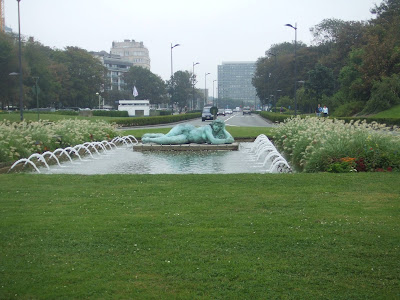
  4. Dikke Mathille.  The Leopold II-laan curves gracefully around the most famous sculpture of a woman in Oostende: De Zee (The Sea). Although Reclining Nude is another name for this lady the locals always refer to her as ‘Dikke Mathille’ (Fat Mathille). In his work as a whole the sculptor Georges Grard showed a preference for the female nude. He emphasised the volume of the full, round forms. In De Zee he portrayed the opulence and sensuality of the sea in a female figure. However, the inhabitants of Oostende know they have to be wary of the apparent tranquillity the figure – and therefore the sea – exudes. Until 1963 the work of art adorned the Kursaal Casino.
  5. The Atlantic Wall.  This open-air museum is a unique historical site of modern fortification. The around sixty German constructions from both World Wars – underground trenches, bunkers and remains of the German coastal batteries of Aachen (built in 1915) and Saltzwedel neu (from 1941), observation points and gun sites are among the best preserved along the Atlantic coast and are the showpiece of the museum. Some of the bunkers have been reconstructed in their original state and furnished with authentic objects. The atmosphere is definitely that of ‘The Longest Day’.
    The Atlantic Wall originally stretched from Norway to the French-Spanish border and had a length of 5,300 km.


Tuesday, 15 May 2012

Liège

Liège


Liège is a major city and municipality of Belgium located in the province of Liège, of which it is the economic capital, in Wallonia, the French-speaking region of Belgium. The city is situated in the valley of the Meuse River, near Belgium's eastern borders with the Netherlands and Germany, where the Meuse meets the Ourthe. It is in the former sillon industriel, the industrial backbone of Wallonia.


Although settlements already existed in Roman times, the first references to Liège are from 558, when it was known as Vicus Leudicus. Around 705, Saint Lambert of Maastricht is credited with completing the Christianization of the region, indicating that up to the early 8th-century the religious practices of antiquity had survived in some form. Christian conversion may still not have been quite universal, since Lambert was murdered in Liège and thereafter regarded as a martyr for his faith. To enshrine St. Lambert's relics, his successor, Hubertus (later to become St. Hubert), built a basilica near the bishop's residence which became the true nucleus of the city. A few centuries later, the city became the capital of a prince-bishopric, which lasted from 985 till 1794. The first prince-bishop, Notger, transformed the city into a major intellectual and ecclesiastical centre, which maintained its cultural importance during the Middle Ages. Pope Clement VI recruited several musicians from Liège to perform in the Papal court at Avignon, thereby sanctioning the practice of polyphony in the religious realm. The city was renowned for its many churches, the oldest of which, St Martin's, dates from 682. Although nominally part of the Holy Roman Empire, in practice it possessed a large degree of independence. 


373 steps leading from 
Hors-Château to the Citadel
The strategic position of Liège has made it a frequent target of armies and insurgencies over the centuries. It was fortified early on with a castle on the steep hill that overlooks the city's western side. In 1345, the citizens of Liège rebelled against Prince-Bishop Engelbert III de la Marck, their ruler at the time, and defeated him in battle near the city. Shortly after, a unique political system formed in Liège, whereby the city's 32 guilds shared sole political control of the municipal government. Each person on the register of each guild was eligible to participate, and each guild's voice was equal, making it the most democratic system that the Low Countries had ever known. The system spread to Utrecht, and left a democratic spirit in Liège that survived the Middle Ages.


Liège's fortifications were redesigned by Henri Alexis Brialmont in the 1880s and a chain of twelve forts was constructed around the city to provide defence in depth. This presented a major obstacle to Germany's army in 1914, whose Schlieffen Plan relied on being able to quickly pass through the Meuse valley and the Ardennes en route to France. The German invasion on August 5, 1914 soon reached Liège, which was defended by 30,000 troops under General Gérard Leman. The forts initially held off an attacking force of about 100,000 men but were pulverised into submission by a five-day bombardment by the Germans' 42 cm Big Bertha howitzers. Due to faulty planning of the protection of the underground defense tunnels beneath the main citadel, one direct artillery hit caused a huge explosion, which eventually led to the surrender of the Belgian forces. The Belgian resistance was shorter than had been intended, but the twelve days of delay caused by the siege nonetheless contributed to the eventual failure of the German invasion of France. The city was subsequently occupied by the Germans until the end of the war. Liège received the Légion d'Honneur for its resistance in 1914. 

The Germans returned in 1940, this time taking the forts in only three days. Most Jews were saved, with the help of the sympathising population, as many Jewish children and refugees were hidden in the numerous monasteries. The German occupiers were expelled by the Allies of World War II in September 1944 but Liège was subsequently subjected to intense aerial bombardment, with more than 1,500 V1 and V2 missiles landing in the city between its liberation and the end of the war.

After the war ended, the Royal Question came to the fore, since many saw king Leopold III as collaborating with the Germans during the war. In July 1950, André Renard, leader of the Liégeois FGTB launched the General strike against Leopold III of Belgium and "seized control over the city of Liège". The strike ultimately led to Leopold's abdication. 
 Liège has shown some signs of economic recovery in recent years with the opening up of borders within the European Union, surging steel prices, and improved administration. Several new shopping centres have been built, and numerous repairs carried out.

The city is well known for its very crowded folk festivals. The 15 August festival ("Le 15 août") is maybe the best known. The population gathers in a quarter named Outre-Meuse with plenty of tiny pedestrian streets and old yards. Many people come to see the procession but also to drink alcohol and beer, eat cabbage, sausages or pancakes or simply enjoy the atmosphere until the early hours. The Saint Nicholas festival around the 6 December is organized by and for the students of the University; for 24 hours, the students (wearing very dirty lab-coats) are allowed to beg for money for drinking.

Liège is renowned for its significant nightlife. Within the pedestrian zone, there is an area (a 100 × 100 m (328.08 ft × 328.08 ft) square called Le Carré) with many lively pubs which are reputed to remain open until the last customer leaves (typically around 6 am). Another active area is the Place du Marché.

The "Batte" market is where most locals visit on Sundays. The outdoor market goes along the Meuse River and also attracts many visitors to Liège. S
tretching over a mile with colorful stalls offering fruit, cheeses, clothes, flower and local products (every Sunday from 8:00 am to 2:30 pm). After visiting "La Batte", time to eat the famous Boulets à la Liégeoise (meatballs with fries) in a typical Belgian café.


Batte Market
With so many great restaurants in Belgium, the hardest part of dinner is to deciding where to go. From a small, inexpensive meal to a multi-course luxurious dinner, local Belgian specialities or dishes inspired by more exotic lands, you will always be able to find cuisine to suit your taste. For those looking to fully emerge in Belgian culture and discover something new, you can enjoy the traditional cuisine of Liege. The menu includes: boulets-frites (meatballs and chip/fries), salade liegeoise (green beans, potatoes, diced bacon), fricassee (omelette with bacon or sausage), rognons de veau (veal kidneys), gauffres (waffles), peket (gin/juniper spirit), cafe liegeois (liege coffee), etc.


The Liège Christmas Market has become one of Belgium’s most famous Christmas Markets with more than 2 million visitors per year from the end of November to the last day of December. Set in Place St Lambert and Place du Marche, 200 wooden chalets offers gastronomic specialties, handicrafts and souvenirs. The ice rink is surrounded by stands where you can shop, eat and drink.

The people of Liège have a reputation for partying… Both in summer and winter, the various districts of the town come alive in the evenings. Discotheques, private clubs, cabaret cafés, bars with beer, student bistros or jazz clubs, these places, many of which are open through the first light of dawn, are ideal places for imbibing the true spirit of the people of Liège.

The market square (Place du Marché) is another centre for nocturnal activity. The pedestrian part of the square is exclusively occupied by lounge bars with large, lively terraces. The Carré district is an original concept not to be missed : a set of very busy pedestrian streets where there is also a concentration of dozens of cafés, pubs and restaurants... Students come here to celebrate the numerous folklore festivals including the one of St. Nicolas at the beginning of December.


The Prince-Bishops' Palace


                                                        Liege’s Top 5:
       
  1. St Paul's Cathedral.  During the French Revolution the ancient cathedral of Liège, St. Lambert's Cathedral, was destroyed systematically, from 1794 onwards. After the revolutionary fervour had evaporated a new cathedral was needed. The ancient collegiate church of St. Paul's was thought suitable for the purpose and was elevated in rank, before 1812. This is the present Liège Cathedral. The present cathedral of Liège was originally one among the seven collegiate churches of the city. It was founded in the 10th century, reconstructed between the 13th and 15th centuries, and restored in the mid-19th century. In 1812, further to a request from Napoléon Bonaparte, the tower, with its ogival windows, was raised by a storey and the belltower installed
  2. The Prince-Bishops' Palace of Liège is on place Saint-Lambert in the centre of the City. It was the residence of the former Prince-Bishops of Liège. It once faced St. Lambert's Cathedral. Its imposing facade dominates the end of the place St-Lambert, centre of commercial life in Liège, where St Lambert's Cathedral formerly stood. Two buildings preceded the present palace, a first palace integrated with the fortifications was built about 1000 AD by Bishop Notger, but it was destroyed in the fire of 1185. The palace was reconstructed under Rudolf of Zähringen. This building was much damaged in the sack of the city by the Burgundians and was also burnt in 1505. On mounting the episcopal throne in 1505 Bishop Érard de La Marck found the palace in ruins and entrusted the construction of a new one to the master builder Arnold van Mulken in 1526. It was finished at the end of the 16th century. The principal facade on the south was completely rebuilt after the fire of 1734 in the Louis XIV-Regency style under the direction of the Brussels architect Jean-André Anneessens, son of François Anneessens. In 1849, a new west wing was built by the architect Jean-Charles Delsaux, in the same style as the old palace to accommodate the provincial government.
  3. The Curtius Museum (Musée Curtius) is a museum of archaeology and decorative arts, located on the bank of the Meuse River in Liège, classified as a Major Heritage of Wallonia. It was built sometime between 1597 and 1610 as a private mansion for Jean Curtius, industrialist and munitions supplier to the Spanish army. With its alternating layers of red brick and natural stone, and its cross-mullioned windows, the building typifies the regional style known as the Mosan (or Meuse) Renaissance. After a 50 million euro redevelopment the museum reopened as the Grand Curtius (Le Grand Curtius) in March 2009, now housing the merged collections of four former museums: themuseum of archeology, the museum of weaponry, the museum of decorative arts, and themuseum of religious art and Mosan art. Highlights in the collections include treasures of Mosan art such as a twelfth century gilded reliquary tryptich, formerly in the church of Sainte-Croix, the Evangelarium of Notger, sculptures by Jean Del Cour, and a portrait of Napoleon Bonaparte painted by Ingres in 1804: Bonaparte, First Consul.
  4. Le Perron. The Perron is a piece of living history in Liège, situated in the Place du Marché. This pillar originally served as a symbol of the prince-bishop of Liège, and its image has been found on money used in the region, dated as early as the 12th Century. In the 15th Century the Perron was placed on Lièges coat-of-arms, and the image of it has stayed there to this day.
  5. The Mountain of Bueren and the slopes of the Citadel. Climb the imposing staircase of 373 steps  leading from Hors-Château to the Citadel, or opt for the smaller streets and stairways leading up to the Citadel's slopes. From the top, you'll have a lovely view of the city, from the Palace rooves to the ancient watchtower.


    Le Perron


Monday, 16 April 2012

Ghent

Ghent


Ghent is a city and a municipality located in the Flemish region of Belgium. It is the capital and largest city of the East Flanders province. The city started as a settlement at the confluence of the Rivers Scheldt and Lys and in the Middle Ages became one of the largest and richest cities of northern Europe. 

Archaeological evidence shows human presence in the region of the confluence of Scheldt and Lys going back as far as the Stone Age and the Iron Age. There are no written records of the Roman period but archaeological research confirms that the region of Ghent was further inhabited. 

Around 650 Saint Amand founded two abbeys in Ghent: the Saint Peter Abbey and the St. Bavo's Abbey. The city grew from several nuclei, the abbeys and a commercial centre. Around 800 Louis the Pious, son of Charlemagne, appointed Einhard, the biographer of Charlemagne, as abbot of both abbeys. In 851 and 879 the city was however attacked and plundered twice by the Vikings. 

The city recovered and flourished from the 11th century on. Until the 13th century Ghent was the biggest city in Europe after Paris; it was bigger than London, Cologne or Moscow. Within the city walls lived up to 65,000 people. 
Today, the belfry and the towers of the Saint Bavo Cathedral and Saint Nicholas' Church are just a few examples of the skyline of the period. Much of the city's medieval architecture remains intact and is remarkably well preserved and restored. Its centre is the largest carfree area in Belgium.


Modern day Ghent is a university city with more than 50,000 students. As such, its streets are filled with young people. But, unlike Leuven, another university town in Flanders, youth is not the only category of people living there. There is an interesting mixture of foreigners who came to live there, or artists, amongst the native people of Ghent. Interestingly, other than the smaller provincial cities or the bigger city of Antwerp, this mixture makes the people more tolerant and open-minded. This atmosphere seeps into every aspect of city life. Many people of Ghent truly see the place like home, and are very proud to live there, seeing it as a place that will always welcome them back home. 

In Ghent and other regions of East-Flanders, bakeries sell a donut-shaped bun called a "mastel" (plural "mastellen"), which is basically a bagel. "Mastellen" are also called "Saint Hubert bread", because on the Saint's feast day, which is 3 November, the bakers bring their batches to the early Mass to be blessed. Traditionally, it is thought that blessed mastellen immunize against rabies.

Other local delicacies are the praline chocolates from local producers such as Leonidas and Dascalides, the 'neuzekes' ('noses'), cone-shaped purple jelly-filled candies, 'babeluten' ('babblers'), hard butterscotch-like candy, and of course, on the more fiery side, the famous 'Tierenteyn', a hot but refined mustard that has some affinity to French 'Dijon' mustard.

'Stoverij' is a classic Flemish meat stew, preferably made with a generous adittion of brown 'Trappist' (strong abbey beer) and served with French fries. 'Waterzooi' is a local stew originally made from freshwater fish caught in the rivers and creeks of Ghent, but nowadays often made with chicken instead of fish. It is usually served nouvelle-cuisine-style, and will be supplemented by a large pot on the side.

For authentic pubs, go to St. Veerleplein (the square in front of the Castle), the pubs around St. Jacob's church (especially during weekends), or the student area around Blandijnberg (Mount Blandin), especially in the proximity of the School of Arts and Philosophy, recognisable from afar by the 64 metres tall art deco Library Tower.


                                                        Ghent’s Top 5:
       
  1. Saint Bavo Cathedral  is the seat of the diocese of Ghent. It is named for Saint Bavo of Ghent. The building is based upon the Chapel of St. John the Baptist, a primarily wooden construction; it was consecrated in 942 by Transmarus, Bishop of Tournai and Noyon. Traces of this original structure are evident in the cathedral's crypt. The chapel was subsequently expanded in the Romanesque style in 1038. Some traces of this phase of expansion are still evident in the present day crypt. In the subsequent period from the 14th through 16th centuries, nearly continuous expansion projects in the Gothic style were executed on the structure. Construction was considered complete June 7, 1569. In 1539, as a result of the rebellion against Charles V, the old Abbey of St. Bavo was dissolved. Its abbot and monks went on to become canons in a Chapter that was attached to what then became the Church of Saint Bavo. When the Diocese of Ghent was founded in 1559, the church became its Cathedral. The church of Saint Bavo was also the site of the baptism of Charles V.
  2. The Gravensteen The present castle was built in 1180 by count Philip of Alsace and was modeled after the crusaders castles that Philip of Alsace encountered while he participated in the second crusade. Before its construction, there stood a wooden castle on the same location, presumably built in the ninth century. The castle served as the seat of the Counts of Flanders until they abandoned it in the 14th century. The castle was then used as a courthouse, a prison and eventually decayed. Houses were built against the walls and even on the courtyard and the stones of the walls were used to erect other buildings. At one time it even served as a factory. At the end of the 19th century, the castle was scheduled to be demolished. In 1885 the city of Ghent bought the castle and started a renovation project. The newly built houses were removed and the walls and dungeon were restored to their original condition. This renovation has been the subject of discussion. People argue whether the castle can still be considered authentic. Despite these discussions, the Gravensteen attracts huge numbers of tourists. The castle has been repaired enough to allow people to travel through it and climb on top. It is still partly surrounded by the moat. Inside is a museum with various torture devices (and a guillotine) that were historically used in Ghent.
  3. St. Nicholas' Church is one of the oldest and most prominent landmarks in Ghent. Begun in the early 13th century as a replacement for an earlier Romanesque church, construction continued through the rest of the century in the local Scheldt Gothic style (named after the nearby river). Typical of this style is the use of blue-gray stone from the Tournai area, the single large tower above the crossing, and the slender turrets at the building's corners. Built in the old trade center of Ghent next to the bustling Korenmarkt (Wheat Market), St. Nicholas' Church was popular with the guilds whose members carried out their business nearby. The guilds had their own chapels which were added to the sides of the church in the 14th and 15th centuries. The central tower, which was funded in part by the city, served as an observation post and carried the town bells until the neighboring belfry of Ghent was built. These two towers, along with the Saint Bavo Cathedral, still define the famous medieval skyline of the city centre. 
  4. The Museum of Fine Arts is situated at the East side of the Citadelpark. The museum holds a large permanent collection of art from the Middle Ages until mid 20th Century. The collection focuses on Flemish Art (Southern Netherlands) but also has several European works, including paintings by Hieronymus Bosch and Peter Paul Rubens. It also has a large amount of sculptures. Next to its permanent collection the museum organises temporary exhibitions (approximately 2 every year). The building was designed by city architect Charles van Rysselberghe around 1900. In 2007 the museum reopened after four years of restoration.
  5. The Belfry.  The 91-metre-high belfry of Ghent is one of three medieval towers that overlook the old city centre. Through the centuries, it has served not only as a bell tower to announce the time and various warnings, but also as a fortified watchtower and town treasury. Construction of the tower began in 1313 to the design of master mason Jan van Haelst, whose plans are still preserved in a museum. After continuing intermittently through wars, plagues and political turmoil, the work reached completion in 1380. It was near the end of this period that the gilded dragon, brought from Bruges, assumed its place atop the tower. The uppermost parts of the building have been rebuilt several times, in part to accommodate the growing number of bells.


    Gravensteen