Translate

Showing posts with label Serbia. Show all posts

Wednesday, 5 December 2012

Pristina

Pristina


Pristina, also spelled Prishtina and Priština is the capital and largest city of Kosovo. It is the administrative centre of the homonymous municipality and district.

In Roman times, a large town called Ulpiana existed 15 kilometers (9.3 mi) to the south of modern-day Pristina. This city was destroyed but was restored by the Emperor Justinian I. Today the town of Lipljan stands on the site of the Roman city, and remains of the old city can still be seen.

After the fall of Rome, Pristina grew from the ruins of the former Roman city. The city was located at a junction of roads leading in all directions throughout the Balkans and it soon rose to become an important trading centre on the main trade routes across south-eastern Europe.

Pristina came to great importance in the medieval Serbian state, and served as the capital of King Milutin (1282–1321) and other Serbian rulers from the Nemanjić and Branković dynasties until the Battle of Kosovo in 1389, when an invading Ottoman army decisively defeated the Balkans coalition army. In the following decades the area gradually came under Ottoman control, with an Ottoman law-court established in 1423. The whole of Serbia was subsequently conquered by the Ottoman Empire in 1459.

During the Ottoman Empire, Pristina became increasingly Ottoman in character following the conversion to Islam of many of its inhabitants, both Albanians and Slavs.

From the 1870s onwards Albanians in the region formed the League of Prizren to resist Ottoman rule, and a provisional government was formed in 1881. On the other hand Serbia tried to enlist the support of Albanians against the Ottomans but this came to nothing, as Albanian Mujahidin were encouraging a policy akin to ethnic cleansing. This increased the number of Kosovo Serbs emigrating from Kosovo, while for their part, Albanians from Albania migrated from the infertile lands of northern Albania to take advantage of the fertile lands of Kosovo.


The First Balkan War erupted in 1912 and the Albanians, with Serbian assistance, launched a rebellion against Ottoman rule. By September, all of Kosovo and central and southern Albania were in rebel hands, but the Ottoman rulers persuaded the Albanians to abandon their uprising by promising reforms. The invasion of Kosovo by the Kingdoms of Serbia and Montenegro saw the expulsion of many Albanians, while the same number of Serbs fled from Albanian mercenaries who exacted vengeance.

The occupation of Kosovo and Albania by Serbia's Army ensued, but the Kingdom of Serbia had to concede independence to Albania as a result of the conference of ambassadors in London in 1913, while it was agreed that Kosovo should remain within its territory. In 1918, Kosovo became a part of the newly formed Yugoslavia, though without any of the autonomy that the region later enjoyed.

Before World War II, Pristina was an ethnically mixed town with large communities of Albanians and Serbs. However, a mass series of both ethnic cleansing and genocide perpetrated by ethnic Albanians backed by the Nazis swung this largely in the Albanian's favour.

In 1946, Pristina became the capital of the Socialist Autonomous Region of Kosovo. Between 1953 and 1999, the population increased from around 24,000 to over 300,000. All of the national communities of the city increased over this period, but the greatest increase was among the Albanian population, a large number of whom had moved from mountain areas to settle in the city. The Albanian population increased from around 9,000 in 1953 to nearly 76,000 in 1981. The Serbian and Montenegrin population increased too but by a far more modest number, from just under 8,000 in 1953 to around 21,000 by 1981. By the start of the 1980s, Albanians constituted over 70% of the city's population.

Although Kosovo was under the rule of local Albanian members of the Communist Party, economic decline and political instability in the late 1960s and at the start of the 1980s led to outbreaks of nationalist unrest. In November 1968, student demonstrations and riots in Belgrade spread to Pristina, but were put down by the Yugoslav security forces. Some of the demands of the students were nonetheless met by the Tito government, including the establishment in 1970 of the University of Pristina as an independent institution. This ended a long period when the institution had been run as an outpost of Belgrade University and gave a major boost to Albanian-language education and culture in Kosovo. The Albanians were also allowed to use the Albanian flag.

In March 1981, students at Pristina University rioted over poor food in their university canteen. This seemingly trivial dispute rapidly spread throughout Kosovo and took on the character of a national revolt, with massive popular demonstrations in Pristina and other Kosovo towns. The Communist Yugoslav presidency quelled the disturbances by sending in riot police and the army and proclaiming a state of emergency, with several people being killed in clashes and thousands subsequently being imprisoned or disciplined.

Following the reduction of Kosovo's autonomy by Serbian President Slobodan Milošević in 1989, a harshly repressive regime was imposed throughout Kosovo by the Serbian government with Albanians largely being purged from state industries and institutions. The University of Pristina was seen as a hotbed of Albanian nationalism and was duly purged: 800 lecturers were sacked and 22,500 of the 23,000 students expelled. In response, the Kosovo Albanians set up a "shadow government" under the authority of the Democratic League of Kosovo (LDK), led by the writer Ibrahim Rugova. Although the city was formally controlled by Serbs appointed by the Milošević government, the LDK established parallel structures, funded by private contributions, to provide free services such as health care and education that were largely denied to the Albanian population.

The LDK's role meant, that when the Kosovo Liberation Army began to attack Serbian and Yugoslav forces from 1996 onwards, Pristina remained largely calm until the outbreak of the Kosovo War in March 1999. The city was placed under a state of emergency at the end of March and large areas were sealed off. After NATO began air strikes against Yugoslavia on March 24, 1999, widespread violence broke out in Pristina. Serbian and Yugoslav forces shelled several districts and, in conjunction with paramilitaries, conducted large-scale expulsions of ethnic Albanians accompanied by widespread looting and destruction of Albanian properties. Many of those expelled were directed onto trains apparently brought to Pristina's main station for the express purpose of deporting them to the border of the Republic of Macedonia, where they were forced into exile. The United States Department of State estimated in May 1999 that between 100,000–120,000 people had been driven out of Pristina by government forces and paramilitaries.

Several strategic targets in Pristina were attacked by NATO during the war, but serious physical damage appears to have largely been restricted to a few specific neighbourhoods shelled by Yugoslav security forces. At the end of the war, most of the city's 40,000 Serbs fled. The few who remained were subjected to harassment and violence in revenge attacks by gangs of Albanian thugs, which reduced Pristina's Serb population even further. Other national groups accused by the Albanians of collaboration with the Serbian war effort–notably the Roma– were also driven out. According to the United Nations High Commissioner for Refugees, by August 1999 fewer than 2,000 Serbs were left in the city. The number reportedly fell even further after the March 2004 unrest in Kosovo.

At the time of writing (Dec 2012), Kosovo remains the subject of a territorial dispute between the Republic of Serbia and the self-proclaimed Republic of Kosovo. The latter declared independence on 17 February 2008, but Serbia continues to claim it as part of its own sovereign territory. Kosovo's independence has been recognised by 96 out of 193 United Nations member states.

If you like coffee, and have a massive amount of time on your hands, Pristina is the city for you. There are cafes absolutely everywhere, and most of them are packed through the warm season with fashionably-dressed young people, dropping a euro a day to keep themselves amused. Unemployment / underemployment is pervasive throughout Kosovo, and tends to affect people from all walks of life and different levels of education. Which means that dude in the sleeveless tshirt with streaked-blond hair at the table beside you could just as easily be an economist as a farm kid from Kamenicë, so learn to say "Mirëdita" with a passable accent and feel free to start a conversation. What to order? "Macchiato" (espresso with hot milk, similar to the American latte) is the catch-all term for "coffee" throughout Kosovo. Lately, some top-end coffee bars have installed WIFI zones and access to Internet.

Shopping-wise, Pristina is full of good bargains but low on selection (and if you happen to be a man who wears shirts or pants, forget about it). Silver is sold in the old quarter and is a pretty good value; Albanians are known throughout the former Yugoslavia as silversmiths.
Do as the locals do: In Pristina, this means korza. In the evenings, when it's warm, a large proportion of the population heads out into the streets and promenades, between cafes or in with no particular destination. The objective is to see and be seen, chat with friends, and take in as much fresh air as possible before the horrific winter descends. Note that 53% of Kosovo's population is under the age of 25, so most of the people on the street around dusk are teenagers and people in their early twenties.


                                                        Pristina’s Top 5:
       
  1. Gračanica Monastery [Manastir Gračanica] The monastery in the village of Gračanica, a short drive south of Pristina, is one of Kosovo's best religious monuments. Completed in 1321 and built by the legendary king of Serbia, Milutin Nemanjic, the Serbian Orthodox monastery church represents the height of Serbian Byzantine tradition. Its real beauty is hidden within, where several distinct periods of fresco painting are extremely well preserved, depicting the early life of Jesus as well as the representations of the ecclesiastical calendar and a terrifying Day of Judgement. The monastery is guarded by police who may require to see your ID. To get there from Pristina, take the bus to Gjilan, which passes through the town after 15 minutes. Note that Gračanica is a Serb enclave that sometimes is the focus of unrest, and some embassies warn against visiting.
  2. The Clock Tower (Sahat Kulla) dates back to the 19th century. Following a fire, the tower has been reconstructed using bricks. The original bell was brought to Kosovo from Moldavia. It bore an inscription reading "this bell was made in 1764 for Jon Moldova Rumen." In 2001, the original bell was stolen. The same year, French KFOR troops replaced the old clock mechanism with an electric one. Given Kosovo's electricity problems the tower is struggling to keep time.
  3. The Museum of Kosovo is located in an Austro-Hungarian inspired building originally built for the regional administration of the Ottoman Vilayet of Kosovo. From 1945 until 1975 it served as headquarters for the Yugoslav National Army. In 1963 it was sold to the Kosovo Museum. From 1999 until 2002, the European Agency for Reconstruction had its main office in the museum building. The Kosovo Museum has an extensive collection of archaeological and ethnological artifacts, including the Neolithic Goddess on the Throne terracotta, unearthed near Pristina in 1960 and depicted in the city's emblem. Although a large number of artifacts from antiquity is still in Belgrade, even though the museum was looted in 1999.
  4. The Fatih Mosque. Opposite the clock tower, the Fatih or Imperial Mosque was built in 1461 under Turkish Sultan Mehmed II Fatih ('the conqueror'), as witnessed by the Arabic engraving above the main door. Inside, painted floral decorations and arabesques grace the walls and ceiling. Pristina's grandest building has a spectacular 15-metre dome resting on support pillars, an architectural feat at the time of construction. The minaret is a reconstruction after the original was damaged during an earthquake in 1955. The mosque was briefly turned into a church during the Austro-Turkish wars from 1690-1698. During Friday payers, the congregation spreads out into the courtyard and even onto the street to pray.
  5. Newborn Monument Missing a central rallying point in the heady days of the declaration of independence in February 2008, these seven huge yellow steel letters spelling out the word 'newborn' were placed in front of the Palace of Youth and Sports. The three metre high letters were quickly covered in autographs and texts, scribbled by thousands of people starting with the PM and president.


Saturday, 9 June 2012

Niš

Niš


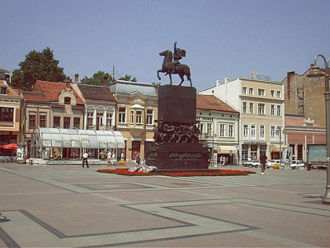
Niš is the largest city of southern Serbia and the third-largest city in Serbia (after Belgrade and Novi Sad). Niš is the administrative center of the Nišava District. It is one of the oldest cities in the Balkans and Europe, and has from ancient times been considered a gateway between the East and the West.

Archaeological evidence shows neolithic settlements in the city and area dating from 5,000 to 2,000 BCE. A notable archeological site is Humska Čuka. The ethnogenesis of the Thracians started in the Iron Age, one of the chief towns was Aiadava, the future Roman Remesiana. The Triballians dwelled in this region, as well and were mentioned as early as 424 BC. In 279 BC, during the Gallic invasion of the Balkans, the Scordisci tribe defeats the Triballi and settles the lands, at which time the city is known as Navissos.

At the time of the conquest of the Balkans by Rome in 168-75 BC, Naissos  was used as a base for operations. Naissus was first mentioned in Roman documents near the beginning of 2nd century CE, and was considered a place worthy of note in the Geography of Ptolemy of Alexandria.

The Romans occupied the town in the period of the "Dardanian War" (75-73 BC), and set up a legionary camp. The city (called refugia and vici in pre-Roman relation), because of its strategic position (the Thracians were based to the south) developed as an important garrison and market town of the province of Moesia Superior. The Romans built the Via Militaris in the early 1st century AD, with Naissus being one of the key towns. Five roads met at Naissus, from Lissus, Serdica, Singidunum, Ratiaria and Thessalonica (through Scupi). Tombstones of auxiliary units date to the rule of either Claudius (41-54) or Nero (54-68). An auxiliary fort was based to the north, at present-day Ravna, called Timacum Minus. Marcus Aurelius (161–180) promoted the city to municipia. Overall, several family tombstones point that this was an important military region and by the 3rd century a social class of peasants and soldiers emerged. Cohort I Aurelia Dardanorum was based in the city.

In the year 268 AD, during the "Crisis of the Third Century" when the Empire almost collapsed, the greatest Gothic invasion in history took place; the Gothic alliance ravaged Thrace, Macedonia, Moesia and Pannonia. Subsequently, Claudius II managed to defeat the invaders at the Battle of Naissus that took place in the same year, in one of the bloodiest battles of the 3rd century. The Gothic alliance allegedly left thirty to fifty thousand dead on the field. In 272 AD, the future Emperor Constantine the Great was born in Naissus. Constantine created theDacia Mediterranea province of which Naissus was the capital and also included Remesiana of the Via Militaris and the towns of Pautalia and Germania. He lived at Naissus in short periods from 316-322.


The latter half of the 6th century AD saw the first major migrations of Slavs and Avars. During the 6th and 7th century, Slavic tribes made eight attempts to take Niš. In 551, the Slavs crossed Niš initially headed for Thessalonica, but ended up in Dalmatia. By the 580s, the Slavs had conquered Serbia and much of northern Greece. During the final attack in 615, the Slavs seized the city and most of the Romans and Romanized Thracian/Dacian population fled, perished, or was assimilated.

The Slavs in the Sclaviniae remained independent for some while; in 785, Macedonia was conquered by Constantine VI, and in 842, with the death of Theophilos, the region was conquered by the Bulgars.

Prince Constantine Bodin was crowned Emperor of Bulgaria in 1072, amid the Bulgarian revolts in Macedonia against the Byzantine Empire. Bodin conquered Niš, but was later captured. During the People's Crusade, on July 3, 1096, Peter the Hermit clashed with Byzantine forces at Niš. He lost a quarter of his men, but managed to march on to Constantinople.

In 1375, after a 25-day long siege, the city fell to the Ottoman-Turks for the first time. The fall of the Serbian state decided the fate of Niš as well. After the Battle of Kosovo in 1389, even though Serbia existed much weakened as a semi-independent state for another 70 years, the Constantinople-Vienna road grew deserted.

In 1443, Niš fell into the hands of Ludanjin. The town itself was given back to the Serbs, while Branković gave it over to Đorđe Mrnjavčević. In the so-called Long Campaign, Christian armies, led by the Hungarian military leader Janos Hunyadi (known as Sibinjanin Janko in Serbian folk poetry) together with Serbian Despot Đurađ Branković, defeated the Turks and repelled them to Sofia. An important battle was fought near Niš, which remained a free city for a whole year after that.

Niš succumbed to Ottoman rule again in 1448 and remained under Ottoman control for the following 241 years. During the period of Ottoman rule, Niš was the seat of the Sanjak of Niš and Niš Eyalet.  On September 24, 1689, the Austrian Army captured the city after defeating the Turks at the Battle of Niš, but the Ottomans managed to retake it the next year. In 1737, Niš was seized again by the Austrian Army, in their campaign against the Turks. The war ended in 1739 and Niš fell under Ottoman rule once more.
Čegar Monument

During the time of German occupation in World War II, the first Nazi concentration camp in Yugoslavia was located in Niš. About 30,000 people passed through this camp, of whom over 10,000 were shot on nearby Bubanj hill. On February 12th 1942, 147 prisoners staged mass escape. In 1944 city was heavily bombed by the Allies. On October 14th 1944 Niš was liberated from the Germans by Partisans and Soviet forces.

In 1996, Niš was the first city in Serbia to stand against the regime of Slobodan Milošević. A coalition of democratic opposition parties called Zajedno (meaning "Together" in Serbian) won the local elections in Niš in 1996 and protested for 88 days in the streets until Milošević`s Socialist Party surrendered power. The first democratic mayor of the City of Niš was Zoran Živković.

In the local elections held in May 2008, the Democratic Party, G17+ and coalition assembled around the Socialist Party of Serbia won and Miloš Simonović from the Democratic party became the elected mayor.

There has never been a better time to visit Niš, other than when Constantine the Great was alive of course. Serbia having been granted visa-free travel within the Schengen zone, in December 2009, the mass movement of people looks imminent. As the Serbs joyously savour the prospect of European travel, the budget airlines move in. With the advent of affordable connections out of Niš, inevitably come the inexpensive connections in. Thus the city can undoubtedly expect many more tourists in the immediate future, and realistically envisage a lot of change in the next 10 to 20 years, most of it positive. 

Though shopping will not be the principal reason for most trips to Niš, you shouldn't have much difficulty finding what you want, be it local art and crafts, a new camera, replacement moisturiser or some tired-looking Yugoslav relics from the country's quite recent past. Serbia, or Niš at least, has retained the traditional Christian working habits, the vast majority of shops being closed on Sundays. Moreover, it seems Saturday late-afternoons are reserved for coffee drinking and gossip, most places only working until 3 or 4pm. Centred around the pedestrianised 'Obrenovaćeva' thoroughfare, there's a good range of high-street outlets and several boutiques. More specialist shops are spread throughout the city. There are some great outdoor markets, worth a trip if only for the experience of wandering through the noisy, vibrant beehive of activity.

Aside from various international options, there are a couple of good fish restaurants and Italian eateries in Niš. Yes, the youth of the city like the same things as the rest of the world's youth; pizzerias are already numerous. That said, the typical and traditional Serbian restaurants do not appear to be suffering. From the simplest kafana - technically a café but often more akin to a restaurant - to mammoth-sized establishments aimed at visitors and locals alike - are equally always occupied. Furthermore, you'll more often than not stumble upon a party atmosphere, complete with live folk music and a jubilant patronage.

Cities the size of Niš are small enough so you'll not find huge crowds, but often there's still plenty going on after dark. The scene in Niš is most definitely alive; there are lots of bars, several varied clubs and many of the mass of cafes are just as popular, or even more so, at night. We stress 'night' rather than 'evening', given that coffee drinking goes on till 6 or 7pm, then the partying begins at about 11pm, on the weekend at least.

Mosaics at Mediana


                                                           Nis’ Top 5:
       
  1. Niš Fortress Is a complex and important cultural and historical monument. It rises on the right bank of the Nišava River, and is over two millennia old. The extant fortification is of Turkish origin, dating from the first decades of the 18th century (1719–1723). It is well-known as one of the most significant and best preserved monuments of this kind in the mid-Balkans. The Fortress was erected on the site of earlier fortifications - the ancient Roman, Byzantine, and later yet Mediaeval forts. The Fortress has a polygonal ground plan, eight bastion terraces and four massive gates. It stretches over 22 ha of land. On the outside, the Fortress was surrounded by a wide moat, whose northern part has been preserved to this day. Beside the massive stone rampart walls, the southern Stambol Gate and the western Belgrade Gate are pretty well preserved. Partly preserved are the water gates, while there are only partial remains of the northern Vidin Gate and the south-east Jagodina Gate. 
  2. The Skull Tower is a monument to 19th century Serbian rebels. It is situated on the old Constantinople Road leading to Sofia. The monument was built using the skulls of the Serbs killed by order of Ottoman Sultan Mahmud II during the 1809 Battle of Čegar.
    The tower stood in the open air until the liberation of Niš in 1878. By that time, much of the tower had deteriorated from weather conditions or from the removal of skulls for burial by relatives of killed rebels. In 1892, with donations gathered from all over Serbia, a chapel designed by the Belgrade architect Dimitrije T. Leko was built to enclose what was left of the tower. Today, only 58 skulls remain, including that of Sinđelić. Skull Tower was declared Monument of Culture of Exceptional Importance in 1979, and it is protected by Republic of Serbia.
  3. Čegar Is the location where the Battle of Čegar Hill took place. It was first marked on July 4, 1878 with the following inscription:"To voivoda Stevan Sinđelić and his undead heroes who lost their lives on May 19, 1809, in their attack on Niš. Knez Milan M. Obrenović IV and his brave soldiers redeemed them on December 27, 1877 by conquering Niš."Today's monument in the shape of a tower - a symbol of the soldiers' fortification - was erected for the fiftieth anniversary of the liberation of Niš from the Turks, on June 1, 1927. In 1938 a bronze bust of Stevan Sinđelić was positioned in the semicircular niche of the monument.
  4. Mediana is an important archeological site from the late Roman period located in the eastern suburb of the city of Niš. It represents a luxurious residence with a highly organized economy. Excavatations have revealed a villa with peristyle, thermae, granary and water tower. The residence dates to the reign of Constantine the Great 306 to 337. Although Roman artefacts can be found scattered all over the area of present-day Niš, Mediana represents the best-preserved part of Roman Naissus. In 1979, Mediana was added to the Archaeological Sites of Exceptional Importance list, protected by Republic of Serbia.
  5. Serbian Wartime Parliament Building - Birthplace of Yugoslavia. The building of the "Youth Home" Restaurant was erected in 1890. At first, the "Bulevar" restaurant was situated in the building. The Army General Staff bought the building in 1903 and turned it into an Officers' Home, which remained there until 1941. At the beginning of World War I this building was in the focus of public attention as the center of the political life of Serbia. On December 7, 1914 a war session of the National Assembly was held there. On that occasion the Assembly made the "Niš Declaration", which explicitly stated the military objectives of Serbia - to fight for the liberation and unification of the Balkan peoples. On May 6, 1915 the Yugoslav Congress was held in this building. The Congress issued the "Niš Resolution" which once again emphasized the need for national unity.


    Remains of the skull tower


Tuesday, 5 June 2012

Novi Sad

Novi Sad


Novi Sad is the second largest city in Serbia, capital of the northern Serbian province of Vojvodina, and the administrative centre of the South Bačka District. It is located in the southern part of Pannonian Plain, on the border of the Bačka and Srem regions, on the banks of the Danube river and Danube-Tisa-Danube Canal, facing the northern slopes of Fruška Gora mountain.

Human settlement on the territory of present-day Novi Sad has been traced as far back as the Stone Age (about 4500 B.C.). This settlement was located on the right bank of the river Danube in the territory of present-day Petrovaradin. This region was conquered by Celts (in the 4th century B.C.) and Romans (in the 1st century B.C.). The Celts founded the first fortress at this location, which was located on the right bank of the Danube. During Roman rule, a larger fortress was built in the 1st century with the name Cusum and was included into the Roman province of Pannonia. In the 5th century, Cusum was devastated by the invasion of the Huns.

By the end of the 5th century, Byzantines had reconstructed the town and called it by the names Cusum and Petrikon. The town was later conquered by Ostrogoths, Gepids, Avars, Franks, Bulgarians, and again by Byzantines. The region was conquered by the Kingdom of Hungary between the 10th and 12th century, and the town was mentioned under the name Bélakút or Peturwarad(Pétervárad) in documents from 1237. In the same year (1237), several other settlements were mentioned to exist in the territory of modern urban area of Novi Sad (on the left bank of the Danube).

Between 1526 and 1687, the region was under Ottoman rule. In the year 1590, population of all villages that existed in the territory of present-day Novi Sad numbered 105 houses inhabited exclusively by Serbs. However, Ottoman records mention only those inhabitants that paid taxes, thus the number of Serbs that lived in the area (for example those that served in the Ottoman army) was larger. 


Petrovaradin Fortress
For much of the 18th and 19th centuries, Novi Sad was the largest city in the world populated by ethnic Serbs. Because of its cultural and political influence, Novi Sad became known as the Serbian Athens. 

During the Revolution of 1848-1849, Novi Sad was part of Serbian Vojvodina, a Serbian autonomous region within the Habsburg Empire. In 1849, the Hungarian army located on the Petrovaradin Fortress bombarded and devastated the city, which lost much of its population.  Between 1849 and 1860, the city was part of a separate Austrian crownland known as the Vojvodina of Serbia and Tamiš Banat. After the abolishment of this province, the city was included into Bačka-Bodrog County. After 1867, Novi Sad was located within the Hungarian part of Austria-Hungary. 

On 25 November 1918, the Assembly of Serbs, Bunjevci and other Slavs of Vojvodina in Novi Sad proclaimed the union of Vojvodina region with the Kingdom of Serbia. Since 1 December 1918, Novi Sad was part of the Kingdom of Serbs, Croats, and Slovenes; and in 1929, it became the capital of the Danube Banovina, a province of the Kingdom of Yugoslavia. 

In 1941, the Kingdom of Yugoslavia was invaded and partitioned by the Axis powers, and its northern parts, including Novi Sad, were annexed by Hungary. During World War II, about 5,000 citizens were murdered and many others were resettled. In three days of Novi Sad raid (21—23 January 1942) alone, Hungarian police killed 1,246 citizens, among them more than 800 Jews, and threw their corpses into the icy waters of the Danube, while the total death toll of the raid was around 2,500. Citizens of all nationalities - Serbs, Hungarians, Slovaks, and others - fought together against the Axis authorities. In 1975 the whole city was awarded the title People's Hero of Yugoslavia.

Since 1945, Novi Sad has been the capital of Vojvodina, a province of the Socialist Federal Republic of Yugoslavia and Serbia. The city went through rapid industrialization and its population more than doubled in the period between World War II and the breakup of Yugoslavia. After 1992, Novi Sad was part of the Federal Republic of Yugoslavia, which, in 2003, was transformed into the State Union of Serbia and Montenegro. Since 2006, Novi Sad is part of an independent Serbia.

The number of tourists visiting Novi Sad each year has steadily risen since 2000. Every year, in the beginning of July, during the annual EXIT music festival, the city is full of young people from all over Europe. In 2005, over 150,000 people visited the festival, which put Novi Sad on the map of summer festivals in Europe. Besides EXIT festival, Novi Sad Fair attract many business people into the city; in May, the city is home to the biggest agricultural show in the region, which 600,000 people visited in 2005. There is also a tourist port near Varadin Bridge in the city centre welcoming various river cruise vessels from across Europe who cruise on Danube river.

There are many restaurants in Novi Sad that serve international and national cuisine, Italian specialities, Chinese food, fish and vegetarian food. The average price for a meal per person is €5 to €10. Local beer costs around €1, imported beer is €1.5 to €2.5, a cup of espresso coffee costs from €0.8 to €1.2 and juices are around €1. Most restaurants close at 11 pm. Numerous fast food restaurants and grill booths are open 24 hours, the average price for a meal is 1€ .


Due to the excellent grape growing conditions, the vineyards of Fruška Gora have been amongst the most important in Central Europe since the Middle Ages. In the Fruška Gora region there are three winemaking centres: Petrovaradin with Sremski Karlovci, Irig and Erdevik.

Not far from Novi Sad is the Fruška Gora National Park which harbours habitats of a large number of animal species. In Fruška Gora, besides forests, valuable ecosystems and geological features, there are also the famous Fruška Gora monasteries and a large number of picnic sites, including Iriški Venac, Zmajevac, Andrevlje and Koruška, as well as the Međeš and Borkovac lakes.

On the shoreline of the Danube near Novi Sad there is the Koviljsko-Petrovaradinski Rit marsh, a significant bird habitat which is home to some rare and endangered species. Each year at the beginning of June a photo-safari is held in the marsh.


                                                        Novi Sad’s Top 5:
       
  1. The Name of Mary Church  is a Roman Catholic church named after Virgin Mary.  Locals refer to it as the "Catholic cathedral", or just "cathedral", even though the actual cathedral (bishop's seat) is located in Subotica. The church was built on the foundation of an old Roman Catholic church, which was damaged during Revolution of 1848. This church was not restored correctly, so Catholics from Novi Sad decided to build a new church. It was finished in the end of the 19th century, in 1894 by architect Georg Molnar. The church is a three-nave building, with gothic arches. The altar is made of carved wood from Tyrol, the windows with stained glass from Budapest and the roof tiles were made of Zsolnay ceramics. It is the tallest church in Bačka region and dominates the city centre of Novi Sad.
  2. Petrovaradin Fortress. Is located in the province of Vojvodina, on the right bank of the Danube river. The cornerstone of the present-day southern part of the fortress was laid on October 18, 1692, by Charles Eugène de Croÿ. Petrovaradin Fortress has many underground tunnels as well (16 km of underground countermine system). In 1991 Petrovaradin Fortress was added to Spatial Cultural-Historical Units of Great Importance list, and it is protected by the Republic of Serbia. 
  3.  Novi Sad Synagogue is a Jewish synagogue and one of the many cultural institutions in Novi Sad. Located in Jevrejska (Jewish) Street, in the city centre, the synagogue has since been recognized as a landmark. The building of the new synagogue, the fifth to be erected on the same location since the 18th century, became a major project for the entire Jewish community of Novi Sad. The building work of the Novi Sad synagogue started in 1905 and was finished in 1909. It was projected by Hungarian architect Baumhorn Lipót.The synagogue was part of a bigger complex of buildings that included on both sides of the synagogue two edifices decorated in a similar pattern. One building served the Jewish school and other as offices of the Jewish Community.
  4. The Museum of Vojvodina, founded by Matica Srpska in 1847, houses a permanent collection of Serbian culture and a life in Vojvodina through history. Vojvodina from the Palaeolithic era to the middle of the 20th century. The museum includes exhibits relating to archaeology, history, ethnology and modern history.  The museum houses a collection of over 400,000 specimens and a library of over 50,000 volumes.
  5. Liberty Bridge is a Cable-stayed bridge on the Danube river. The bridge was built in 1981 and destroyed during NATO bombardment on April 4, 1999. It was rebuilt 2003-2005 and reopened on October 7, 2005. The bridge was designed by Nikola Hajdin.
    Rebuilding the bridge cost the city €40 million and lasted for 2 years and 22 days. Maja Gojković, the mayor of Novi Sad, reopened it on October 7, 2005. The official reopening was held a few days later, with officials from the European Agency for Reconstructionpresent. The bridge's reconstruction and opening was a cause for political clashes; one side saying Novi Sad and its citizens should be thankful to EU for the gift of the reconstructed bridge, and the other that EU was obliged to reconstruct it anyway, as a part of war damages compensation.


                 http://www.serbia.travel/destinations/cities-and-municipalities/novi-sad/#


Thursday, 8 March 2012

Belgrade

Belgrade


Belgrade is the capital and largest city of Serbia. The city is located at the confluence of the Sava and Danube rivers, where the Pannonian Plain meets the Balkans. Its name in English translates to White city. The city proper has a population of over 1.1 million, while its metropolitan area has over 1.6 million people, making it one of the largest cities in Southeast Europe.


One of the largest prehistoric cultures of Europe, the Vinča culture, evolved around the area Belgrade in the 6th millennium BC. In antiquity, Thraco-Dacians inhabited the region, and after 279 BC Celts conquered the city, naming it Singidūn. It was conquered by the Romans during the reign of Augustus, and awarded city rights in the mid 2nd century. It was settled by the Slavs in the 520s, and changed hands several times before it became the capital of King Stephen Dragutin (1282–1316). In 1521 Belgrade was conquered by the Ottoman Empire and became the seat of a the Sanjak of Smederevo. It frequently passed from Ottoman to Habsburg rule, which saw the destruction of most of the city during the Austro-Ottoman wars. Belgrade was again named the capital of Serbia in 1841. The north of Belgrade remained a Habsburg outpost until 1918, when it was merged into the capital city. As a strategic location, the city was battled over in 115 wars and razed to the ground 44 times. Belgrade was the capital of Yugoslavia (in various forms of governments) from its creation in 1918, to its final dissolution in 2006.

Cathedral of St Sava


In the inner area of the City of Belgrade there are over 5,500 streets, 16 plazas and 32 squares. The oldest streets that have retained their original routes are: Vase Čarapića, Kralja Petra, Cara Dušana, Jevrejska, Narodnog fronta, Gavrila Principa, and Karađorđeva Streets. The development of the street network started in 1867, after the Turks had departed, when the regulatory plan of Belgrade was adopted, which had been drawn up by engineer Emilijan Josimović. In the territories of the 10 City municipalities, the oldest is the Student Square, and the most famous one is the Republic Square. 


Kneza Mihaila Street is a pedestrian zone and shopping center - protected by law as one of the oldest and most valuable monumental complexes of the city, with a large number of representative buildings and urban houses built at the end of 1870s. It is thought that in as early as the Roman times there was the center of the Singidunum settlement. In this area, at the time of Turks, there were winding streets with gardens, drinking-fountains and mosques. In the mid19th century, in the upper part of the street was the garden of Knez Aleksandar Karađorđević. After the making of the regulation plan of Belgrade in 1867, byEmilijan Josimović, the street has soon been built and gained its physionomy and content. The houses have been built there and the most influential and wealthiest families of the commercial and political society of Belgrade have come to live there. In 1870, the city authorities officially gave a name to this street - Ulica Kneza Mihaila.

Belgrade has a reputation for offering a vibrant nightlife, and many clubs that are open until dawn can be found throughout the city. The most recognizable nightlife features of Belgrade are the barges (splavovi) spread along the banks of the Sava and Danube Rivers.
Many weekend visitors—particularly from Bosnia-Herzegovina, Croatia and Slovenia—prefer Belgrade nightlife to that of their own capitals, due to a perceived friendly atmosphere, great clubs and bars, cheap drinks, the lack of language difficulties, and the lack of restrictive night life regulation. The Times reported that Europe's best nightlife can be found in buzzing Belgrade. In the Lonely Planet "1000 Ultimate Experiences" guide of 2009, Belgrade was placed in the number 1 spot of the top 10 party cities in the world.


                                                                             Belgrade’s Top 5:
Belgrade Fortress
       
  1. Belgrade Fortress.  High above the Sava and Danube confluence, on the rocky ridge which overlooks The city, Zemun and wide plains of Pannonia, there is the Belgrade Fortress with Kalemegdan, the former historical and urban center of Belgrade. This spatial complex consists of: The Fortress, divided into Upper Town and Lower Town, and the Kalemegdan park, the most popular promenade for Belgrade citizens. Because of its exceptional strategic significance, at the end of the first century A.D. the Romans built a fortress here - Roman castrum, as a permanent military camp of the IV Flavius' legion. After its destruction by the Goths and Huns, it was reconstructed in the first decades of the sixth century. Less than a hundred years later, it was destroyed by the Avars and Slavs. A mediaeval town has developed over the centuries in the Fortress area, clinging on to safety within its thick walls. The Belgrade Fortress has been destroyed and renewed many times. Above the Roman walls there are the Serbian walls, and above these the Turkish and Austrian fortifications. In the twelfth century, the Byzantine Czar Manuel Comnenus erected a new castle upon the Roman ruins. In the first decades of the fourteenth century, this small stronghold on the hill was expanded to the river banks.
  2. The Cathedral of Saint Sava or Saint Sava Temple in the Vračar region of Belgrade, is an Orthodox church, the largest in the Balkans, and one of the 10 largest church buildings in the world. The church is dedicated to Saint Sava, founder of the Serbian Orthodox Church and an important figure in medieval Serbia. It is built on the Vračar plateau, on the location where his remains were burned in 1595 by the Ottoman Empire's Sinan Pasha. From its location, it dominates Belgrade's cityscape, and is perhaps the most monumental building in the city. The building of the church structure is being financed exclusively by donations. The parish home is nearby, as will be the planned patriarchal building. It is not a cathedral in the technical ecclesiastical sense, as it is not the seat of a bishop (the seat of the Metropolitan bishop of Belgrade is St. Michael's Cathedral). In Serbian it is called a hram (temple), which is in Eastern Orthodoxy another name for a church. In English, it is usually called a cathedral because of its size and importance.
  3. The National Museum.  The largest and oldest museum in Serbia. It is located in Republic Square. The museum was established on May 10, 1844. Since it was founded, its collections have to over 400,000 objects including many foreign masterpieces. The National Museum building was declared a Monument of Culture of Great Importance in 1979. The Museum has 34 archeological, numismatic, artistic and historical collections today. The main collection consists of sculptures from Vinca (6–5th millennium B.C.) such as Lady of Vinča and Lepenski Vir (7th millennium B.C.). There are also numerous sculptures, weapons, helmets and other items from ancient Rome and 1005 items from ancient Greece and items from Ancient Celtic people. The most valuable pieces from that period are Dupljaja Chariot (16-13th century B.C), golden masks from Trebenište (6th century B.C.), household sets from Jabučje (1st century A.D.), the Belgrade Cameo (4th century) .Silver belt with swastika, 5th century BC. There is also a collection from ancient Egypt. The most famous piece is a rare gold sarcophagus and mummy of the Egyptian priest Nesmin.
  4. The Old Palace. The palace was built between 1882 and 1884, according to the design of Aleksandar Bugarski, in the style of academism of the 19th century, with intention to surpass all existing residences of the Serbian rulers. A number of important events from the time of the political power of the Obrenović dynasty are linked to the Old Palace: the Palace was built when Serbia was proclaimed a Kingdom; in that same building, King Milan abdicated in favor of his son, Aleksandar, on February 22, 1889. Between 1903 and 1914, the Old Palace was the residence of the Karadjordjević dynasty. In 1919 and 1920, meetings of the Provisional National Assembly took place there. Royal festivities and receptions of foreign guests took place there until 1941.
  5. Skadarlija.  is a vintage street, an urban neighborhood and former municipality of Belgrade. It is located in the Belgrade municipality of Stari Grad (Old town) and generally considered the main bohemian quarter of Belgrade, styled as the Belgrade Montmartre. Skadarlija is located less than 300 metres (330 yd) north-west of Terazije, central Belgrade. It begins right below the Republic Square and stretches along the short, winding Skadarska Street. One of the most famous streets in Belgrade, it is less than 400 metres (440 yd) long. It connects the Despot Stefan Boulevard with the Dušanova Street, near the Bajloni open green market and the Mira Trailović Square, where it extends into the neighborhood of Dorćol. Skadarlija became a separate municipality of Belgrade in 1952, after the previous post-World War II division of Belgrade into raions from 1945 to 1952 ended. That municipality included a large portion of urban Belgrade, mainly the Danube oriented neighborhoods like Dorćol, Jalija, Stari Grad, etc. On January 1, 1957 it merged into the new municipality of Stari Grad. 


    The bohemian area. Skadarlija 

References: http://www.beograd.rs/cms/view.php?id=220
                    http://www.backpackserbia.com
                    http://www.icpdr.org