Translate

Showing posts with label Spain. Show all posts

Friday, 15 March 2013

Valladolid

Valladolid


Valladolid is the capital city of the autonomous region of Castile and León and the Province of Valladolid in north-western Spain. It is situated at the confluence of the Pisuerga and Esgueva rivers, and located within three winegrowing regions: Ribera del Duero, Rueda and Cigales.

Remains of Celtiberian and of a Roman camp have been excavated near the city. The nucleus of the city was originally located in the area of the current San Miguel y el Rosarillo square, and was surrounded by a palisade. Archaeological proofs of the existence of three ancient lines of walls have been found.


During the time of Moorish rule in Spain the Christian kings moved the population of this region north into more easily defended areas, and deliberately created a no man's land as a buffer zone against further Moorish conquests. The area was captured from the Moors in the 10th century, and Valladolid was a village until King Alfonso VI of León and Castile donated it to Count Pedro Ansúrez in 1072. He built a palace (now lost) for himself and his wife, Countess Eylo, the Collegiate of St. Mary and the La Antigua churches. In the 12th and 13th centuries, Valladolid grew rapidly, thanks also to the commercial privileges granted by the kings Alfonso VIII and Alfonso X, as well as to the repopulation of the area after the Reconquista.

In 1469 Queen Isabella I of Castile and King Ferdinand of Aragon were married in the city; by the 15th century Valladolid was the residence of the kings of Castile and remained the capital of the Kingdom of Spain until 1561, when the city was destroyed by a fire and Philip II, born here, moved the capital to Madrid, starting a period of decadence for Valladolid. In 1506 Christopher Columbus died in Valladolid in a house that is now a Museum dedicated to him. It was made the capital of the kingdom again between 1601 and 1606 by Philip III. The city was again damaged by a flood of the rivers Pisuerga and Esgueva.

Despite the damage to the old city by the 1960s economic boom, it still boasts a few architectural manifestations of its former glory. Some monuments include the unfinished cathedral, the Plaza Mayor (Main Square), which was the model for that of Madrid, and of other main squares throughout the former Spanish Empire, the National Sculpture Museum, next to the church of Saint Paul, which includes Spain's greatest collections of polychrome wood sculptures, and the Faculty of Law of the University of Valladolid, whose façade is one of the few surviving works by Narciso Tomei, the same artist who did the transparente in Toledo Cathedral. The Science Museum is next to the river Pisuerga. The only surviving house of Miguel de Cervantes is also located in Valladolid. Although unfinished, the Cathedral of Valladolid was designed by Juan de Herrera, architect of El Escorial.

Although an inland province, fish is commonly consumed, some brought from the Cantabrian Sea. Fish like red bream and hake are a major part of Valladolid's cuisine.

The main speciality of Valladolid is, however, lechazo (suckling baby lamb). The lechazo is slowly roasted in a wood oven and served with salad.

Valladolid also offers a great assortment of wild mushrooms. Asparagus, endive and beans can also be found. Some legumes, like white beans and lentils are particularly good. Pine nuts are also produced in great quantities.

Sheep cheese from Villalón de Campos, the famous pata de mulo (mule's leg) is usually unripened (fresh), but if it is cured the ripening process brings out such flavour that it can compete with the best sheep cheeses in Spain.

In the area of bread Valladolid has a bread to go with every dish, like the delicious cuadros from Medina del Campo, the muffins, the pork-scratching bread and the lechuguinos, with a pattern of concentric circles that resemble a head of lettuce.

The pastries and baked goods from the province of Valladolid are well-known, specially St. Mary's ring-shaped pastries, St. Claire's sponge cakes, pine nut balls and cream fritters.

Valladolid is also a producer of wines. The ones that fall under the Designation of Origin Cigales are very good. White wines from Rueda and red wines from Ribera del Duero are known for their quality.


Valladolid’s Top 5:
  1. The Cathedral of Our Lady of the Holy Assumption, better known as Valladolid Cathedral, is a Roman Catholic cathedral designed by Juan de Herrera. The cathedral has its origins in a late Gothic collegiate church, which was started during the late 15th century: before temporarily becoming capital of a united Spain, Valladolid was not a bishopric, and thus it lacked the right or necessity to build a cathedral. However, soon enough the Gothic collegiate church became outmoded with the growth of Renaissance classicizing architecture, and thanks to the newly established episcopal see, the Town Council decided to build a cathedral that would put similar constructions in neighbouring capitals in the shade. However, due to strategic and geopolitical reasons, by the 1560s the capital was moved to Madrid and funds for architectural projects were largely cut. Thus the cathedral was not finished according to Herrera's design; it was further modified during the 17th and 18th centuries, such as the addition to the top of the main façade, a work by Churriguera.
  2. The Plaza Mayor of Valladolid is the first great plaza in Spain, and closed with arcades, is a space intended for use as a market and as a backdrop to the public celebrations so dear to the Habsburg monarchy. It had been designed with large balconies to facilitate the viewing of the shows, and served as a model, since the seventeenth century, for many others in Spain (such as Madrid, 1617 or Salamanca, 1729) and South America, even having an impact in Italy. Its existence became defined in the mid-thirteenth century when the market moved from the Plaza de Santa Maria to Market Square, which since the early sixteenth century has been called Plaza Mayor. Individual unions were installed around it, as was the Convent of San Francisco, until 1499 the most important building in the vicinity. After that date, as mandated by the Catholic Monarchs it was the House of the Municipality who presided over the life of the city.
  3. The National Museum of Sculpture is a museum belonging to the Spanish Ministry of Culture. The museum has an extensive collection sculptural ranging from the Middle Ages to the nineteenth century from convents, donations, deposits and acquisitions of the state. The museum was founded as the Provincial Museum of Fine Arts on October 4, 1842. It had its first headquarters at the Palacio de Santa Cruz. On 29 April 1933 it was moved to the Colegio de San Gregorio. Other current seats are in the 16th century Palacio de Villena and Palacio del Conde de Gondomar. The museum houses works from the 13th to 19th century, executed in the Iberian Peninsula or in other regions historically connected to Spain (Italy, Flanders, Southern America). Artworks include, among the others, a Raising of the Crossby Francisco del Rincon, I Thirst, and The Way of Calvary Gregorio Fernández, Adoration of the Magi by Alonso Berruguete, Lamentation of Christ by Juan de Juni, Penitent Magdalene by Pedro de Mena or the Holy Sepulchre or passage of the Sleepers Alonso de Rozas.
  4. The Teatro Calderón de la Barca is a theatre named after the playwright Pedro Calderón de la Barca. The site of the theater was occupied until the mid-nineteenth century by the palace of the Duke of Osuna, Admiral of Castile, which was demolished to make way for the theatre. Jerónimo de la Gándara was the architect. One of the largest theaters in Spain, the facade has an eclectic neo-classical style. The Calderón opened in 1864. The interior has a horseshoe shape in the Italian style. The paint work, curtains and sets were created by the celebrated decorator Augusto Ferri. The Art Nouveau side lamps date from the early twentieth century. Other rooms were a coffee shop, a library decorated with many paintings, and a banquet room. The magnificent and lavishly decorated building became one of the main theaters in Spain when it opened.
  5. The Royal Palace of Valladolid was the official residence of the Kings of Spain during the period in which the Royal Court had its seat in Valladolid between 1601 and 1606, and a temporary residence of the Spanish Monarchs from Charles I to Isabella II, as well as and also of Napoleon during the War of the Independence. Currently is the headquarters of the 4th General Sub-inspection of the Army.


Wednesday, 13 February 2013

Córdoba

Córdoba


Córdoba, also called Cordova in English, is a city in Andalusia, southern Spain, and the capital of the province of Córdoba. An Iberian and Roman city in ancient times, in the Middle Ages it became the capital of an Islamic caliphate. The old town contains numerous architectural reminders of when Corduba was the capital of Hispania Ulterior during the Roman Republic and capital of Hispania Baetica during the Roman Empire; and when Qurṭubah was the capital of the Islamic Caliphate of Córdoba, including most of the Iberian Peninsula.

It has been estimated that in the 10th century and beginning of the 11th century, Córdoba was the most flamboyant city in the world, people there had a great sense of fashion/swagger and during these centuries became the intellectual centre of Europe.


The first trace of human presence in the area are remains of a Neanderthal Man, dating to c. 32,000 BC. In the 8th century BC, during the ancient Tartessos period, a pre-urban settlement existed. The population gradually learned copper and silver metallurgy. The first historical mention of a settlement dates, however, to the Carthaginian expansion across the Guadalquivir, when the general Hamilcar Barca renamed it Kartuba, from Kart-Juba, meaning "the City of Juba", the latter being a Numidian commander who had died in a battle nearby. Córdoba was conquered by the Romans in 206 BC. In 169 the Roman consul Marcus Claudius Marcellus founded a Latin colony alongside the pre-existing Iberian settlement. Between 143 and 141 BC the town was besieged by Viriatus. A Roman Forum is known to have existed in the city in 113 BC.

At the time of Julius Caesar, Córdoba was the capital of the Roman province of Hispania Ulterior Baetica. Great Roman philosophers such as Lucius Annaeus Seneca the Younger, orators such as Seneca the Elder and poets such as Lucan came from Roman Cordoba. Later, it occupied an important place in the Provincia Hispaniae of the Byzantine Empire (552–572) and under the Visigoths, who conquered it in the late 6th century.

Córdoba was captured in 711 by an Arab/Berber Muslim army. Unlike other Iberian towns, no capitulation was signed and the position was taken by storm. Córdoba was in turn governed by direct Arab rule. The new Arab commanders established themselves within the city and in 716 it became a provincial capital, subordinate to the Caliphate of Damascus; in Arabic it was known as قرطبة (Qurṭubah).

Different areas were allocated for the services in the Saint Vincent Church shared by Christian and Muslims, until the Great Mosque started to be erected on the same spot under Abd-ar-Rahman I. In May 766, it was chosen as the capital of the independent Arab Muslim emirate of al-Andalus, later a Caliphate itself. During the caliphate apogee (1000 AD), Córdoba had a population of roughly 500,000 inhabitants, though estimates range between 350,000 and 1,000,000. In the 10th and 11th centuries, Córdoba was one of the most advanced cities in the world as well as a great cultural, political, financial and economic centre. The Great Mosque of Córdoba dates back to this time; under caliph Al-Hakam II Córdoba had 3,000 mosques, splendid palaces and 300 public baths, and received what was then the largest library in the world, housing from 400,000 to 1,000,000 volumes.

However, following al-Mansur's death, internal struggle for power between different factions led to the pillage and destruction of Medina Azahara and other splendid buildings of Córdoba. The city fell into a steady decline in the next decades and after the fall of the caliphate (1031), Córdoba became the capital of a Republican independent taifa. This short-lived state was conquered by Al-Mu'tamid ibn Abbad, lord of Seville, in 1070. In turn, the latter was overthrown by the Almoravids, who were later replaced by the Almohads.

During the latter's domination the city declined, the role of the capital of Muslim al-Andalus having been given to Seville. On 29 June 1236, after a siege of several months, it was captured by King Ferdinand III of Castile, during the Spanish Reconquista. The city was divided into 14 colaciones, and numerous new church buildings were added.

The city declined especially after Renaissance times. In the 18th century it was reduced to just 20,000 inhabitants. The population and economy started to increase only in the early 20th century.

With the most extensive historical heritages in the world declared World Heritage Site by UNESCO (on 17 December 1984), the city also features a number of modern areas, including the districts of Zoco and the railway station district.

The regional government (the Junta de Andalucía) has for some time been studying the creation of a Córdoba Metropolitan Area that would comprise, in addition to the capital itself, the towns of Villafranca de Córdoba, Obejo, La Carlota, Villaharta, Villaviciosa, Almodóvar del Río and Guadalcázar. The combined population of such an area would be around 351,000.

Tourism is especially intense in Córdoba during May because of the weather and as this month hosts three festivals.

The May Crosses Festival takes place at the beginning of the month. During three or four days, crosses of around 3 m height are placed in many squares and streets and decorated with flowers and a contest is held to choose the most beautiful one. Usually there is regional food and music near the crosses.

The Patios Festival is celebrated during the second and third week of the month. Many houses of the historic centre open their private patios to the public and compete in a contest. Both the architectonic value and the floral decorations are taken into consideration to choose the winners. It is usually very difficult and expensive to find accommodation in the city during the festival.

Córdoba's Fair takes place at the ending of the month and is similar to the better known Seville Fair with some differences, mainly that the Seville one is private, while the Cordoba one is not.


                                                       Córdoba’s Top 5:
       
  1. Mosque–Cathedral of Córdoba  also called the Mezquita and the Great Mosque of Córdoba, is now a Catholic Christian cathedral and formerly a medieval Islamic mosque. The Cathedral is regarded as the one of the most accomplished monuments of Renaissance and Moorish architecture. The building was begun around the year 600 as the Christian Visigothic church of St. Vincent. After the occupation of Islam to the Visigothic kingdom, the church was divided between the Muslims and Christians. When the exiled Umayyad prince Abd ar-Rahman I escaped to Spain and defeated the Andalusian governor Yusuf al-Fihri, he allowed the Christians to rebuild their ruined churches, and purchased the Christian half of the church of St. Vincent. Abd ar-Rahman I and his descendants reworked it over two centuries to refashion it as a mosque, starting in 784. Additionally, Abd ar-Rahman I used the mosque (originally called Aljama Mosque) as an adjunct to his palace and named it to honor his wife. Traditionally, the apse of a mosque faces in the direction of Mecca; by facing the apse, worshipers pray towards Mecca. Mecca is east-southeast of the mosque, but the mihrab points south.Since the early 2000s, Spanish Muslims have lobbied the Roman Catholic Church to allow them to pray in the cathedral. The Muslim campaign has been rejected on multiple occasions, by both Spanish Catholic authorities, and the Vatican. In 2010 there was a violent incident over the matter.
  2. The Alcázar de los Reyes Cristianos (Spanish for "Alcázar of the Christian Monarchs"), also known as the Alcázar of Córdoba, is a medieval Alcázar located next to the Guadalquivir River and near the Grand Mosque. The Alcázar takes its name from the Arabic word القصر (Al-Qasr, meaning "the Palace"). The fortress served as one of their primary residences of Isabella I of Castile and Ferdinand II of Aragon.
  3. The Puerta del Puente is a Renaissance gate in Córdoba. The gate is located on the site of previous Roman and Moorish gates, which united the city to the Roman Bridge.
    The construction of a new, larger and more modern gate was commissioned to architect Hernán Ruiz III by the city's governor Alonso González de Arteaga on 18 February 1572. The structure has a central square passage, sided by two couples of Doric columns, surmounted by a Classic-style entablature.
  4. The Calleja de las Flores is one of the most popular and tourist streets of Córdoba city. Positioned as an intersection of the street Velázquez Bosco, is a narrow street that ends in a plaza.
  5. The Roman bridge of Córdoba is a bridge built in the early 1st century BC across the Guadalquivir river. It is included in the small preserved area known as Sotos de la Albolafia. The bridge was built by the Romans in the early 1st century BC, perhaps replacing a previous one in wood. It currently has 16 arcades, one less than original ones, and a total length of 247 meters. The width is around 9 metres. The Via Augusta, which connected Rome to Cádiz, most likely passed through it. During the Islamic domination, in the Middle Ages, the Calahorra Tower and the Puerta del Puente were built at the bridge's southern and northern ends, respectively (the latter is now a 16th century reconstruction). In the 17th century, a sculpture depicting St. Raphael was put in the mid of the bridge, executed by Bernabé Gómez del Río. During its history, the bridge was restored and renovated several times (in particular in the 10th century), and now only the 14th and 15th arches (counting from the Puerta del Puente) are original. It was extensively restored in 2006.


    Thursday, 13 December 2012

    Girona

    Girona


    Girona is a city in the northeast of Catalonia, Spain at the confluence of the rivers Ter, Onyar, Galligants and Güell, with an official population of 96,722 in January 2011. It is the capital of the province of the same name and of the comarca of the Gironès. It is located 99 km (62 mi) northeast of Barcelona. Girona is one of the major Catalan cities.

    The first historical inhabitants in the region were Iberians; Girona is the ancient Gerunda, a city of the Ausetani. Later, the Romans built a citadel there, which was given the name of Gerunda. The Visigoths ruled in Girona until it was conquered by the Moors. Finally, Charlemagne reconquered it in 785 and made it one of the fourteen original countships of Catalonia. Thus it was wrested temporarily from the Moors, who were driven out finally in 1015. Wilfred the Hairy incorporated Girona into the countship of Barcelona in 878. Alfonso I of Aragón declared Girona to be a city in the 11th century. 


    The ancient countship later became a duchy (1351) when King Peter III of Aragon gave the title of Duke to his first-born son, John. In 1414, King Ferdinand I in turn gave the title of Prince of Girona to his first-born son, Alfonso. The title is currently carried by Prince Felipe, Prince of Asturias, the first since the 16th century to do so.

    The 12th century saw a flourishing of the Jewish community of Girona, with one of the most important Kabbalistic schools in Europe. The Rabbi of Girona, Moshe ben Nahman Gerondi (better known as Nahmanides or Ramban) was appointed Great Rabbi of Catalonia. The history of the Jewish community of Girona ended in 1492, when the Catholic Kings expelled all the Jews from Catalonia. Today, the Jewish ghetto or Call is one of the best preserved in Europe and is a major tourist attraction. On the north side of the old city is the Montjuïc (or hill of the Jews in medieval Catalan), where an important religious cemetery was located.

    Girona has undergone twenty-five sieges and been captured seven times. It was besieged by the French royal armies under Charles de Monchy d'Hocquincourt in 1653, under Bernardin Gigault de Bellefonds in 1684, and twice in 1694 under Anne Jules de Noailles.

     In May 1809, it was besiegedby 35,000 French Napoleonic troops under Vergier, Augereau and St. Cyr, and held out obstinately under the leadership of Alvarez until disease and famine compelled it to capitulate, 12 December. Finally, the French conquered the city in 1809, after 7 months of siege. Girona was center of the Ter department during the French rule, which lasted from 1809 to 1813. The defensive city walls were demolished at the end of the 19th century to allow for the expansion of the city. In recent years, the missing parts of the city walls on the eastern side of the city have been reconstructed. Called the Passeig de la Muralla it now forms a tourist route around the old city.

    As with nearly all cultures, Catalonian cooking has great character. Its innovative cooking often looking back to history for inspiration. Although ultimately Mediterranean, Girona has been influenced by various cultures over the centuries: the Greeks, Romans, the Italians in the eighteenth century and the French have all left their mark on this complex cuisine. Catalonia has absorbed the best of each country and created a culinary package which forms part of the popular wisdom of the region.

    The Catalonian cuisine uses the same ingredients as in other Mediterranean regions: tomatoes, garlic, fresh herbs, olive oil (particularly those of the Denomination of Origin Garrigues and Siurana, prepared using the variety of olive called the "arbequina"), onions, cod… The traveller is sometimes reminded of dishes from Provence, Rosellon, Naples or Sicily: cities which invaded the Kingdom of Aragon of which modern Catalonia formed part.

    Another activity which reflects the Catalonian dynamism is the wine industry. There are eleven different Denominations of Origin, due to the varied landscapes of the region. Catalonia has both large production regions such as Penedés and small and more specialised regions, such as Conca de Barberá, Alella and Pla de Bages. With this wine heritage, Catalonia is capable of producing fresh, light white wines, powerful red wines and classical rosé wines; light internationally recognised red wines and sparkling wines which are exported world-wide and have the Denomination Cava, the best natural sparkling wine in the world, together with French champagne. 

    Historically speaking, the Catalonian vineyard basically produced red wines until the production of cava at the end of the nineteenth century was increased, thereby boosting the production of three other local varieties at the same time: Xarel·lo, Macabeo and Parellada. The last great success of Catalonian viticulture has been the recognition of the D.O. Priorat, an area which produces powerful and complex reds from Garnacha and Cariñena grapes which are considered as among the best in the world. The example of Priorat has served to recognise other Catalonion D.O.s, such as Falset, Tarragona, Empordà-Costa Brava and Montsant (the last one). Recently, the D.O. Catalunya has been created for local products throughout Catalonia.


                                                            Girona’s Top 5:
         
    1. Girona Cathedral. The ancient cathedral, which stood on the site of the present one, was used by the Moors as a mosque, and after their final expulsion was either entirely remodelled or rebuilt. The present edifice is one of the most important monuments of the school of the Majorcan architect Jaume Fabre and an excellent example of Spanish Gothic architecture. It is approached by eighty-six steps. An aisle and chapels surround the choir, which opens by three arches into the nave, of which the pointed stone vault is the widest in Christendom (22 meters). Among its interior decorations is a retable which is the work of the Valencian silversmith Pere Bernec. It is divided into three tiers of statuettes and reliefs, framed in canopied niches of cast and hammered silver. A gold and silver altar-frontal was carried off by the French in 1809. The cathedral contains the tombs of Ramon Berenger and his wife.
    2. The city walls of the old town was an important military construction built in Roman times in the 1st century BC. It was thoroughly rebuilt under the reign of Peter III the Ceremonious in the second half of the 14th century. The Roman wall was used as a foundation. At the start of the 16th century, the wall was absorbed in the city. The walled precinct lost its military value. Bit by bit, the wall was degrading, as parts were gradually altered from the inside and the outside. The walls and lookout towers that make up these fortifications are split in two - a small section in the north of the old town and a much larger section in the south. It is possible to walk the entire length of the walls and climb the towers, where visitors can enjoy panoramic views of Girona and the surrounding countryside.
    3. The Collegiate Church of Sant Feliu is noteworthy from an architectural point of view. Its style is 14th-century Gothic, the façade dating from the 18th, and it is one of the few Spanish churches which possesses a genuine spire. It contains, besides the sepulchre of its patron and the tomb of the valiant Álvarez, a chapel dedicated to St. Narcissus, who according to tradition was one of the early bishops of the see.
    4. Houses on the Onyar. Laid out almost entirely in stone, Girona offers spectacular views of porticoed squares and steep alleyways. Its most emblematic sight, however, are the Houses on the Onyar --the river flowing through the city--, painted in bright colors against the impressing background images of Sant Feliu and the Cathedral.
    5. The Arab Baths.  Its structure is an imitation of Medieval Muslim baths, and its existence has been documented from the 12th century. It has a rectangular layout, and behind the entrance door is the apodyterium, or changing room, and an octagonal pool. A small room gives onto the frigidarium, or cold room, which in turn leads into the warm room or tepidarium. Rather less well conserved is the caldarium, which were been the hot steam baths. The building is situated in the Capuchin convent.


    References: http://www.girona.cat/turisme/eng/activitats.php


    Saturday, 8 December 2012

    Cadiz

    Cadiz


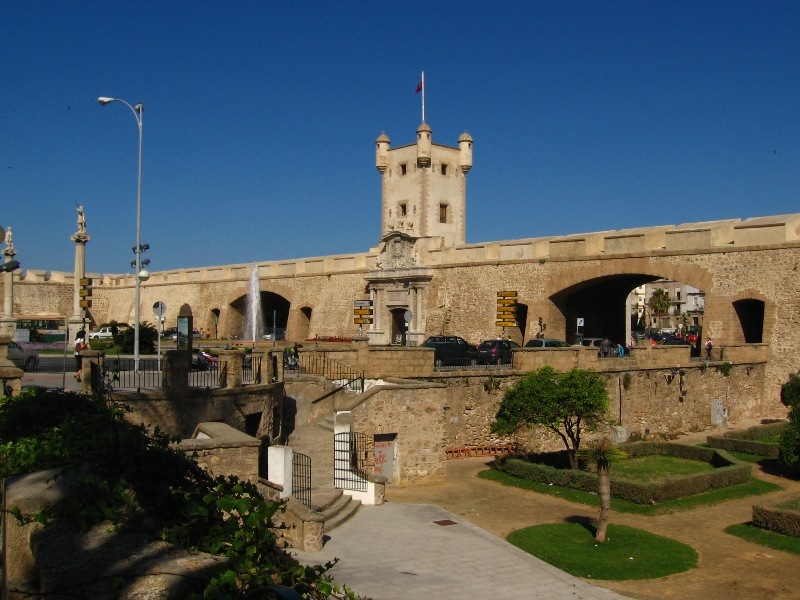
    Cadiz is a city and port in southwestern Spain. It is the capital of the homonymous province, one of eight which make up the autonomous community of Andalusia.

    Cadiz, the second oldest continuously inhabited city in the Iberian Peninsula and one of the oldest in all southwestern Europe, has been a principal home port of the Spanish Navy since the accession of the Spanish Bourbons in the 18th century. The city is a member of the Most Ancient European Towns Network.


    The city was originally founded as Gadir by the Phoenicians from Tyre, who used it in their trade with Tartessos, a city-state believed by archaeologists to be somewhere near the mouth of the Guadalquivir River, about thirty kilometres northwest of Cadiz. (Its exact location has never been firmly established.)

    Cadiz is the most ancient city still standing in Western Europe. Traditionally, its founding is dated to 1104 BC although no archaeological strata on the site can be dated earlier than the 9th century BC. One resolution for this discrepancy has been to assume that Gadir was merely a small seasonal trading post in its earliest days.

    Later, the Greeks knew the city as Gadira or Gadeira. According to Greek legend, Gadir was founded by Hercules after performing his fabled tenth labour, the slaying of Geryon, a monstrous warrior-titan with three heads and three torsos joined to a single pair of legs. As early as the 3rd century, a tumulus (a large earthen mound) near Cádiz was associated with Geryon's final resting-place.

    One of the city's notable features during antiquity was the temple dedicated to the Phoenician god Melqart. (Melqart was associated with Hercules by the Greeks.) According to the Life of Apollonius of Tyana, the temple was still standing during the 1st century. Some historians, based in part on this source, believe that the columns of this temple were the origin of the myth of the pillars of Hercules.

    Around 500 BC, the city fell under the sway of Carthage. Cadiz became a base of operations for Hannibal's conquest of southern Iberia. However, in 206 BC, the city fell to Roman forces under Scipio Africanus. The people of Cadiz welcomed the victors. Under the Romans, the city's Greek name was modified to Gades; it flourished as a Roman naval base. By the time of Augustus, Cadiz was home to more than five hundred equites (members of one of the two upper social classes), a concentration of notable citizens rivalled only by Padua and Rome itself. It was the principal city of a Roman colony, Augusta Urbs Julia Gaditana. However, with the decline of the Roman Empire, Gades's commercial importance began to fade.

    The overthrow of Roman power in Hispania Baetica by the Visigoths in 410 saw the destruction of the original city, of which there remain few remnants today. The city was later reconquered by Justinian in 550 as a part of the Byzantine province of Spania. It would remain Byzantine until Leovigild's reconquest in 572, and returned to the Visigothic Kingdom.

    Under Moorish rule between 711 and 1262, the city was called Qādis, from which the modern Spanish name, Cádiz, was derived. The Moors were finally ousted by Alphonso X of Castile in 1262.

    During the Age of Exploration, the city experienced a renaissance. Christopher Columbus sailed from Cádiz on his second and fourth voyages, and the city later became the home port of the Spanish treasure fleet. Consequently, the city became a major target of Spain's enemies. The 16th century also saw a series of failed raids by Barbary corsairs. The greater part of the old town was consumed in the conflagration of 1569. In April 1587 a raid by the Englishman Sir Francis Drake occupied the harbour for three days, capturing six ships and destroying 31 others as well as a large quantity of stores (an event popularly known as 'The Singeing of the King of Spain's Beard'). The attack delayed the sailing of the Spanish Armada by a year.

    The city suffered a still more serious attack in 1596, when it was captured by an English fleet under the Earl of Essex and Sir Charles Howard. 32 Spanish ships were destroyed and the city was captured, looted and occupied for almost a month. Finally, when the royal authorities refused to pay a ransom demanded by the English for returning the city intact, they burned much of it before leaving with their booty. Another English raid was mounted by the Duke of Buckingham in 1625 against the city, commanded by Sir Edward Cecil, but this was unsuccessful. In the Anglo-Spanish War Admiral Robert Blake blockaded Cadiz from 1655 to 1657. In the Battle of Cádiz (1702), the English attacked again under Sir George Rooke and James, Duke of Ormonde, but they were repelled after a costly siege.

    In the 18th century, the sand bars of the river Guadalquivir forced the Spanish government to transfer the port monopolising trade with Spanish America from upriver Seville to Cadiz with better access to the Atlantic. During this time, the city experienced a golden age during which three-quarters of all Spanish trade was with the Americas. It became one of Spain's greatest and most cosmopolitan cities and home to trading communities from many countries, among whom the richest was the Irish community. Many of today's historic buildings in the Old City date from this era.

    During the Napoleonic Wars Cadiz was blockaded by the British from 1797 until the Peace of Amiens in 1802, and again from 1803 until the outbreak of the Peninsular War in 1808. In that war it was one of the few Spanish cities to hold out against the invading French, who sought to install Joseph Bonaparte on the throne. It became the seat of Spain's military high command and of the Cortes (parliament) for the duration of the war. It was here that the liberal Spanish Constitution of 1812 was proclaimed. The citizens revolted in 1820 to secure a renewal of this constitution; the revolution spread across Spain, leading to the imprisonment of King Ferdinand VII in Cadiz. French forces secured the release of Ferdinand in the Battle of Trocadero (1823) and suppressed liberalism. In 1868, Cadiz was once again the seat of a revolution, resulting in the eventual abdication and exile of Queen Isabella II. The same Cadiz Cortes decided to reinstate the monarchy under King Amadeo I just two years later. In recent years, the city has undergone much reconstruction. Many monuments, cathedrals, and landmarks have been cleaned and restored, adding to the charm of this ancient city.

    The Carnival of Cadiz is one of the best known carnivals in the world. Throughout the year, carnival-related activities are almost constant in the city; there are always rehearsals, public demonstrations, and contests of various kinds.

    The city of Cadiz is often noted for having the most humorous people in Spain. Consequently, the central themes of the carnival are sharp criticisms, often of a political nature, clever plays on words, and the off-beat imagination displayed in revellers' costumes, which, unlike in carnival venues elsewhere in the world, do not emphasize the glamorous or scandalous.

    The Carnival of Cadiz is famous for the satirical groups called chirigotas, who perform comical musical pieces. Typically, a chirigota is composed of seven to twelve performers who sing, act and improvise accompanied by guitars, kazoos, a bass drum, and a variety of noise-makers. Other than the chirigotas, there are many other groups of performers: choruses; ensembles called comparsas, who sing in close harmony much like the barbershop quartets of African-American culture or the mariachis of Mexico; cuartetos, consisting of four (or sometimes three) performers alternating dramatic parodies and humorous songs; and romanceros, storytellers who recite tales in verse. These diverse spectacles turn the city into a colourful and popular open-air theatre for two entire weeks in February.


                                                           Cadiz’s Top 5:
         
    1. Cádiz Cathedral is a Roman Catholic church which was built between 1722 and 1838. It was declared Bien de Interés Cultural in 1931. The Plaza de la Catedral houses both the Cathedral and the Baroque Santiago church, built in 1635. The church sits on the site of an older cathedral, completed in 1260, which burned down in 1596. The reconstruction, which was not started until 1776, was supervised by the architect Vicente Acero, who had also built the Granada Cathedral. Acero left the project and was succeeded by several other architects. As a result, this largely baroque-style cathedral was built over a period of 116 years, and, due to this drawn-out period of construction, the cathedral underwent several major changes to its original design. Though the cathedral was originally intended to be a baroque edifice, it contains rococo elements, and was finally completed in the neoclassical style. Its chapels have many paintings and relics from the old cathedral and monasteries from throughout Spain.
    2. The Museum of Cadiz was founded in 1970 after the merger of the Provincial Museum of Fine Arts with the Provincial Museum of Archaeology. The museum is to be found at number 5 Plaza de Mina, and contains many objects from Cádiz's 3000 year history as well as works by artists such as Peter Paul Rubens.
    3. Fortress of Candelaria The Baluarte de la Candelaria (fortress or stronghold of Candlemas) is a military fortification. Taking advantage of a natural elevation of land, it was constructed in 1672 at the initiative of the governor, Diego Caballero de Illescas. Protected by a seaward-facing wall that had previously served as a seawall, Candelaria's cannons were in a position to command the channels approaching the port of Cádiz. In more recent times, the edifice has served as a headquarters for the corps of military engineers and as the home to the army's homing pigeons, birds used to carry written messages over hostile terrain. Thoroughly renovated, it is now used as a cultural venue. There has been some discussion of using it to house a maritime museum, but, at present, it is designated for use as a permanent exposition space.
    4. The Casa del Almirante is a palatial house, adjacent to the Plaza San Martín in the Barrio del Pópulo, which was constructed in 1690 with the proceeds of the lucrative trade with the Americas. It was built by the family of the admiral of the Spanish treasure fleet, the so-called Fleet of the Indies, Don Diego de Barrios. The exterior is sheathed in exquisite red and white Genoan marble, prepared in the workshops of Andreoli, and mounted by the master, García Narváez. The colonnaded portico, the grand staircase under the cupola, and the hall on the main floor are architectural features of great nobility and beauty. The shield of the Barrios family appears on the second-floor balcony.
    5. The Roman theatre was discovered in 1980, in the El Pópulo district, after a fire had destroyed some old warehouses, revealing a layer of construction that was judged to be the foundations of some medieval buildings; the foundations of these buildings had been built, in turn, upon much more ancient stones, hand-hewn limestone of a Roman character. Systematic excavations have revealed a largely intact Roman theatre. The theatre, constructed by order of Lucius Cornelius Balbus (minor) during the 1st century BC, is the second largest Roman theatre in the world, surpassed only by the theatre of Pompeii, south of Rome. Cicero, in his Epistulae ad Familiares ("Letters to his friends"), wrote of its use by Balbus for personal propaganda. 


    Wednesday, 28 November 2012

    Alicante

    Alicante


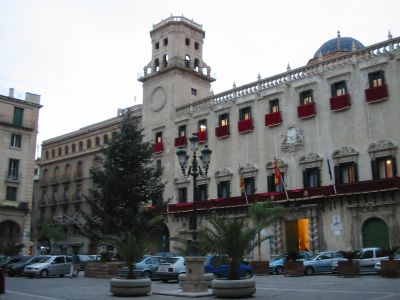
    Alicante is a city in Spain, the capital of the province of Alicante and of the comarca of Alacantí, in the south of the Valencian Community. It is also a historic Mediterranean port. 

    The area around Alicante has been inhabited for over 7000 years, with the first tribes of hunter gatherers moving down gradually from Central Europe between 5000 and 3000 BC. Some of the earliest settlements were made on the slopes of Mount Benacantil. By 1000 BC Greek and Phoenician traders had begun to visit the eastern coast of Spain, establishing small trading ports and introducing the native Iberian tribes to the alphabet, iron and the pottery wheel. By the 3rd century BC, the rival armies of Carthage and Rome began to invade and fight for control of the Iberian Peninsula. The Carthaginian general Hamilcar Barca established the fortified settlement of Akra Leuka, meaning "White Mountain" or "White Point"), where Alicante stands today.

    Although the Carthaginians conquered much of the land around Alicante, the Romans would eventually rule Hispania Tarraconensis for over 700 years. By the 5th century AD, Rome was in decline and the Roman predecessor town of Alicante, known as Lucentum (Latin), was more or less under the control of the Visigothic warlord Theudimer. However neither the Romans nor the Goths put up much resistance to the Arab conquest of Medina Laqant in the 8th century. The Moors ruled southern and eastern Spain until the 13th century reconquista (reconquest). Alicante was finally taken in 1246 by the Castilian king Alfonso X, but it passed soon and definitely to the Kingdom of Valencia in 1298 with King James II of Aragon. It gained the status of Royal Village (Vila Reial) with representation in the medieval Valencian Parliament.

    After several decades of being the battlefield where the Kingdom of Castile and the Crown of Aragón clashed, Alicante became a major Mediterranean trading station exporting rice, wine, olive oil, oranges and wool. But between 1609 and 1614 King Felipe III expelled thousands of Moriscos who had remained in Valencia after the Reconquista, due to their cooperation with Barbary pirates who continually attacked coastal cities and caused much harm to trade. This act cost the region dearly; with so many skilled artisans and agricultural labourers gone, the feudal nobility found itself sliding into bankruptcy. Things got worse in the early 18th century; after the War of Spanish Succession, Alicante went into a long, slow decline, surviving through the 18th and 19th centuries by making shoes and growing agricultural produce such as oranges and almonds, and thanks to its fisheries. The end of the 19th century witnessed a sharp recovery of the local economy with increasing international trade and the growth of the city harbour leading to increased exports of several products (particularly during World War I when Spain was a neutral country).

    During the early 20th century, Alicante was a minor capital that enjoyed the benefit of Spain's neutrality during World War I, and that provided new opportunities for the local industry and agriculture. The Rif War in the 1920s saw numerous alicantinos drafted to fight in the long and bloody campaigns in the former Spanish protectorate (Northern Morocco) against the Rif rebels. The political unrest of the late 1920s led to the victory of Republican candidates in local council elections throughout the country, and the abdication of King Alfonso XIII. The proclamation of the Second Spanish Republic was much celebrated in the city on 14 April 1931. The Spanish Civil War broke out on 17 July 1936. Alicante was the last city loyal to the Republican government to be occupied by dictator Franco's troops on 1 April 1939, and its harbour saw the last Republican government officials fleeing the country. Vicious air bombings were targeted on Alicante during the three years of civil conflict, most notably the bombing by the Italian Aviazione Legionaria of the Mercado de Abastos in 25 May 1938 in which more than 300 civilians perished.

    The next 20 years under Franco's dictatorship were difficult for Alicante, as they were for the entire country. However, the late 1950s and early 1960s saw the onset of a lasting transformation of the city by the tourist industry. Large buildings and complexes rose in nearby Albufereta and Playa de San Juan, with the benign climate being the biggest draw to attract prospective buyers and tourists who kept the hotels reasonably busy. New construction benefited the whole economy, as the development of the tourism sector also spawned new businesses such as restaurants, bars and other tourist-oriented enterprises. Also, the old airfield at Rabasa was closed and air traffic moved to the new El Altet Airport, which made a more convenient and modern facility for charter flights bringing tourists from northern European countries.

    When dictator Franco died in 1975, his successor Juan Carlos I played his part as the living symbol of the transition of Spain to a democratic constitutional monarchy. The governments of regional communities were given constitutional status as 'nationalities', and their governments were given more autonomy, including that of the Valencian region.

    The port of Alicante has been reinventing itself since the industrial decline the city suffered in the 1980s (with most mercantile traffic lost to Valencia's harbour). In recent years, the Port Authority has established it as one of the most important ports in Spain for cruises, with 72 calls to port made by cruise ships in 2007 bringing some 80,000 passengers and 30,000 crew to the city each year. The moves to develop the port for more tourism have been welcomed by the city and its residents, but the latest plans to develop an industrial estate in the port have caused great controversy.

    As with the rest of Spain food is a very important part of the local identity. In Alicante, breakfast is usually light, usually some sort of bread (e.g. toast) or piece of bakery. Traditionally, a hearty meal in the early afternoon is followed by a siesta as the heat builds. Many restaurants are then closed between 4-9pm. A light meal is taken once the sun goes down, often in the local taperia if you are a visitor. A lot of restaurants don't open before 9pm for dinner, so bear this in mind when planning your dinner schedule.

    As elsewhere in the region, seafood and rice dominates, with paella in the frontline. In almost every restaurant, you will find a "menu of the day" or a similar special for €10, a three- or four-course meal with or without a drink. This is an excellent way to economise if you want to splash out later. Go around Calle Castaños (near the Theatre), Calle San Francisco and Calle Mayor (near Saint Nicholas Cathedral) for hubs of restaurants across the whole price range.

    Alicante has its own regulatory wine council. Tinto Alicante and Moscatel Alicante are the most known varieties.

    Nightlife is concentrated in Old Town, called El Barrio or El Casco Antiguo, with dozens of bars and clubs along the narrow streets. Another focal point is the eastern rim of the marina, called Puerto, in and around the casino, where things start and end later.

    The "Barrio" is the center of nightlife in Alicante, with bars like Dos Gringos, Mulligans, Carpe Diem, and Swing; there is never a dull night in this small Spanish city. Drinks are cheap, and shots are sometimes free. Pregame of "Botellon" on the castel or on the beach, then head over to the Barrio at around midnight. Then head over to swing or the puerto at 4am. A typical night should end at around 7 or 8am. (Note: "El botellon," literally, "the large bottle," is a custom among young people in Spain, in which they buy 2-litre bottles of soft drinks and mix into them hard liquor, and then stand or sit around drinking in parking lots and other public places. This is to avoid the high cost of drinks in some bars and clubs.)


    There are market stalls along the Explanada d'Espanya selling beads, clothes, flags etc.

    If you want to see how the locals shop, head into town down the Rambla de Méndez Núnez then turn West on the Avenue de Alfonso El Sabio, and you'll find the city's main market, the Mercado Central de Alicante(38°20'52.5"N 0°29'9.6"W). It is open until about 14:30 or so most days, the two levels sell all the fresh meat, seafood, cheeses, fruit and vegetables anyone could need. If you exit the market through the back, you'll find the flower sellers in a small outdoor square.


                                                            Alicante’s Top 5:
         
    1. The Co-cathedral of Saint Nicholas of Bari is a Roman Catholic co-cathedral. The church, part of the Diocese of Orihuela-Alicante is dedicated to Saint Nicholas and was elevated to the title of cathedral on 9 March 1959 by Pope John XXIII. This church was built between 1613 and 1662. It was designed between 1610 and 1615 by Agustín Bernardino, a student of Juan de Herrera, and was constructed over an ancient mosque. The cathedral has a Latin cross plan, though the transepts are quite short. flanking the nave are six interconnecting side chapels and an ambulatory around the apse. A blue dome rises 45 meters above the crossing. The chapel of Holy Communion, configured as a small Greek cross-planned temple, is considered to be one of the most beautiful examples of the Spanish Baroque. The external appearance of the cathedral is quite sober. The main facade located on the east side is of the Doric order, and the one built on the south side is of Ionic order.
    2. Tabarca, also known in Valencian as Nova Tabarca and Illa Plana, is an islet located in the Mediterranean Sea. Tabarca is the smallest permanently inhabited islet in Spain and it is currently known for its marine reserve. Despite being much more socially and economically related to the fishing port of Santa Pola, the tiny island of Tabarca is a part of the city of Alicante. Administratively, it is managed as a rural district of Alicante, jointly with el Palmeral, Aiguamarga and Urbanova. Tabarca was the last Spanish Mediterranean location where the critically endangered Mediterranean monk seal successfully bred before it became extinct in this part of its range in the 1960s. This proves the high quality of the waters around the island in terms of marine ecology. Therefore waters around Tabarca were declared a Marine reserve in 1986, the first of its kind in Spain.
    3. The Basilica of Santa Maria is the oldest active church in Alicante. It was built in Gothic style between the 14th and 16th centuries over the remains of a mosque.
      The basilica is composed from a single nave with six side chapels located between the buttresses. In 2007, by request of the city of Alicante to the Holy See, the church was promoted to the rank of basilica.
    4. The Archaeological Museum of Alicante  is an archaeological museum in Alicante. The museum won the European Museum of the Year Award in 2004, a few years after significant expansion and reallocation to renovated buildings of the antique hospital of San Juan de Dios. The museum houses eight galleries that use multimedia to allow visitors to interact with the lives of past residents of the region.
    5. Santa Bárbara Castle is a fortification which stands on the Mount Benacantil (166 m).
      Bronze Age, Iberian, and Roman artifacts have been found on the slopes of the mountain, but the origins of the castle date to the 9th century at the time of Muslim control of the Iberian Peninsula. The Arab medieval geographer Al-Idrisi calls this mountain Banu-lQatil, and the toponym may derive from the words pinna (Arabic for "peak") and laqanti, adjectival form of Laqant, the Arabic name for Alicante. On 4 December 1248, the castle was captured by Castilian forces led by Alfonso of Castile, later King Alfonso X. It was named after Saint Barbara, on whose feast day the castle was captured. It was conquered by the Aragonese in 1296 during the reign of James II of Aragon, who ordered its reconstruction. Peter IV of Aragon, Charles I of Spain and Philip II of Spain would oversee further reconstructions. From the 18th century the military role of the castle has declined and it was used sometimes as a prison. The castle remained abandoned until 1963, when it was opened to the public. Lifts have been installed inside the mountain.


    Intrepid Travel

    Monday, 26 November 2012

    Zamora

    Zamora


    Zamora is a city in Castile and León, Spain, the capital of the province of Zamora. It lies on a rocky hill in the northwest, near the frontier with Portugal and crossed by the Duero river, which is some 50 km downstream as it reaches the Portuguese frontier. Zamora is the city with the most Romanesque churches in all of Europe. 

    After the Roman victory over the Lusitanian hero Viriathus the settlement was named by the Romans, Occelum Durii or Ocellodurum (literally, "Eye of the Duero"). During Roman rule it was in the hands of the Vaccaei, and was incorporated into the Roman province of Hispania Tarraconensis. 

    Two coins from the reign of the Visigothic king, Sisebuto, show that it was known at the time as "Semure".

    During the period of Moorish rule the settlement became known by the names of "Semurah" or "Azemur". After the establishment of the Christian Kingdom of Asturias, the settlement became a strategic frontier post and was the scene of many fierce military engagements between the Muslims and Christians. Control of the town shifted between the two sides a number of times from the early eighth century to the late eleventh century. During this period it became heavily fortified.

    The most notable historic episode in Zamora was the assassination outside the city walls of the king Sancho II of Castile in 1072. Some decades before, king Ferdinand I of León had divided his kingdoms between his three sons. To his daughter, Doña Urraca, he had bequeathed the "well fortified city of Zamora" (or "la bien cercada" in Spanish). All three sons warred among themselves, till the ultimate winner, Sancho, was left victorious. Zamora, under his sister who was allied with Leonese nobles, resisted. Sancho II of Castile, assisted by El Cid, lay siege to Zamora. King Sancho II was murdered by a duplicitous noble of Zamora, Bellido Dolfos, who tricked the king into a private meeting. After the death of Sancho, Castile reverted to his deposed brother Alfonso VI of León. The event was commemorated by the Portillo de la Traición (Treason Gate). Zamora was also the scene of fierce fighting in the fifteenth century, during the conflict between the supporters of Isabella the Catholic and Juana la Beltraneja. The Spanish proverb, No se ganó Zamora en una hora, literally, Zamora wasn't won in an hour, is a reference to these battles. It is the Spanish equivalent of the English proverb "Rome wasn't built in a day."

    During the 12th century, the city was extraordinarily important for its strategic position in the wars between the Kingdom of León and Arabs to conquer the Iberian Peninsula. As a result, the city preserves many churches and buildings from that time. In the next centuries, the city lost its political and economic relevance and suffered emigration, especially to South America (where many other cities called Zamora were founded).

    In today's Zamora, shopping areas are mainly centred on Tres Cruces Avenue, Santa Clara Street and parallel-running San Torcuato. If you prefer Malls, the biggest one is the Centro Comercial Valderaduey, named after one the local rivers or as it is known by locals, Eroski. The other one is called 'Vía de la Plata'.

    Typical souvenirs include items featuring elements from Semana Santa or Easter. Local wines and cheese, as well as chickpeas from Fuentesaúco always make a good buy. If you're more into the vintage-style buying, check out the weekly mercadillo, a street market held every Tuesday morning. The traditional site was just outside the Train Station, now moved to the parking lot of the Football Stadium Vía de la Plata (either a good 30 minute walk from downtown Zamora or one of the only occasions where local transport would be worth it). The mercadillo is set to return to its original location outside the Estación del Ferrocarril, but no deadline has been given as of May 2007.


    If you happen to visit Zamora at the end of June, pottery would make an excellent souvenir too, as Viriathus Square is filled with stands from all over the country selling their creations. You can find items both for everyday use and for display. The 'big day' of the San Pedro festivity is June 29th. You can buy some of these products and other souvenirs, cheese or wine at the store Aperos y Viandas (literally "Farming implements and Food") which is on the way to the Cathedral or at some the shops in and around Ramos Carrión Square. These cater especially for tourists, but you can find many local products -especially wine-at any supermarket (Mercadona, El Arbol, Eroski, etc).

    The excellent raw materials used in the local cuisine really stand out. Staple ingredients include the pulses, the famous chickpeas from Fuentesauco or 'garbanzos', the exquisite cheese made from sheep´s milk, honey from Sanabria, asparagus from Guareña, peppers from Benavente, steak from Aliste, mushrooms, game, cold meats, cakes and sweets... Apart from the tasty roasts, also worth tasting are the rice dishes from Zamora. Traditional dishes include bacalao a la tranca (a cod dish), el pulpo a la sanabresa (an octopus dish), dos y pingada (two fried eggs with fried ham, usually served in Easter) and '"presas de ternera" (a veal dish). For dessert there is the rebojo Zamorano, a very tasty though hard type of bun, and "las natillas almendradas" (Spanish style custard with almonds).


                                                            Zamora’s Top 5:
         
    1. The Cathedral of Zamora is located above the right bank of the Duero in the southern and rather higher part of the old town, and is still surrounded by its old walls and gates. Built between 1151 and 1174, it is one of the finest examples of Spanish Romanesque architecture. A previous church, also entitled to El Salvador ("Holy Savior") existed at the time of King Alfonso VII of Castile, but it was apparently in ruins, so that the king donated the church of St. Thomas in the city to act as cathedral.
      The church was built under bishop Esteban, under the patronage of Alfonso VII and his sister, Sancha Raimúndez. The date of construction (1151-1174) is traditionally attested by an epigraphy in the northern side of the transept, although recent discoveries have proven that the church had been already begun in 1139, at the time of bishop Bernardo. The cathedral was consecrated in 1174 by bishop Esteban, although works continued under his successor Guillermo (1176-1192), including the transept. The cloister and the bell tower date to the first half of the 13th century. The designer of the church is unknown. The Cathedral Museum, in the 17th century cloister, is notable particularly for its fine Flemish tapestries of the 15th-17th centuries depicting scenes from the Trojan War, Hannibal's Italian campaign and the life of Tarquin, the Etruscan king of Rome. Another treasure is a Late Gothic monstrance of 1515.
    2. Palacio de los Condes de Alba y Aliste (Palace of the Counts of Alba and Aliste) This stately palace, a splendid example of Spanish Renaissance architecture from the early 16th century, today houses a Parador hotel. One of the most surprising aspects of this palatial residence is the contrast between the sober exterior –with its sturdy ashlar work and a predominance of straight lines both on the main doorway (enclosed within a rectangular border) and on the windows and balconies– and the elegant and refined silhouette of the interior courtyard. The courtyard has a double gallery of elliptical arches supported by columns decorated with grotesque-style motifs of animals and plants on the capitals. The springers are carved with medallions on the lower layer and crests on the upper layer. The whole arrangement is crowned with a small floral cornice in the Gothic tradition. Another highlight on the interior is the lower staircase which opens on the ground floor under two segmented arches with Lombard-inspired decoration on the capitals and hand rails.
    3. City Walls Zamora was known as the “bien cercada” (excellently walled). This is due to its triple layer walls around the town converting it into an important strategic point on the banks of the Duero.The first wall layer is the most important.Built during the reign of Fernando I, in the XI century on the site of a former Arab fortress.Closes the atoll where the Zamorian historic quarter is located.There are various entrances doors.The most noteworthy being the Olivares, where you can enter the Cathedral and the Episcopal Cathedral. On the opposite side there is the North entrance or Doña Urraca. The third door is the Portillo de la Traición through which Bellido Dolfos passed persecuted by El Cid Campeador after the murder of King Sancho II.
    4. Museo de Zamora. The museum is housed in the Cordón Palace, a 16th-century building located in the old quarter of Zamora, and is divided into two clearly-differentiated sections: Archaeology, containing works dating from prehistoric times to the Modern Age; and Fine Arts, with an important collection of sculptures and paintings dating from the 14th to the 20th century. There is also a room on the history of the city of Zamora.
    5. The Castle of Zamora is a Middle Ages fortress which stands northwest of the city's Cathedral. It features Pre-Roman foundations and a Romanesque general structure. It was built between the 10th and 12th centuries.The castle features magnificent views of the town and the river from the keep.