Translate

Wednesday, 25 January 2012

Dubrovnik

Dubrovnik
"Those who seek paradise on earth should come to Dubrovnik"
George Bernard Shaw 1929


Dubrovnik is situated in Southern Dalmatia, the most beautiful part of the Adriatic coast. Rich vegetation, beautiful lakes, rare islands, white pebble beaches and the crystal clean sea, all make this region to an unforgettable experience for every visitor traveling through Croatia.

File:Dubrovnik-shelling-91-92.jpgIt's hard to believe now, but less than 20 years ago, Dubrovnik was a ghost town as the remains of the Yugoslav Peoples Army shelled the city during the seven month Siege Of Dubrovnik. According to the Red Cross, 114 people were killed and 56% of the buildings sustained some level of damage as 650 artillery hits were recorded. In May 1992, the Croatian Army lifted the siege and the rebuilding began, adhering to UNESCO guidelines. As of 2005, most damage had been painstakingly repaired to it's former glory and, only on close inspection, can new mortar be seen and the slightly brighter red of new roof tiles evident. A chart close to the city gate shows the extent of the damage.


There is no disputing the breathtaking beauty of Dubrovnik. As you enter the walls through the Pile Gate, you are immediately awed by the sheen from the limestone paved floors worn to look like marble through generations of visitors. As you enter The Stradun, Onofrio's Large Fountain looms in front of you, originally constructed in 1438 by Italian architect Onofrio Della Cava and part of the city's water mains which brought water from the Dubrvacka river some 12km away. The fountain is a main meeting point for visitors and usually surrounded by thirsty travellers serenaded by the city's one note busker on his home made instrument of torture!


The Old Town is very compact and very easy to walk from one gate to another or one wall to the opposite. The Stradun or the main street through the centre of the city is an ideal place to sit in an outdoor cafe people watching or enjoy a light al fresco meal 
Tip: move away from the Stradun if your budget is tight!. Random, unannaounced mini carnivals appear on the Stradun, during our stay, a group of pirates took to the street and a gaggle of photographers surrounded a leggy model in a wedding dress on the steps of a church.


There are, however, many different, colourful back streets to discover filled with cafes, restaurants and local shops which will keep you going for a number of days. Each street brings it's own delights with lacemakers on street corners and artists shops dotted between the inevitable gift and souvenir shops.

A takeaway pizza slice shop, followed by a coffee shop followed by a cake shop means you can enjoy a complete meal while on the move (by far the most economical method)


You must, of course, climb the city walls and take the 2km walk.. I would highly recommend early morning or later in the afternoon as the heat can be stifling although refreshment stops are regular. There are so many things you can only see from on high, like the basketball court hidden within a school yard or a private swimming area at the foot of the walls, school choirs can be heard rehearsing through open windows and small courtyard gardens are dotted around. There is also still evidence of unrepaired war damage and neglect. Make sure you have your camera to hand as the walls will give you some of the greatest views you will ever see.


One of Dubrovnik's famed attractions used to be its cable car - built in 1969 - which rose up to the top of Mount Srd above the city, giving visitors a chance to take in some (even more) spectacular views of the Old Town and the shoreline. Sadly, the cable car was completely destroyed during the war in the early 1990s and was never repaired...until 2010. The service has now been fully restored with entirely new equipment and is sure to be a must-do for visitors once again. A journey to the top of Mount Srd takes only 3 minutes, and once there you can take in the views whilst enjoy a snack, or something more, at the cafe or restaurant at the top.
Also at the top of Mount Srd, and also newly opened, is the Museum of the Croatian War of Independence which, though its various exhibits, shows how Dubrovnik defended itself during the 1991-95 war.

We stayed outside the City, in the little seaside resort of Cavtat. There were many advantages, not least the cost of everything was so much cheaper and made our break affordable. One of the unexpected bonuses to staying here was taking the water taxi from the city to the resort, a bargain at roughly £12 each and a great way to see the city and its walls. the alternative is the bus which comes in via the high mountain road, Tip: be careful where you get off the bus, you need to look out for where you can see the city from above and walk down, if not, you will be taken to the new, harbour side of the city which is a good day out in itself but miles away from the old city.


Dubrovnik’s Top 5:
  1. The City walls . The City walls were originally constructed in the 10th century, considerably fortified in 1453 and, following damage and repair after the shelling in the 90's, are complete to walk all the way round. The old town has fortresses at it's four corners, which are the Minceta Tower, Revelin Fortress, St John's Fortress and Bokar Bastion.
  2. Stradun/Placa. The Stradun, also called Placa, runs through the centre of the old town from Pile Gate to Ploce Gate. Originally a marshy channel seperating two settlements, the limestone pavers were laid in 1468 and run for 300 metres. Both ends of the Stradun are marked with 15th century fountains, The Large Onofrio's at the Western end and The Small Onofrio's in the East.
  3. Sponza Palace. Constructed in 1522, a survivor of the 1667 earthquake, the palace has had a variety of uses over the centuries, includingwhere the Republic of Ragusa minted it's currency. Currently it houses the city archives upstairs whilst the ground floor is used for exhibitions during the summer festivals. It also houses a permanent exhibition named "Memorial Room of the Dubrovnik Defenders", a memorial to those citizens who lost their lives during the war between 1991 and 1995.
  4. Church of St Blaise. A Baroque church, built between 1705and 1717, which features a silver statue of the Dubrovnik patron saint on the altar holding a model of the city, brought out each year during The Festival of St Blaize. The stained glass windows of the church are relatively recent, having been added in the 1970's.
  5. Franciscan Monastery. Includes a calming cloister from 1360, the main part of the Monastery was destroyed in the earthquake of 1667 and rebuilt. The Monastery contains what is though to be the oldest apothecary/pharmacy in Europe dating from 1316-17 . 
             References:    http://www.visit-croatia.co.uk
                                     http://www.dubrovnik-online.net/english/dugeneral.php
            All photographs by Tony & Michelle Bonson 2011

Tuesday, 24 January 2012

Carcassonne

Carcassonne


Throughout the centuries the historic site of Carcassonne has played a decisive role in the history of Languedoc. although both the Romans and the Visigoths ruled over Carcassonne,  the city-state flourished in the possession of the powerful Viscount Trencavel who ruled over Bas-Languedoc. At the end of the crusade against the Albigensians the city, with its improved fortifications, became one of the strongholds symbolising royal power on the frontier between France and Aragon. However, after the Treaty of the Pyrenees made the Roussillon a French possession, the city lost its strategic role and its defence works were neglected. In the 19th Century, the residents of Carcassonne and the Historic Monuments Department (Service des Monuments historiques), commissioned Eugène Viollet-le-Duc to restore the ancient fortress to its original appearance. It was this project which helped save Carcassonne and ensure that the city of today is so outstandingly beautiful.

Our visit to Carcassonne was in late September, the perfect time of year for a stress-free short break, in the summer months the city can be over populated and cramped. After a short, 10 Euro taxi ride from the airport to the13th century Porte Narbonnaise to the east of the walls, if , as we were, you are booked into one of the two hotels inside the cite, a smart car appears from nowhere to take you into the city itself. 


Manoeuvring through some of the tightest gates and round the sharpest corners, this (free) journey itself brings a huge smile to your face before your adventure has even began.

The cite is truly captured in time, tiny, winding cobbled streets opening out into glorious squares lined with cafes and restaurants make you almost feel like you are on a film set (in fact parts of the city have been used as a backdrop for many Hollywood blockbusters, most notably Robin Hood, Prince of thieves with Kevin Costner).


We decided to use our first day to discover the new town or low town (Ville Basse). The Ville Basse is located on the left bank. It contains most of Carcassonne’s business activity, and two 13th century churches: The Cathedral of Saint Michael and the Church of Saint Vincent.

Whilst the medieval Cité is Carcassonne’s main attraction, there is plenty to do in the Ville Basse, the modern town. In 1260 the Bastide Saint-Louis was created to house the population whose villages flanking the Cité had been destroyed. This new town now lies at the centre of the Ville Basse, and the main Tourism Office runs guided tours of its main attractions. One of these is the Musée des Beaux-Arts, which houses a collection of paintings from the 17th to the 20th century. Within the Bastide, at the Place Carnot, there is a lively food market on Tuesdays, Thursdays and Saturdays. The Ville Basse also offers a wide selection of restaurants, some specialising in local produce, and cuisine such as the famous cassoulet stew.


The Cité is a very popular tourist attraction. Within the ramparts, the Cité still houses a resident population of about 120 people, and alongside the many bistros and gift shops, there are also all the usual facilities that you would expect for a small town - a post office, a school, a hotel, etc. The Cité includes the Basilique Saint-Nazaire, an open air theatre and the fortified Chateau Comtal within its double ramparts. The walls consist of a vast circle of double battlements, enclosing medieval streets, containing many boutiques, souvenir shops, and restaurants. It relies heavily on tourism. The outer ramparts connect 14 towers, and are separated by the outer bailey and inner ramparts, which has 24 towers. On the 14th July there is a massive firework display to celebrate Bastille Day, in which the whole of the Cite appears to go up in flames.
The Tourist Information Centre houses a scale model of the Cité - a very useful way to view the immense size, and complexity of the fortified town, and to get your bearings.


Carcassonne’s Top 5:
  1. The walls of the Cité. The upper town is surrounded by a double wall – the area in-between is known as the lices or “lists” where medieval knights once did their thing. Whilst the outer wall is the work of Louis IX, parts of the inner wall date back to Roman times.
  2. Château Comtal. The citadel of the upper town dating from the twelfth century with an amazing 31 towers. There are mandatory guided tours of the château which also take in sections of the walls and the amphitheatre. 
  3. St-Nazaire basilica. Pope Urban V (born near Mende in the north of Languedoc) visited here in 1096 and ordered the construction of the basilica. However, the original Romanesque style is now predominantly Gothic after alterations over the years – the best features are its enormous rose windows and the weird gargoyles.
  4. Pont Vieux and the banks of the Aude. A wonderful place for a picnic once you’ve done the upper town. The bridge dates from the fourteenth century and boasts a Gothic chapel at its western end dating from 1538.
  5. Local delicacies - Place du Château. This gloriously old-fashioned store is stuffed full of regional specialties such as cassoulet and olives aux herbes. If you’re craving cakes and pastry, it’s also the place to stock up on grés de la cité, a Carcassonne favourite that features a heavenly mix of almonds and vanilla wrapped in puff pastry.


References: http://www.languedoc-roussillon.eu.com/carcassonne.htm
All photographs by Tony & Michelle Bonson 2010

Monday, 23 January 2012

Barcelona

Barcelona


Barcelona is the capital of Catalonia and the second largest city in Spain, after Madrid.  About five million people live in the Barcelona metropolitan area. It is also Europe's largest metropolis on the Mediterranean Sea. It is the main component of an administrative area of Greater Barcelona, It is located on the Mediterranean coast between the mouths of the rivers Llobregat and Besòs.

Barcelona is today one of the world's leading tourist, economic, trade fair/exhibitions and cultural-sports centres, and its influence in commerce, education, entertainment, media, fashion, science, and the arts all contribute to its status as one of the world's major global cities. 


Barcelona is the 16th-most-visited city in the world and the fourth most visited in Europe after Paris, London, and Rome, with several million tourists every year.

Founded as a Roman city, Barcelona became the capital of the County of Barcelona. After merging with the Kingdom of Aragon, Barcelona became one of the most important cities of the Crown of Aragon. Besieged several times during its history, Barcelona has a rich cultural heritage and is today an important cultural centre and a major tourist destination. Particularly renowned are the architectural works of Antoni Gaudí and Lluís Domènech i Montaner, which have been designated UNESCO World Heritage Sites.  


The founding of Barcelona is the subject of two different legends. The first attributes the founding of the city to the mythological Hercules 400 years before the building of Rome. The second legend attributes the foundation of the city directly to the historical Carthaginian Hamilcar Barca, father of Hannibal, who named the city Barcino after his family in the 3rd century BC
Barcelona is the passionate capital of Catalonia, an unforgettable city of art, culture and beauty. Gaudi's works, museums, concerts and FC Barcelona’s football team homeland.


A tree-lined pedestrian mall, La Rambla stretches for 1.2 kilometers between Barri Gòtic and El Raval, connecting Plaça de Catalunya in the centre with the Christopher Columbus Monument at Port Vell. La Rambla can be considered a series of shorter streets, each differently named, hence the plural form Les Rambles (the original Catalan form; in Spanish it is Las Ramblas). From the Plaça de Catalunya toward the harbour, the street is successively called the Rambla de Canaletes, the Rambla dels Estudis, the Rambla de Sant Josep, the Rambla dels Caputxins, and the Rambla de Santa Mònica. Construction of the Maremàgnum in the early 1990s resulted in a continuation of La Rambla on a wooden walkway into the harbour called the Rambla de Mar.

La Rambla
Walk along Las Ramblas to enjoy street musicians, living statues, hustlers and just plain loonies. Hop onto the Tramvia Blau for a tram trip up to the top of Tibidabo and take in the magnificent sights of the city below you. Shop along the Passeig de Gracia, at the most well known boutiques in Barcelona.

Have a sunset drink at a chiringuito bar on the Barceloneta beach, then after dark, join the locals for pub crawling at the Barri Gotic for a huge selection of tapas bars, wine bars, cocktail lounges and even Irish pubs! Now that you've worked up an appetite, head for El Born where you'll find the finest in new catalonian cuisine.


Picasso's Museum - Barcelona
The Picasso Museum
The best way to visit the Old Town is on foot, Gothic quarter streets, the old fisherman’s village of Barceloneta and the beach, the fantastic Palau de la Musica Catalana in the Borne district, leading you all the way over to the garden of Barcelona – La Cuitadella . This is a huge part of Barcelona and is a really great way to spend a day.


Barcelona is an extremely practical city in which to go shopping, everything you need is concentrated in the centre and the historical city. Fashion is particularly well represented, by world famous brands which all have a store in Barcelona alongside exciting, young designers. Barcelona is a city well known for interior design and decoration with many stylish outlets in the city, also Barcelona city markets are popular, colorful and noisy places. From food markets to fleas or books markets there is a wide selection throughout the centre on most days.

Barcelona has a uniquely wide range of bars: Ranging from colourful tapas bars , outdoor cafés, chocolaterias, coctelerías (cocktail bars), whiskerias (often singles bars with professional escorts), xampanyerias (Catalan cava, sparkling wine bars), and beer halls. Most stay open until about 2:30am, some even later..

Nightlife in Barcelona starts around 10pm for bars and midnight for clubs. Bars close around 2am in week days and 3am during the weekend. Clubs will often still be bouncing till dawn breaks.

Santa Maria del Mar
Santa Maria del Mar


                                                        Barcelona’s Top 5:
       
  1. La Sagrada Familia is the world wide symbol of Barcelona. The monumental church El Temple Expiatori de la Sagrada Família (Expiatory Temple of the Sacred Family) is Gaudi's most famous work and the finest example of his visionary genius. The architect undertook the task in 1883 on the site of a previous neo-Gothic project begun in 1882 by F. del Villar. Gaudi dedicated his life to carrying out this ambitious undertaking which due to his sudden death was left unfinished. Gaudi became obsessed with the church to the point that not only did he focus all of his creative energies into it, but he set up residence in his on-site study as well. On June 7, 1926, Gaudi was hit by a street car while crossing the Gran Vía at Barcelona. Three days later not having regained consciousness, Gaudi died at the age of 74. Work continued on the church, however, until it was interrupted in 1936 when the crypt and Gaudi's study holding his notes and designs were burnt by Spanish Civil War shelling. The project was resumed in 1952 using drawings and scale models as a base although the continuation of the work gave rise to much debate. From 1954 to 1976, the facade and the four towers of the Passion (Western side) were completed.
    The sculptor Josep. M. Subirachs joined the project team to work on the sculptures on the Portal of Passion in 1987. Today, the constructed part is open to visitors as well as the small Museu del Temple Expiatori de la Sagrada Família with scale models and drawings showing the construction process. The towers can be climbed and offer incredible sights of the city.
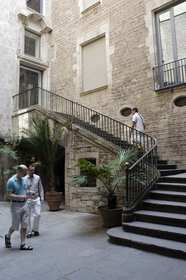
  2. The Picasso museum is "the" museum to visit in Barcelona. For the artist and for the building. Located in Montcada street, in the Gothic area, five medieval palaces linked together to make a museum. Concerning Pablo Ruiz Picasso the museum is indispensable for understanding his formative years. The genius of the young artist is revealed through the more than 3,500 works that make up the permanent collection. It also reveals his relationship with Barcelona: an intimate, solid relationship that was shaped in his adolescence and youth, and continued until his death. To see as well some oils and drawings from Picasso's Barcelona period and even some works from later stages in his career. The Museum also has a set of 42 pieces of ceramics (vases, dishes and plates) made in the 1950s and bequeathed by Jaqueline Picasso in 1982.
  3. Santa Maria del Mar is a Gothic church from the 14th century, located at the seaside, was built as a private initiative on the wealth accrued from overseas ventures by the inhabitants of La Ribera. The stained glass windows of this basilica, dating from the 15th and 18th centuries, are very famous. From the outside, Santa Maria gives an impression of massive severity that belies the interior. It is hemmed in by the narrow streets of the Ribera, making it difficult to obtain an overall impression, except from the Fossar de les Moreres and the Plaça de Santa Maria, both of them former burial grounds. The latter is dominated by the west end of the church with its rose window. Images of Saint Peter and Saint Paul occupy niches on either side of the west door, and the tympanum shows the Saviour flanked by Our Lady and Saint John. The north-west tower was completed in 1496, but its companion was not finished until 1902.
  4. The Cathedral of the Holy Cross and Saint Eulalia, also known as Barcelona Cathedral, is the Gothic cathedral and seat of the Archbishop of Barcelona. The cathedral was constructed throughout the 13th to 15th centuries, with the principal work done in the 14th century. The cloister, which encloses the Well of the Geese (Font de les Oques) was completed about 1450. The neo-Gothic façade was constructed over the nondescript exterior that was common to Catalan churches in the 19th century. The roof is notable for its gargoyles, featuring a wide range of animals, both domestic and mythical. The cathedral was constructed over the crypt of a former Visigothic chapel, dedicated to Saint James, which was the proprietary church of the Viscounts of Barcelona, one of whom, Mir Geribert, sold the site to Bishop Guislebert in 1058. Its site faced the Roman forum of Barcelona.
  5. Casa Milà.  After the Sagrada Familia, Casa Milà or "la Pedrera" as it is often called, is probably Gaudi's second most popular building in Barcelona. Casa Milà covers an area of more than 100 square meters and includes two large circular patios, so that almost every part of the house gets its share of sunlight. It is constructed entirely in natural stones, and lacking all the colors and ornamentation design. Maybe one of the most interesting places of the whole complex is the rooftop: here you can find a large ensemble of surrealistic chimneys all looking different and like sculptures standing there alone or in small groups, dominating the rooftop.


    La Pedrera Gaudi
     Casa Milà or "la  Pedrera"